




Battery storage proves its value in moderating Texas power price volatility
Research suggests storage reduces price peaks, benefiting consumers but reducing returns for investors
11 minute read

Ed Crooks
Vice Chair Americas and host of Energy Gang podcast

Ed Crooks
Vice Chair Americas and host of Energy Gang podcast
Ed examines the forces shaping the energy industry globally.
Latest articles by Ed
-
Podcast
Predictive care for energy workers
-
Opinion
Elon Musk’s gas strategy shows how the US market is changing
-
Podcast
AI beyond the hype
-
Opinion
US oil production starts to respond to higher prices
-
Podcast
Can energy security and climate action work together?
-
Opinion
US permitting reform plan could transform energy investment
Research suggests storage reduces price peaks, benefiting consumers but reducing returns for investors
The climate of west Texas is described in Larry McMurtry’s epic novel Lonesome Dove as “a blur of heat and as dry as chalk”. It is a punishing environment that puts people and machinery to the test. One of the technologies that is being put through its paces in Texas today is battery storage, with potentially significant lessons for electricity markets around the world.
Not all of Texas has the same desert conditions as the far west, but it still gets hot in the summertime. Most of the state is formally designated as a “humid subtropical” climate. Air-conditioning is essential for modern life, which means that power demand always peaks over the summer.
Driven by population and economic growth, cryptocurrency mining and data centres, those summer demand peaks have been getting higher year by year. In July 2021, about 39 terawatt hours of power were supplied on ERCOT, the grid operator for most of Texas. In July 2026, it is expected to be about 49 terawatt hours.
ERCOT is an “energy-only” market, which means that unlike some other large US electricity grids, it does not pay generators to keep capacity available to be brought online when supplies are tight. Instead, it relies on movements in wholesale prices to encourage additional generation to come online or consumers to cut back. That can lead to some extreme movements in wholesale prices.
In the early 2020s, rising electricity demand and warm weather caused some sharp summer peaks. In 2022, average power prices in ERCOT’s North zone rose from US$34/MWh in January to US$123/MWh in July, according to data from Wood Mackenzie’s Lens Power platform. In 2023, prices rose from US$25/MWh in January to US$266/MWh in August.
In the past two years, however, the summer price increases have been much more modest. That pattern has so far continued in 2026.
The weather may have contributed to that. Across the state, summer temperatures in 2024 and 2025 – and so far in 2026 – did not reach the extremes of 2022 and 2023. But conditions were still demanding enough to put strain on the grid at some times and in some places. In 2025 Houston experienced a record number of days with temperatures above 90 °F.
Another proposed explanation for the moderation in price extremes is the state’s boom in investment in battery storage systems. Battery supply capacity on the ERCOT grid has risen from about 857 megawatts in 2021 to about 21.7 gigawatts this year. Texas has the second-largest battery storage capacity of any state in the US, after California. Industry advocates argue that it is playing an important role in moderating price peaks.
Over the next few years, the demands placed on the storage industry are set to become even more stringent. ERCOT projected in April that its peak demand, including new data centres and other large loads, would rise from about 113 gigawatts this year to about 368 gigawatts in 2032.
For proposed data centre development, Texas is the number one state in the US, and the number one region anywhere in the world, Wood Mackenzie data show.
Even if the majority of those proposed new data centres do not materialise, the projections still point to a massive increase in electricity demand in Texas. A substantial increase in supply capacity is going to be needed, and that probably includes more storage as well as new generation.
The Wood Mackenzie view
Kasim Khan, a senior research analyst at Wood Mackenzie, says the evidence is fairly conclusive that battery storage has indeed played an important role in moderating peaks in Texas electricity prices over the past two years.
Our research shows that power price volatility is driven principally by three factors: gas prices, the proportion of wind and solar on the grid, and the flexibility of thermal power generation.
Since 2024, two of those factors – gas prices and generation from variable renewables – have tended to put upward pressure on electricity price volatility. Gas prices have trended higher, and the contribution from wind and solar has grown, rising from about 13% of total generation on ERCOT in 2021 to 19% in 2026. The ramping up and down of thermal generation has stayed about the same.
But as it has turned out, those factors have not made electricity prices in ERCOT more volatile. “We would have expected a big increase in volatility since 2023, but instead we saw a decrease,” Khan says. “The extreme prices have all but disappeared.”
He says the most likely reason is the increased availability of storage to help meet demand when supplies are tight. Storage facilities can discharge to capture higher prices, putting a cap on how high those prices go.
The problem for investors, Khan says, is that by preventing extreme price spikes, the storage industry weakens its own returns. It is a phenomenon sometimes known as cannibalisation: new investments can eat the profits of the entire sector.
The Texas storage market does not appear to have become saturated yet, Khan says. Investment returns for battery projects can still be attractive, even if they are lower than when extreme price spikes were more common.
Local price effects can also be very significant, so the business case for investing in storage at a particular location can still be compelling, even if average prices across larger areas are lower.
Other factors that can affect the economics of storage include extreme weather events. If heatwaves and storms become more intense or more common, then power prices will tend to become more volatile, increasing the returns to storage. Heavy rains have been hitting central Texas this week, leading to what may be record flooding.
Surging electricity demand growth that reduces spare capacity on the system, as Texas expects over the next few years, could also increase the value of storage.
There are features of ERCOT that make it particularly attractive as a location for battery storage systems. The energy-only market structure tends to create greater volatility in wholesale prices, as does the relatively high proportion of variable renewable generation on the grid. About 11% of the power supplied on ERCOT this year will come from wind, with a further 8% from solar.
Even so, the record of storage systems in Texas will have important lessons for investors and developers in other markets in the US and around the world. Cannibalisation is an issue that the industry will increasingly have to take into account as it grows.
Working out the extent of the impact in particular markets, and the implications for returns on a specific investment, will be a complex exercise. Follow our Power & Renewables research, or talk to a Wood Mackenzie representative, for more details on how the economics of storage systems are changing as the industry grows.
US-Iran conflict flares up
The fighting between the US and Iran intensified on Thursday night, following several days of escalating clashes. The US used missiles and aircraft to strike targets across Iran, reportedly including multiple bridges.
The strikes followed attacks by Iran on shipping moving through the Strait of Hormuz and on US bases and energy facilities around the Gulf region.
US forces also resumed their blockade to stop ships moving to or from Iranian ports, redirecting three vessels, disabling one and boarding another.
Iran has asked its Houthi allies in Yemen to close the Bab El Mandeb Strait at the entrance to the Red Sea if its power infrastructure is attacked, Reuters reported.
US President Donald Trump said in a television address on Thursday night that the US was “winning big in Iran,” adding: “You will see the fruits of that labor very, very shortly.”
Oil prices continued to climb as news of the latest attacks emerged. Brent crude was trading at around US$87 a barrel on Friday morning, up from about US$72 a barrel at the beginning of July.
European gas prices have also been rising. Benchmark TTF gas futures for August delivery were trading at about €57/MWh, up from about €43/MWh on 1 July.
In brief
Governor Kathy Hochul of New York has announced a one-year moratorium on new data centres. Her order freezes awards of state environmental permits for data centres for up to one year, “in order to build a nation-leading regulatory framework that protects ratepayers, the environment, the energy grid and communities across the state,” her office said.
The moratorium is intended to allow time for New York state to develop regulations and recommendations governing the economic and environmental impacts of new data centres. The state’s government is working on a proposed requirement for new data centres to either pay more for their energy or supply their own, so they do not drive up bills for household ratepayers.
PJM, the largest power market in the US, held another capacity auction that raised fears about the future reliability of electricity supplies. The auction, intended to procure commitments from generators to supply power when needed, was again restricted by a cap on the capacity price that could be paid. The auction left PJM with a roughly 6.8-GW shortfall below its target of having a 20% reserve margin for available supply over peak demand, Utility Dive reported.
PJM warned that a capacity price cap set too low tended to reduce the amount of investment and, therefore, electricity supply, in the PJM region. It added that such a shortage did not necessarily mean that the grid would be unable to meet demand for electricity reliably. But it does mean that PJM will have to operate with slimmer reserves and face a greater level of risk.
Other views
Is Nigeria’s deepwater roaring back? – Simon Flowers, Gavin Thompson and Ian Thom
America’s EV reckoning – Joshua Busby
Fission Impossible? Financing New Nuclear – Chris Keefer
Quote of the week
"We have to electrify our energy, our economy as much as possible, which means more electric cars, more heat pumps, and more electrified industry... Last year, 85 gigawatts of renewables were added to the European grid. This is a big number. But 600 gigawatts, almost seven times that, of renewable projects finished [but could not supply power] because there was no grid to bring it to the homes and to the industry… This is really an economic crime.”
Fatih Birol, executive director of the International Energy Agency, argued that because Europe could not discover new large reserves of oil and gas, its best option for strengthening its energy security was to electrify its economy rapidly. He also urged the EU to accelerate grid investment to support the progress of electrification.
Chart of the week
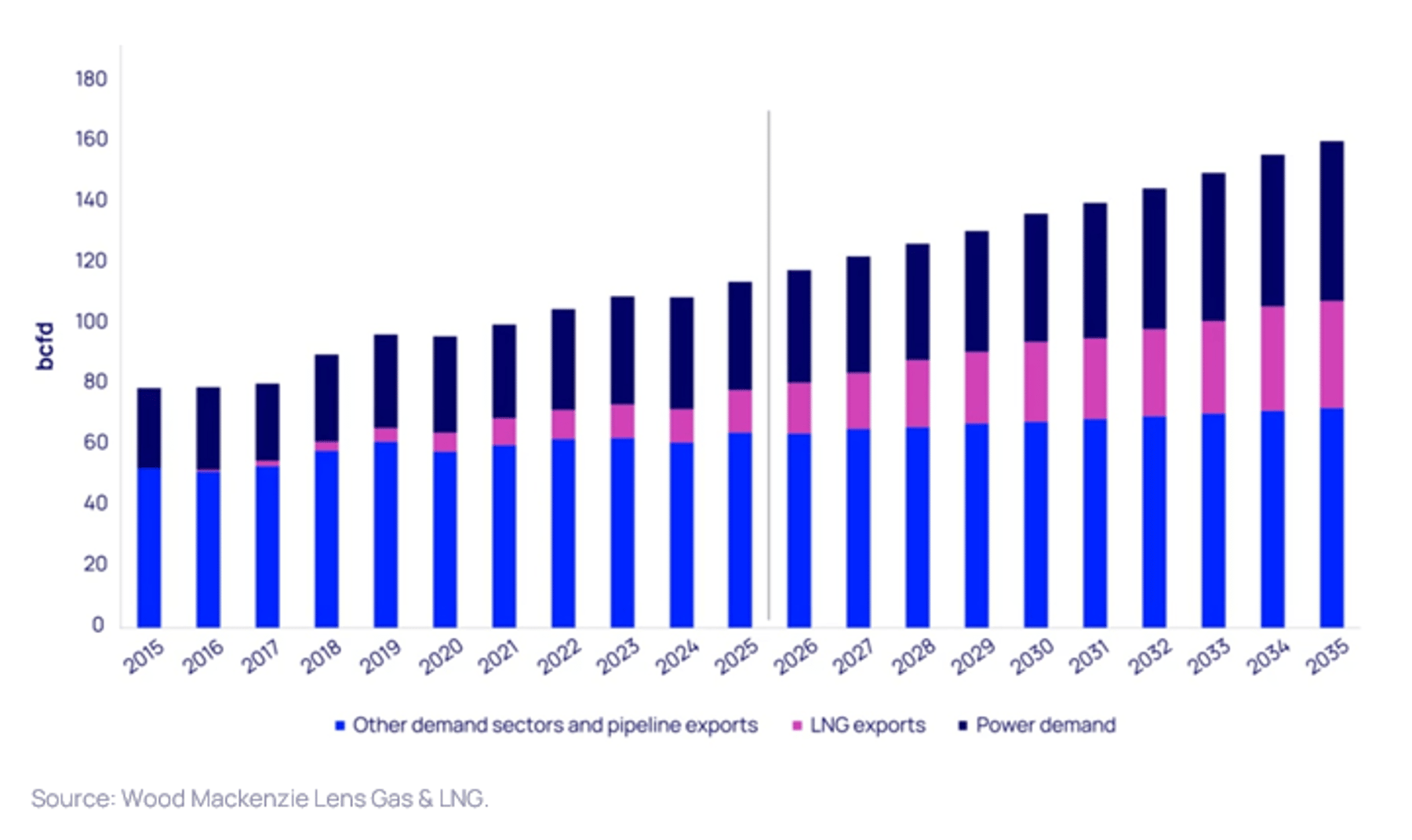
This comes from our most recent Horizons report: ‘Defying gravity: Why US Henry Hub natural gas prices are set to rise’. It shows the past and future of US natural gas demand, which we expect to nearly double from 2017 to 2035.
The authors, Kristy Kramer and Dulles Wang, write: “Instead of simply absorbing supply, the US gas market is hungry for more.” Electricity demand from new data centres means that gas consumption for power generation is surging, even as US LNG export capacity is more than doubling.
Read the full report for more details of our outlooks for gas demand and supply, and our assessment of the implications for producers and consumers in America and around the world.

Get The Inside Track
Ed Crooks’ Energy Pulse is featured in our weekly newsletter, alongside more news and views from our global energy and natural resources experts. Sign up today via the form on this page to ensure you don’t miss a thing.