



Get Ed Crooks' Energy Pulse in your inbox every week
Oil prices rise despite IEA reserves release
Drawdown of stocks provides temporary relief, but reopening the Strait of Hormuz is the only lasting solution
1 minute read

Ed Crooks
Vice Chair Americas and host of Energy Gang podcast

Ed Crooks
Vice Chair Americas and host of Energy Gang podcast
Ed examines the forces shaping the energy industry globally.
View Ed Crooks's full profileAmid all the statistics from the Iran war about missiles fired and sorties flown, only one number really matters for energy and the world economy: the number of vessels passing through the Strait of Hormuz.
In peacetime, about 150 to 175 ships would move through the strait each day. This week, that number has been down to eight to 10 a day, Wood Mackenzie’s VesselTracker service reports.
The strait is a crucial artery for crude and oil products, LNG and other commodities including urea and sulphur. The longer this shipping disruption lasts, the higher the cost to the world economy.
That threat was underlined by an Iranian attack on two tankers off the coast of Iraq on Wednesday. They were set on fire and at least one crew member was killed. The UK Maritime Trade Operations reports 16 attacks on merchant shipping in and around the Gulf since the war began on 28 February.
A statement read on Iranian television on Thursday, attributed to the new Supreme Leader Mojtaba Khamenei, said the blockade would continue.
For the world economy, the effects will be wide-ranging, and lasting. Fertiliser prices, for example, have been rising sharply, adding to inflationary pressure in the food supply chain.
For the US, the most visible impact is through the price of oil. Over the past two weeks, drivers have been watching prices at gas stations rise steadily day by day.
The average price of regular gasoline in the US was US$3.63 a gallon on Friday, according to the Automobile Association of America, up about 68 cents from a month ago and 62 cents from the week of President Donald Trump’s inauguration in January 2025.
As the world’s largest oil producer, and one of the largest net exporters, the US is less affected by surging oil prices than countries that are large importers. But the higher cost of fuel still has some disruptive effects. It redistributes income from consumers to the oil industry and may stoke inflation.
It also acts as a very visible sign of President Trump’s failure, at least for the time being, to deliver on his campaign promise to cut energy costs for American consumers.
There are some routes for oil exports from the Gulf to bypass the Strait of Hormuz. Saudi Arabia has its East-West pipeline, which runs to the oil terminal at Yanbu on the Red Sea, where tankers can load. It was built for exactly this threat – the closure of the strait – and it is proving its value now.
Amin Nasser, chief executive of Saudi Aramco, said on the company’s 2025 full-year earnings call this week that it was ramping up the flow through that pipeline, to reach its maximum of 7 million barrels of crude per day. About 2 million b/d will be used by local refineries, which export some of their production.
That route also has its risks, however. Shipping in the southern Red Sea has been vulnerable to attacks by Iranian-backed Houthi rebels in Yemen, who have threatened to resume their campaign of drone and missile attacks.
The United Arab Emirates also has a pipeline, running to the terminal of Fujairah on the Gulf of Oman, outside the Strait of Hormuz. Operations there were interrupted for a time this week by debris from an Iranian drone intercepted by the UAE’s air defence system, but have since resumed.
Some oil has been leaving the Gulf in Iranian and Chinese tankers, which Iran is allowing to move through the strait.
But all of those routes together can only restore flows to roughly half of the pre-war oil exports from the Gulf.
The US has been looking for other ways to increase the flow of oil onto world markets. On Thursday, it announced it was waiving sanctions on Russian oil. Crude and products from Russia loaded on to a tanker before 12 March can be bought by anyone for the next month, without facing any US retribution.
The lasting solution must be reopening the strait. In 1987 and 1988, during the Iran-Iraq war, the US Navy mounted what was at the time its largest deployment since World War II, Operation Enduring Will, to escort tankers through the Gulf. But armaments, particularly drones, have advanced significantly since then.
US administration officials have been saying that the Navy could be used in a similar role to reopen the strait, but not yet. Chris Wright, the US energy secretary, said on Thursday: “It'll happen relatively soon, but it can't happen now. We're simply not ready.”
Instead, the US strategy is aimed at suppressing Iran’s ability to strike tankers and other ships in the Gulf.
“The most critical thing right now is the US military degrading their ability to project power,” Wright told Fox News. “Not just missiles for long range, but also their assets that impede travel through the Straits of Hormuz.”
The International Energy Agency (IEA) this week acted to mitigate the impact on oil markets while the fighting continues. On Wednesday, the IEA announced that its 32 member countries would carry out the largest-ever release of oil from their strategic reserves, to ease the strains in the market caused by the war.
The total to be released is 400 million barrels, which is more than double the release in 2022 following Russia’s invasion of Ukraine. It represents about 22% of all the stocks held by IEA member governments and under regulatory obligations.
Fatih Birol, the IEA’s executive director, described the challenges in the oil market as “unprecedented in scale”, and said he was glad they had produced an unprecedented response.
However, the market reaction to the announcement did not suggest the release was having much impact on prices. The action may have been enough to forestall a steeper rise, but it has not brought prices down. Brent crude was trading at about US$99 a barrel on Friday morning, up from about US$85 a barrel a week ago.
The Wood Mackenzie view
Wood Mackenzie analysts have been warning about the possibility that a prolonged disruption in the Strait of Hormuz could send oil prices to US$200 a barrel. The IEA’s reserves release does not change that picture.
There are two fundamental issues: the size of the drawdown and the pace at which oil can reach the market. Andrew Harbourne, Wood Mackenzie’s senior analyst for oil markets, says the 400-million-barrel release will cover only about four weeks of disruption in the Gulf.
The rate at which oil can be released from reserves is also likely to be significantly smaller than the shortfall in exports moving through the Strait of Hormuz.
The US plans to release 172 million barrels of oil from its Strategic Petroleum Reserve (SPR) as part of the coordinated action, over a period of 120 days. That makes an average rate of about 1.4 million b/d, which is well below the SPR’s claimed maximum drawdown rate of 4.4 million b/d.
Assuming other IEA member countries release oil at a roughly similar pace, that would add about 3.3 million b/d to global supply. That is still some way short of the supply that has been lost.
Wood Mackenzie’s Harbourne says: “Strategic stocks remain an effective emergency buffer, but they are a one-off intervention that must eventually be rebuilt and cannot cover a sustained supply gap.”
Demand for oil is relatively price inelastic. People must get to work or move goods to where they are needed, however much their fuel costs. That means relatively large price movements can be needed to bring supply and demand into balance. If several million barrels of oil remain blocked from world markets, the global economy will need a sharp and painful downturn to adjust to that.
If the war and the disruption in the Strait of Hormuz persist, historical supply shocks still suggest Brent crude could get to US$150 to US$200 per barrel. For some products, including diesel and jet fuel, the effective prices could be US$200 to US$250 a barrel or more.
In brief
The US administration has launched a series of investigations into other countries’ trading practices that could lead to a new round of tariffs. The US Trade Representative (USTR) Jamieson Greer announced investigations into economies including China, the EU, Mexico, Japan, India and others, under Section 301 of the 1974 Trade Act. The investigations will be focused on questions relating to structural excess capacity and production in manufacturing sectors, and whether those represent unreasonable or discriminatory treatment of American companies.
The Trade Act gives the USTR the authority to assess whether an act, policy or practice of a foreign government is burdening or restricting US commerce and to take retaliatory action, including imposing tariffs.
The launch of the investigations follows a ruling from the US Supreme Court last month that the Trump administration acted illegally in using a different law, the International Emergency Economic Powers Act, to justify wide-ranging tariffs. Greer said the Trump administration’s efforts to reindustrialise the US economy faced significant challenges due to structural excess capacity in foreign countries.
PJM, the grid operator for the largest power market in the US, has begun using ambient-adjusted ratings for its transmission lines, a technique that should allow more efficient use of its grid infrastructure. The safe capacity of a transmission line varies according to ambient conditions such as air temperature. But the rating limits for maximum capacity have traditionally been set as constants, using cautious assumptions about worst-case conditions. Using ambient-adjusted ratings will allow more power to be carried on lines when conditions make it safe to do so, potentially delivering significant efficiency improvements in grid infrastructure utilisation.
PJM’s move makes it the first regional transmission operator to comply with a 2021 order from the Federal Energy Regulatory Commission that grids across the US should start adjusting ratings based on weather conditions. The regulator argued that more efficient use of infrastructure would help hold down costs for consumers.
Other views
Strait of Hormuz closure threatens South Asia LNG supply
Chemical markets in the crossfire: assessing the impacts of the Middle East conflict – Rob Gilfillan
Vaca Muerta requires US$22 billion and 1,000 new wells to meet export targets
The US solar industry navigated unprecedented change in 2025 – Zoë Gaston
Is AI really to blame for costly electricity bills? – Lynne Kiesling
Seizing the data centre buildout for grid modernization – Jane Flegal
Quote of the week
“It took 16 months to build the Pentagon. We can't get an interconnection agreement in most parts of the country in that time. It took 4 years to build the Hoover Dam. Can't build a CCGT in that amount of time. And in some parts of this country, you can't build, interconnect, and energise a data center in less than 10 years. We put a man on the moon in 9 years.”
Peter Lake, Senior Director of Power at the National Energy Dominance Council at the White House, said one of the Trump administration’s priorities was “getting back to building big things in America again”. He was speaking at the Electric Power Supply Association’s Competitive Power Summit.
Chart of the week
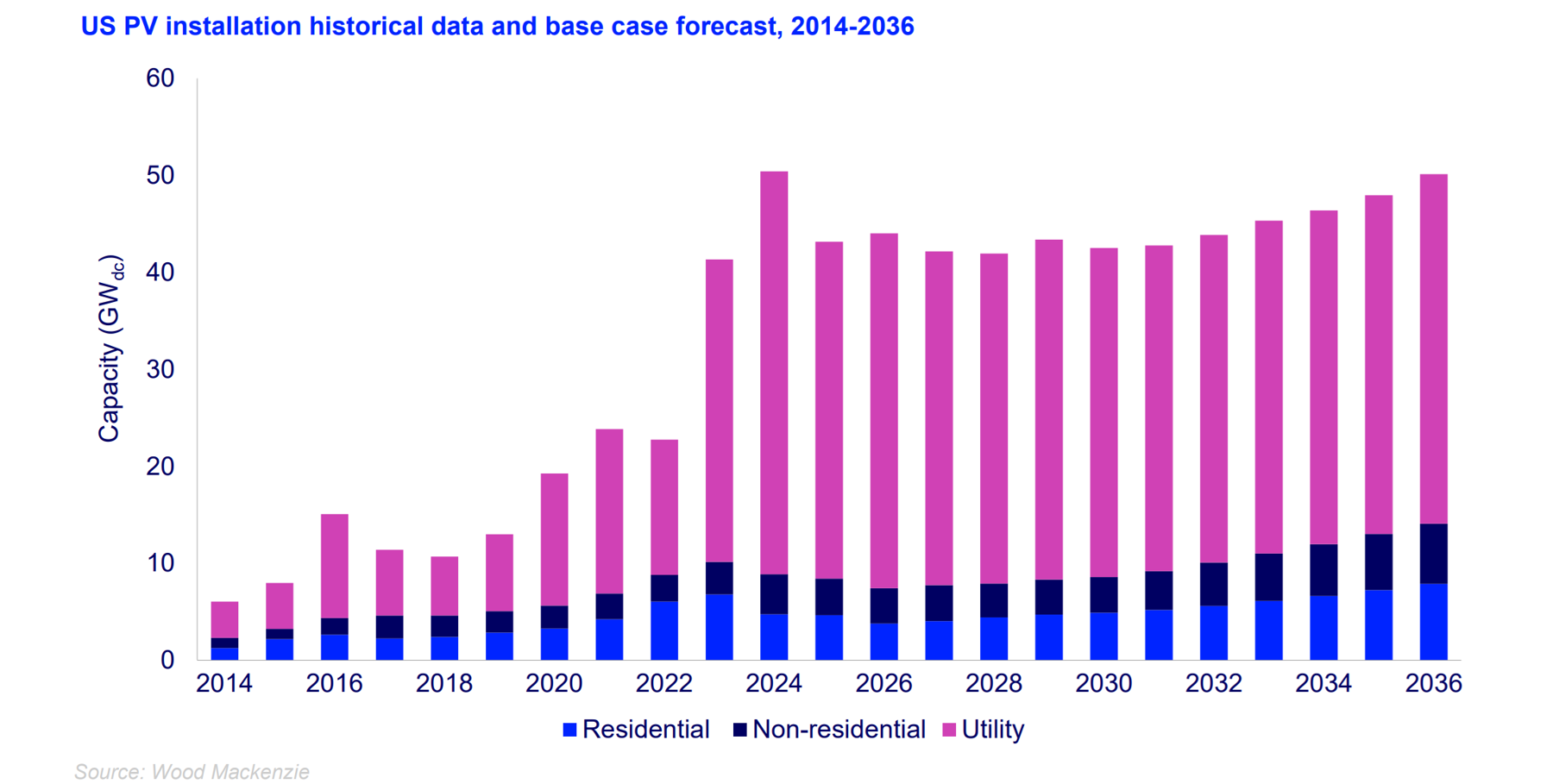
This comes from our latest US Solar Market Insight, assessing the state of the industry today. The chart shows historic installations of solar generation capacity in the US, going back to 2014, with forecasts out to 2036.
The crucial point is that although there was a clear slowdown in 2025, and the market seems set to remain at about those levels for the next few years, it is absolutely not collapsing following the withdrawal of tax credits in last year’s “one big beautiful bill” legislation.
For more details, check out the free download of an excerpt from the Solar Market Insight, or ask about the full report.

Get The Inside Track
Ed Crooks’ Energy Pulse is featured in our weekly newsletter, the Inside Track, alongside more news and views from our global energy and natural resources experts. Sign up today via the form at the top of the page to ensure you don’t miss a thing.