



Sign up today to get the best of our expert insight in your inbox.
Five themes shaping the energy world in 2026
Geopolitics and commodity markets, affordability and power prices and M&A
1 minute read

Simon Flowers
Chairman, Chief Analyst

Simon Flowers
Chairman, Chief Analyst
Simon is our Chief Analyst; he provides thought leadership on the trends and innovations shaping the energy industry.
Latest articles by Simon
-
The Edge
How war in the Middle East is hitting Asia hard
-
The Edge
The energy crisis is coming to the boil
-
The Edge
Boiling a frog – could oil prices test US$200/bbl?
-
The Edge
War is once again reshaping gas and LNG
-
Opinion
Middle East conflict set to drive oil and LNG prices significantly higher
-
The Edge
Can natural hydrogen deliver its potential?
1. Disruptive geopolitics, the global economy and commodity markets
Strap in for another year of volatility with geopolitics influencing energy and natural resources markets as much as the fundamentals do.
The war in Ukraine rumbles on, seemingly still some distance from a sustainable peace deal. The capture of Venezuela’s President Nicholas Maduro embeds global fragmentation, with the US administration’s goals for Iran and Greenland adding to an ongoing disruptive narrative. Global trade is increasingly polarising into US- and China-led blocs and all that implies. This November’s US mid-term elections will be more significant than usual, with ramifications for all markets, including commodities.
In our forecasts, global GDP growth slows to 2.5% in 2026 from 2.8% last year as trade tariffs bite, adding to the inauspicious backdrop. However, the Fed’s ongoing rate cuts suggest 2026 may prove to be the low point of the cycle. Any weakening of the dollar that results may provide some support for commodity prices.
Oil: The OPEC+ strategy to dampen non-OPEC liquids supply by driving prices down is working. We forecast Brent will average US$59/bbl in 2026, US$10/bbl below last year. The market is awash with supply, with global liquids growth of 2.5 million b/d swamping demand growth of 0.7 million – even before any additional volumes from Venezuela. Intensifying geopolitical tension may limit the downside.
Gas and LNG: Global LNG prices enter the anticipated, potentially long-duration, slump. The massive new wave of LNG supply, mainly from the US and Qatar, ramps up through 2026 and continues for several years. Delivered prices into Europe and Japan – already two-thirds down from the post-Ukraine war peak of 2022, at an average of US$12/mmbtu in 2025 – could halve again by the early 2030s.
The writing is already on the wall. European prices (TTF) slipped below US$10/mmbtu in early January despite the cold temperatures while Chinese demand remains weak. Meanwhile, the rising call on US gas for export and domestic use will heap pressure on Henry Hub prices. The US benchmark temporarily climbed above US$5/mmbtu last December. While this was weather-driven, demand growth sets the stage for a future that may arrive sooner than expected. The prospect of lower margins for US LNG producers is no longer as distant as it once felt.
Metals: Copper again looks the standout this year, with demand growth driven by electrification and supply disruptions continuing to buoy prices. Governments will step up efforts to secure access to critical minerals and consider building out domestic supply chains.
2. Energy affordability: power prices are now a political concern
Over the past four years, European electricity consumers have faced some of the highest power prices in the world, mainly a result of soaring gas prices, which set the wholesale power price in most markets. We expect European economies to get a boost from 2026 as gas prices fall.
Addressing rising US retail power prices is firmly on the agenda for the US Administration a theme we highlighted in the Edge exactly a year ago. In 2025, 39 of the 50 states experienced real increases in residential electricity rates. Power demand is soaring on rampant AI investment and data centre build-out. Utilities have to invest to make the grid more resilient against wildfires and extreme weather events. And with a host of other factors – constrained power supply chain, rising equipment, labour costs and domestic gas prices – wholesale and retail electricity prices are only going one way: up.
The heat is on regulators, state and federal, to find solutions to mitigate retail price increases. Innovative tariff mechanisms are urgently required to protect retail customers while expediting the development of infrastructure, including new gas pipelines.
The US administration is determined to win the AI race and will support whatever is needed to make it happen – except, that is, making it easy to develop new solar and wind generation. The scale of new capacity committed by developers – in the main, gas-fired plant so far – attests to the huge part the power industry will play. The risks to energy providers from the AI boom are becoming apparent – not least a breakthrough in chip efficiency, which could lead to overbuild and stranded assets a few years from now. That potential development will increasingly be at the centre of the debate in 2026.
3. Growth in investment stalls
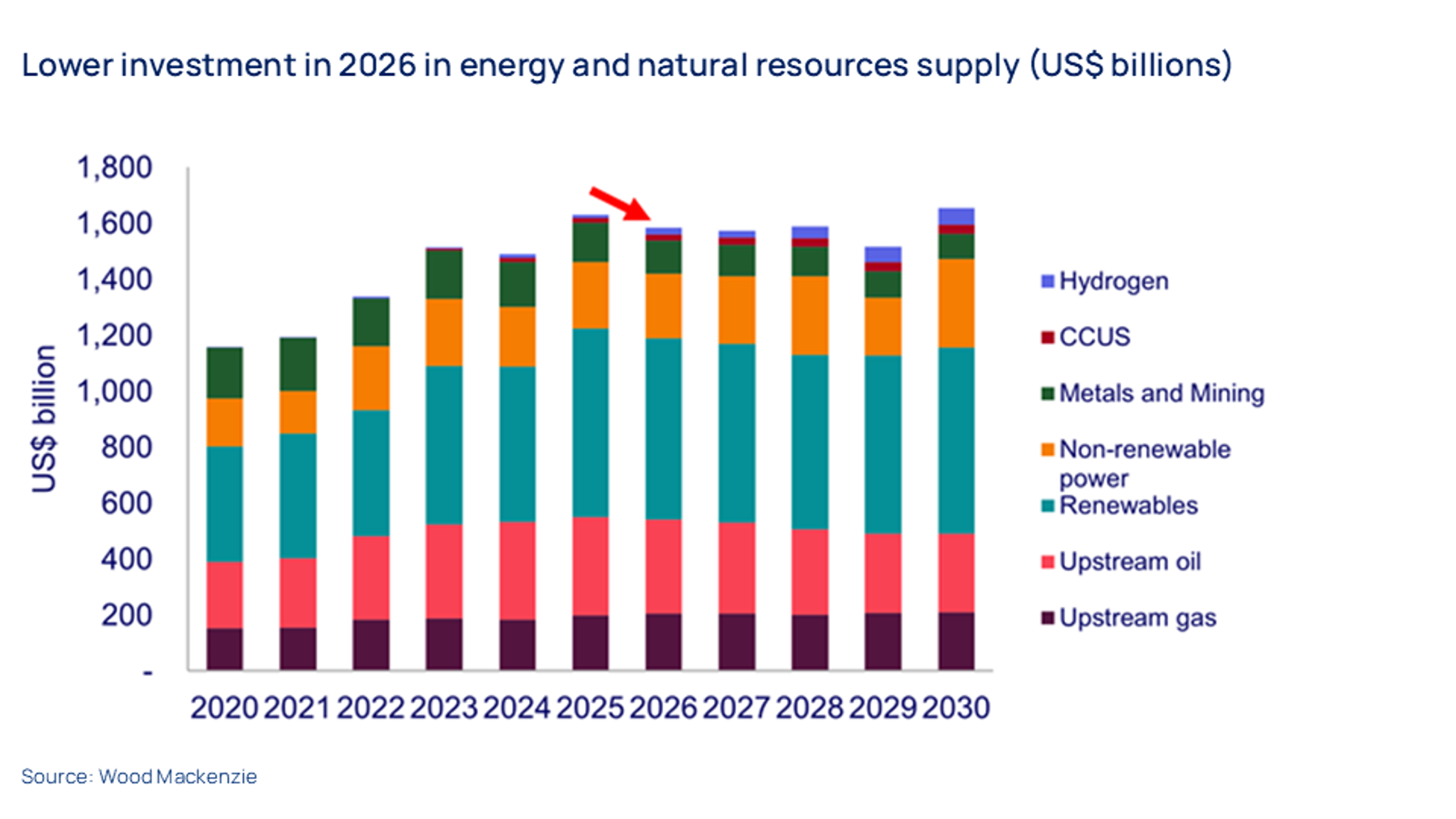
Geopolitical tension and short-term weakness in commodity prices have led to a pause in the upward trend of investment in energy and natural resources. Having climbed by 41% since 2020 to reach a record US$1.63 trillion (real) last year, we forecast overall investment in energy and natural resources supply will slip by 4% to US$1.58 trillion (real terms) in 2026. Given the urgent need for sustained investment in supply to meet rising demand in the future and to decarbonise the energy system, we expect only a brief blip before investment resumes its upward trend.
Power and renewables spend, 54% of the total, slips from US$900 billion to US$877 billion, mainly due to China curbing its policy incentives for solar and wind capacity. After 10% CAGR since 2020 lifted global renewables spend to a record high of US$675 billion in 2025, we forecast flat investment in real terms through 2030. Battery energy storage will hold at US$20 billion in 2026 (real) after jumping by 50% last year on falling unit costs.
Investment in emerging low-carbon technologies accounts for 3% of the total. The pipeline of carbon capture, utilisation and storage projects – though mainly storage – continues to build. But 2026 could be make-or-break for hydrogen, with 2 Mtpa poised for FID, double that of last year.
Upstream investment will slip to US$485 billion, 3% below 2025, a second year of decline from the cyclical peak of US$515 billion in 2024 and reflecting weakening oil prices. However, we expect the dip in spend to be short-lived as the industry recognises the opportunity to build supply to meet resilient oil and gas demand well into the 2030s.
For metals and mining, we expect a flat year, with spend of around US$170 billion. This includes projects companies have yet to commit to – still well below 2021’s peak of US$214 billion. Uncertainty triggered by trade tariffs has reinforced tight capital discipline. Along with gold, copper will again be the hot spot for investment, thanks to AI and datacentre infrastructure.
4. M&A and corporate strategic positioning
Renewables: Diverging views on the outlook for US renewables in the wake of the Trump administration’s antipathy towards the sector will drive more M&A in the power sector. Companies are reassessing portfolio exposure. International and some domestic renewables players are aiming to cut exposure to US renewables, while renewables developers there are looking outside the domestic market, with Canada on the radar.
Derisking will include developers shifting strategies from early-stage projects to more mature, cash-generating assets. A growing number of private equity companies that funded development platforms five to seven years ago will be seeking exits to return cash to their investors. Soaring valuations for existing combined-cycle gas turbine plants on the back of the data centre boom present a great opportunity for sellers.
Oil and gas: Upstream companies will balance belt-tightening in a year of weak oil prices with expanding resource capture strategies. All but a few upstream companies face steep production declines over the next decade. Success will require putting multiple levers into play – organic investment in new projects; strengthening exploration exposure, including high impact; international oil companies looking to access large-scale discovered resource (with Venezuela re-emerging as a potential option), partnering with national oil companies in some cases. M&A will be important in portfolio reloading and weak oil prices could present an opportunity for transformational corporate M&A.
Metals: Mining companies’ strategies have a similar duality, balancing continued dedication to capital discipline, which has worked well with investors, while strategically positioning for future metals demand growth. Copper-led M&A remains the big thematic. Diversified miners are eager to strengthen their portfolios by targeting the tier-one assets – low-cost mines of scale – though it’s doubtful deals would gain them the higher stock market ratings accorded to the purer players. Critical minerals are also on the agenda as governments look to secure access to supply, although it’s not yet clear how Big Miners can gain material scale in these niche minerals.
5. Decarbonisation bright spots
Energy and affordability have forced countries to take a more pragmatic approach to decarbonisation. Yet despite deglobalisation and the difficult political and economic challenges governments face, there are bright spots in key sectors, with China leading the way on multiple fronts. Here’s where we expect to see more progress in 2026.
- Renewables: the world continues to install more renewables than new fossil-fuel-based power capacity. We expect global capacity of solar and wind to reach 4,000 GW in 2026, overtaking operating capacity of coal and gas-fired power capacity for the first time, albeit with output commensurate with lower capacity factors.
- Next-generation nuclear: we expect SMR nuclear projects to progress towards construction in 2026. Our pipeline shows a potential 6.7 GW capacity advancing towards FID in the next few years.
- Electric vehicles and batteries: global EV sales are expected to climb to 24 million in 2026, up 3.2 million units or 15% year-on-year. EVs now account for 26% of total light vehicle sales, up from 4% at the start of the decade, with China the driving force. Autonomous vehicles are coming, with major players on track to run trials this year in Houston and Dallas in the US and in Europe including Germany, the Netherlands and the UK. CATL’s Chinese sodium-ion battery technology is scheduled to scale up production to serve the European EV and energy storage market, complementing its lithium-ion batteries, which currently dominate there.
- Hydrogen: China’s developers FID’d over 70% of green hydrogen capacity last year, defying the negative sentiment elsewhere. We anticipate more clarity in 2026 around Envision Energy’s astonishing prediction made at our November 2025 Hydrogen Conference in London. In short, that hydrogen’s low production costs in China could see its ammonia exports cracked back to hydrogen in Europe undercut green hydrogen production in the region.

Through another turbulent year, the Wood Mackenzie team will continue to deliver insight and analysis across all markets and sectors. Subscribe to The Edge to stay ahead.
Contributors: Peter Martin (Chief Economist), Gavin Thompson (Vice Chair EMEA), Ed Crooks (Vice Chair Americas), Joshua Ngu (Vice Chair AsiaPac), Chris Seiple (Vice Chair P&R), Julian Kettle (Vice Chair Metals and Mining), Prakash Sharma and Jonny Sultoon (Energy Transition Service). Alan Gelder and Douglas Thyne (Macro Oils), Massimo Di-Odoardo (Global Gas), Brian Gaylord (P&R), Milan Thakore (BRMs), Fraser MacKay (Upstream) James Whiteside, Tom Ellacott, Greig Aitken (Corporate Analysis), Mhairidh Evans (CCS), Murray Douglas (Hydrogen).
Business as usual is over
Introducing the latest insight from our thought leaders, the book Connected: Bringing predictability to the increasingly uncertain world of energy.
As climate change accelerates and geopolitical tensions reshape global markets, the energy landscape has become increasingly interconnected. Connected explores why those interconnections have developed, and how they bring clarity to the most important decisions we make about the future of energy.
