






Sign up today to get the best of our expert insight in your inbox.
How the oil market could move from famine to glut
Supply growth is coming through higher than expected
6 minute read





Simon Flowers
Chairman, Chief Analyst
Simon is our Chief Analyst; he provides thought leadership on the trends and innovations shaping the energy industry.
Latest articles by Simon
-
The Edge
Middle East NOC oil and gas strategies beyond the crisis
-
The Edge
Putting the 'renew’ into renewables
-
The Edge
Speed to power: solutions to US data centres’ challenges
-
The Edge
What’s on upstream leaders’ minds?
-
The Edge
Are we at an inflection point for a new wave of EV growth?
-
The Edge
Unleashing the Caspian’s potential in oil, gas and critical minerals

Alan Gelder
SVP Refining, Chemicals & Oil Markets
Alan is responsible for formulating our research outlook and cross-sector perspectives on the global downstream sector.
Latest articles by Alan
-
Opinion
5 things you need to know about the future of Asian refining
-
Opinion
Oil, Gas & Power in H2 2026: a trader’s guide
-
The Edge
Oil and gas markets’ perilous dilemma
-
Opinion
The Hormuz shock: what the data reveals about global oil markets in 2026
-
The Edge
Has the oil price bubble burst?
-
Opinion
Horizons Live: Strait talking | Webinar replay

Gavin Thompson
Senior Vice President, Research
Gavin oversees our Europe, Middle East and Africa research.
Latest articles by Gavin
-
The Edge
Middle East NOC oil and gas strategies beyond the crisis
-
The Edge
Putting the 'renew’ into renewables
-
The Edge
Are we at an inflection point for a new wave of EV growth?
-
The Edge
‘Here be giants’ – unlocking Africa’s deepwater exploration puzzle
-
The Edge
War is reshaping LNG beyond winter
-
The Edge
UAE’s oil potential boosted by promising shale discovery

Harry Paton
Senior Research Analyst, Oil Supply
Harry is a member of four oil supply research team. His focus is developing oil price models and benchmarking assets.
View Harry Paton's full profileThe constraint of Gulf crude exports since the closure of the Strait of Hormuz in March pushed Brent prices above US$100/bbl for much of the past nine months, triggering soaring fuel prices, rising inflation and weaker economic growth.
Senior VP Alan Gelder and the wider WoodMac Macro Oils team foresee the potential for much lower prices when flows of exports resume on a peace agreement, reversing these knock-on effects. Importantly, it may not be a fleeting downturn. Additional supply is set to arrive on the market that could contribute to prices trading below our previous long-term forecasts well into the early 2030s. I asked Alan about the new analysis.
Why have you lowered your near-term price outlook?
We believe that the oil market is headed towards substantial oversupply. Much depends on how the Iran war plays out. The key assumption in our new Base Case is that the US and Iran reach a peace agreement late in 2026, but with no breakthrough in the Russia-Ukraine war. Crude flows through the Strait of Hormuz normalise progressively through 2027, allowing fundamentals to play a greater role in shaping the market once again.
We expect demand to bounce back in 2027, but the growth in supply will be much more substantial. The significant change in our supply data is the addition 1million b/d in 2027 and another 1.8 million b/d in 2028 – even as Middle East ‘legacy’ production rapidly returns to pre-war levels and beyond. Just over half of the additional volumes come from the US (including gas production-related NGLs and tight oil), the UAE, Brazil and Venezuela. Plentiful supply not only meets higher demand in 2027 but allows the rebuilding of global observable inventories – which reduced by 1 billion barrels this year – to pre-war levels of over 7 billion barrels by mid-2028.
We forecast Brent will track down over the next two years, averaging US$84/bbl in 2027 and US$55/bbl in 2028.
What happens if the crisis doesn’t end this year?
The next two years are very different in our US-Iran Stand-off scenario. The scenario assumes that the realignment of US politics after the midterm elections rules out a return to military conflict. Without a credible threat of attack, Iran waits out the rest of President Trump’s term. Strait of Hormuz transits do not fully normalise until after 2028 and Middle East crude output stays around 3 million b/d below our Base Case through 2027-28.
Supply growth outside the region would keep the crude market on the long side, but inventories rebuild more slowly. In the scenario, Brent averages US$105/bbl in 2027 and US$91/bbl in 2028.
The underlying fundamentals won’t change, though. Whenever peace comes – by the end of the year in our Base Case or later as in the scenario – an agreement ending the threat to flows through the Strait could mark a shift from famine to glut.
Could Brent be lower-for-longer?
Yes, because there are more low-cost barrels coming into the future supply stack. We base our longer-term price outlook on the marginal cost of the barrel needed to meet demand. Demand growth and declines in producing fields lead to a supply gap of 20 million b/d in 2036. As ever, this gap must be filled by supply from existing fields (reserves growth), new fields, yet-to-find and other technical discoveries.
What’s changed is that our asset-by-asset data shows there are more lower-cost barrels available through 2036 than in our previous analyses. These barrels are from a variety of sources, including the UAE and Iran, along with higher NGLs. The marginal cost is now nearer US$60-65/bbl compared with US$70-75/bbl previously.
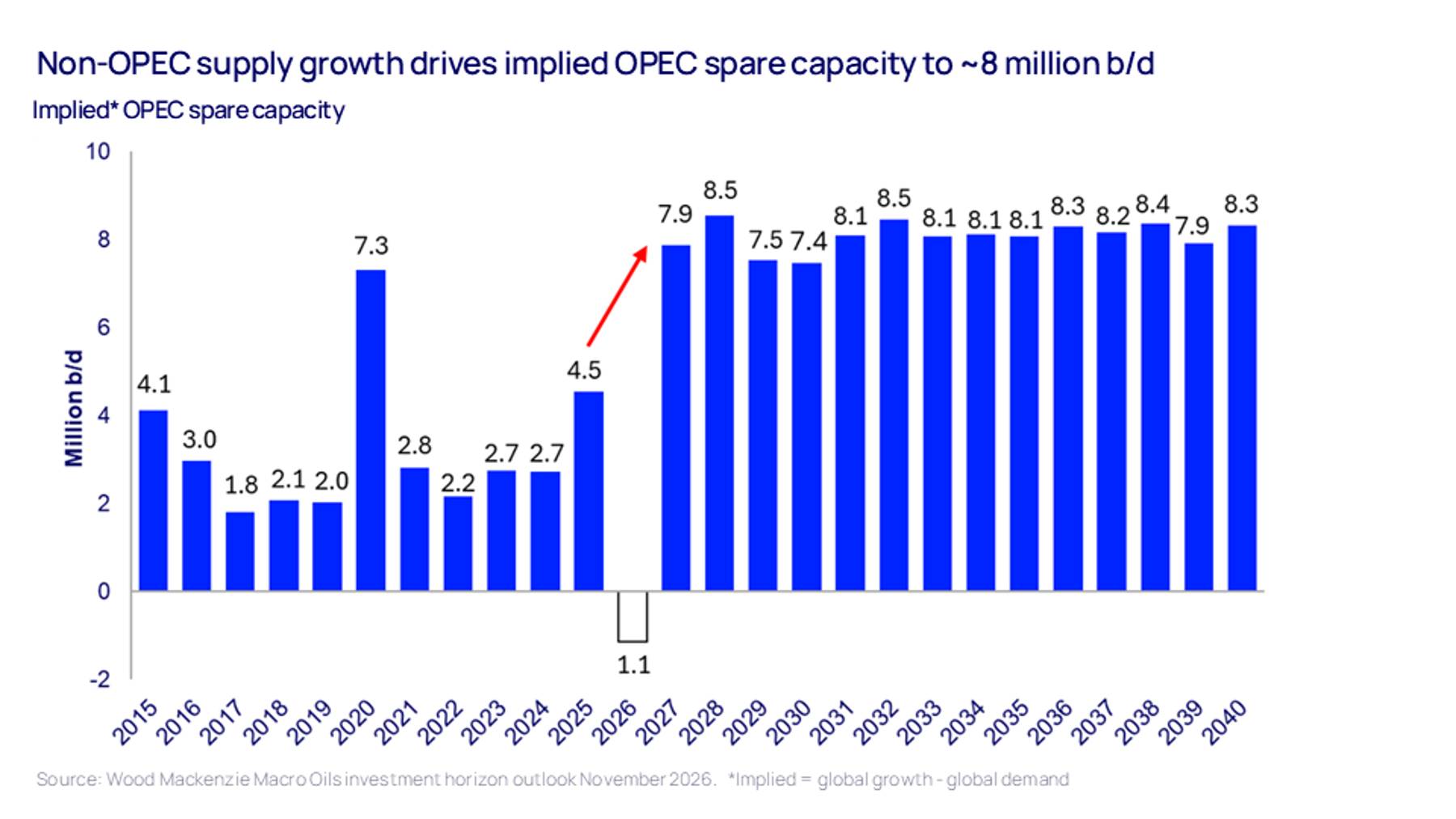
Implied OPEC spare capacity remains broadly unchanged at 8 million b/d through this entire period, suggesting ample available supply will dampen the potential for price upside from geopolitical risk.
Won’t OPEC cut production to support prices?
We think they will have to before the decade ends if a serious price crash is to be avoided. Balancing the books is one consideration in favour of a cut, given several OPEC countries have a fiscal breakeven of above US$80/bbl (Brent). OPEC, along with its OPEC+ partners, had success in pursuing its price-driven strategy before the war. Holding substantial volumes off the market was a material factor in Brent averaging US$90/bbl from 2021 to 2025.
The coming years, though, may prove tougher. With the UAE now outside OPEC, there are fewer remaining members to share the burden of cuts. Moreover, OPEC may baulk at production cuts that support prices and so help recent departees, which are free to increase production.
How could lower prices affect corporate strategies?
Oil and gas companies are looking to strengthen portfolios to offset production declines in the mid-2030s. With the midterm oil demand outlook robust, that won’t change. The mindset of the industry is still based around capital discipline and resilience, both portfolio-wise and financially. Much of the US$0.75 trillion net cash flow windfall in 2026 will be used to strengthen balance sheets, helping businesses to navigate any commodity price downturn.
Any shift in business development will be to sharpen the existing focus on low-cost opportunities that can be resilient as prices fall. A dip in oil prices could present M&A opportunities for the financially strong. Players, though, may be in no hurry to deal if oil prices remain high, preferring to wait for the right time to make a counter-cyclical move.

Make sure you get The Edge
Every week in The Edge, Simon Flowers curates’ unique insight into the hottest topics in the energy and natural resources world. Sign up today using the form at the top of the page.
FEATURED
Energy transition outlook 2026-27
The energy transition is entering a new era shaped by energy security, AI and economic resilience. Explore five possible pathways to 2060 and discover how changing policy, technology and market dynamics could reshape the future of energy and natural resources.
