




BESS valuation: revenue and risk outlook for Germany
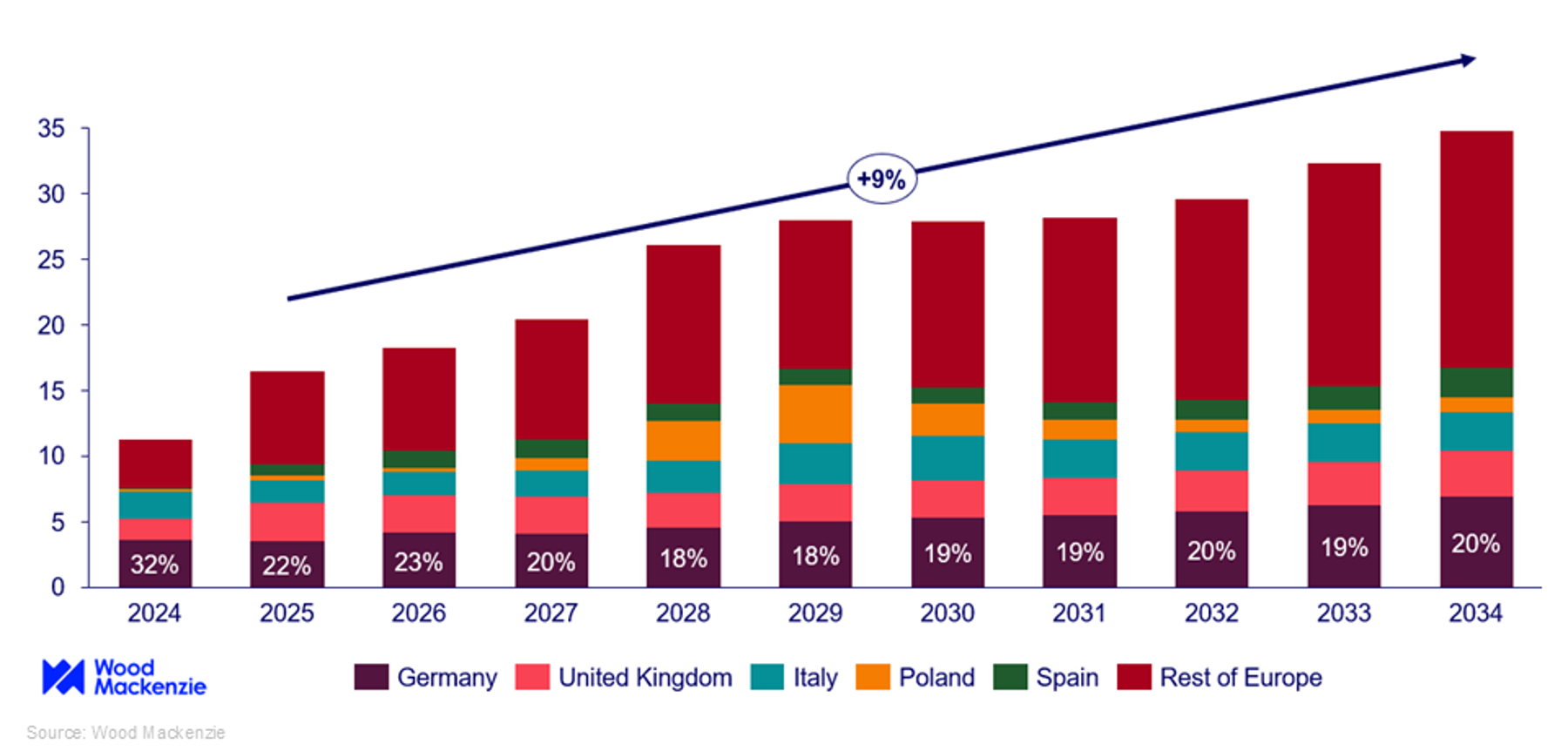
Considerable BESS volumes are now being deployed across Europe – 11 GW as of 2024, at a 9% CAGR over the ten-year outlook with 35 GW expected in 2034.
2 minute read

Rory McCarthy
VP, Head of Power and Renewables Consulting EMEA

Rory McCarthy
VP, Head of Power and Renewables Consulting EMEA
Rory is a Director in the Power & Renewables Consulting division for Europe, the Middle East and African markets.
Latest articles by Rory
-
Opinion
Digital load, clean grid: How data centres can catalyse grid decarbonisation in the UAE
-
Opinion
BESS valuation: revenue and risk outlook for Germany
-
The Edge
Re-thinking energy transition supply chains
-
Opinion
Will renewable auctions underpin Europe’s net zero ambitions?
-
Featured
Will 2021 be a record-breaking year for renewables auctions in Europe?
-
Opinion
Three reasons why Europe is set to lose the energy storage race
Germany has quickly become the most attractive market across Europe for utility scale BESS deployments with 18 GW expected by Wood Makcenzie’s base case outlook by 2034. However, grid connection bottlenecks and revenue cannibalisation threaten FID success and long-term project economics. Wood Mackenzie's new hybrid valuation modelling approach aims to quantify risk and reveals how increased competition will erode returns whilst revenue volatility is likely to diminish as the market matures and flexibility is built-out.

European BESS deployment accelerates amid revenue uncertainties
As investment for European BESS deployment begins to proliferate through the continent, questions remain over revenue availability and access particularly as the mechanisms are set to remain largely merchant based. Wood Mackenzie has invested in a new BESS revenue optimisation and valuation model, fully integrated with its holistic power market fundamentals research and cQuant, a leading third-party stochastic modelling platform, to help our clients understand the full range of potential revenue outturns and risks to assist project valuation for financing, project development, M&A and strategic decision making.
Market scale and growth trajectory
Across all segments (utility, C&I, residential) in the ten-year outlook Germany comes out as the largest, with over 3.5 GW expected this year doubling to 7 GW by 2034. Although the utility segment represents 35% of this, it is still an attractive 18 GW of BESS demand over the outlook, with a further 8 GW in C&I, also offering scale to developers with the capabilities to sell and develop behind the meter.
Market fundamentals face emerging headwinds
Strong market fundamentals for the storage outlook are currently supported by seemingly lucrative revenues and returns across various revenue pools. Could things get any better? There are visible headwinds. At the beginning of the year there was around 300 GW of connection requests for BESS across Germany and this has ballooned to over 500 GW, highlighting major grid connection challenges ahead. Aside from this, as with any flexible asset, the availability of revenue and complexity in commercialising projects to reaching FID should not be underestimated and this differs from market to market.
Addressing valuation challenges
So – how can we provide a sensible assessment of the market revenues today and for assets and portfolios looking ahead? What are the risks and uncertainties that require most attention in valuation? Are revenues high enough to obtain the required capital recovery and return rates and are they attractive enough in the long term to support a sustainable BESS development and operating business plan?
We believe current modelling methods underestimate the risk and revenue variance incorporated in BESS projects. They also typically do not fully value the impact of actual trading behaviour.
Wood Mackenzie's hybrid modelling approach
To incorporate trading behaviour and enable probabilistic simulations Wood Mackenzie has developed a hybrid modelling approach cQuant’s market-leading third-party software platform that draws benefits from both deterministic, fundamental and machine learning modelling alongside stochastic methods.
In this approach Wood Mackenzie’s research-integrated fundamentals models are used to forecast base case power and ancillaries prices. The pricing model then ingests historical data, tracked in real-time by Wood Mackenzie, up to the most recent outturns. Using ML, it trains each revenue stream against Wood Mackenzie research backed deterministic power and ancillary price curves. The result is a fundamentals price that incorporates up to date trading behavior. Machine Learning models are ideal in this scenario, forecasting price series where outlooks are highly uncertain, granular, volatile and difficult to predict, but have rich historical data with multiple known parameters such as detailed supply, demand, plant and pricing data points.

We have rigorously backtested this model alongside Wood Mackenzie's BESS cost models and globally connected intelligence we can accurately calibrate, validate and in the process model full project economics. This hybrid modelling approach for simulating revenues provides our clients with all the necessary data to inform a robust base case view, with full P1 to P99 results on the project. This can be applied for a detailed valuation for a standalone BESS asset, a hybrid BESS asset, or a portfolio of BESS assets. The model can also be expanded to a complete portfolio of BESS, renewables and conventional assets, offering a complete portfolio valuation with optimisation functionality, but that goes well beyond the narrative of this paper.
Long-term outlook: Revenue cannibalisation risks

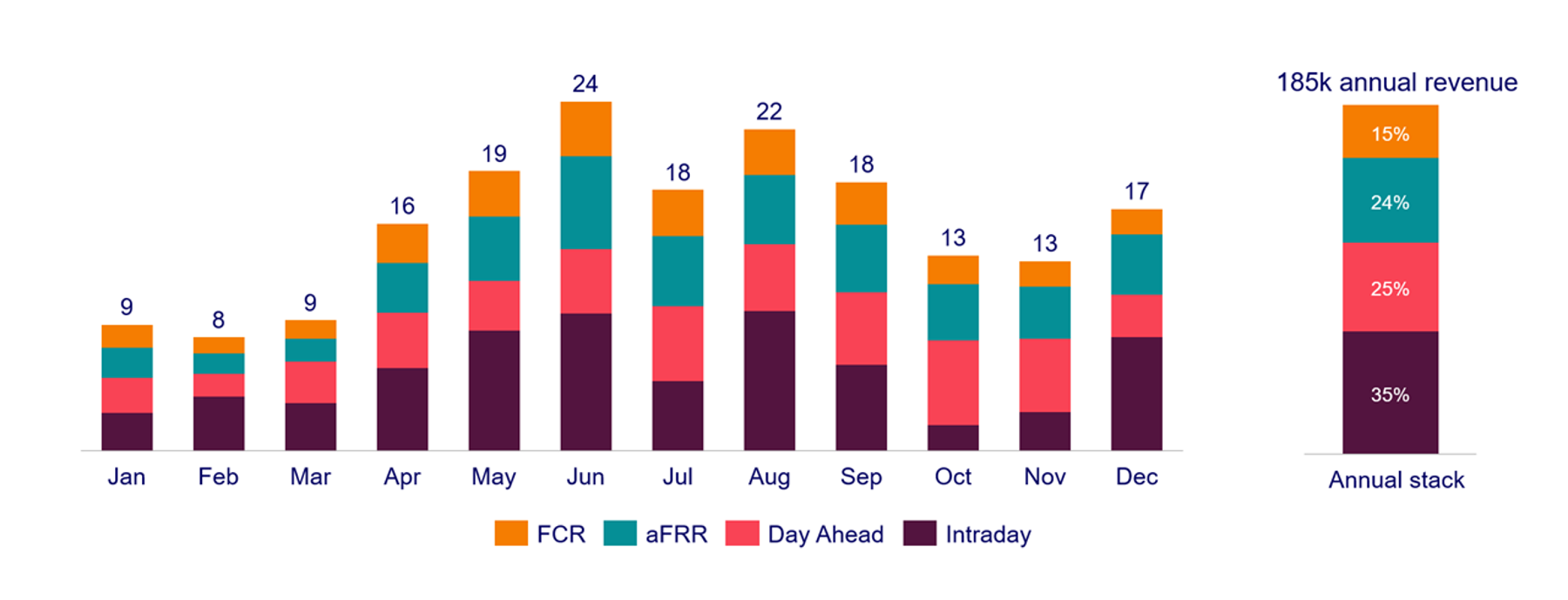
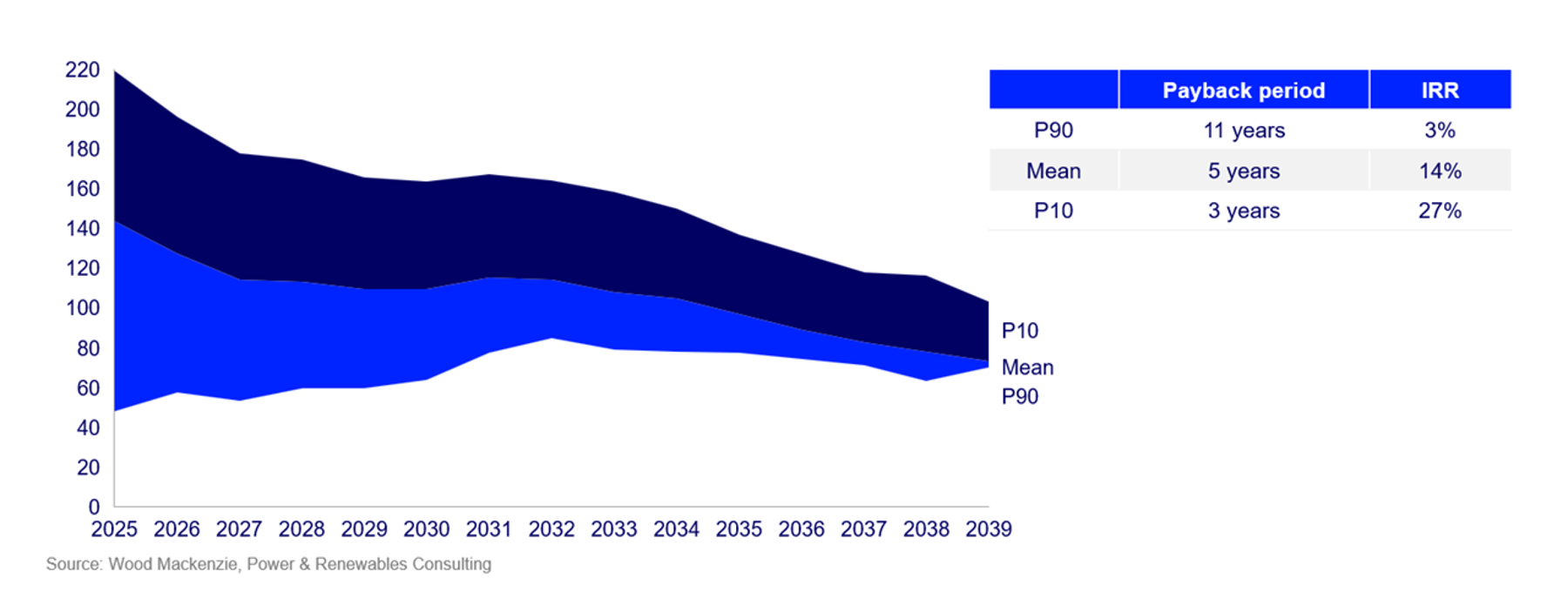
With this analysis we can see that potential volatility and value will reduce over time. There are a few key drivers for this, firstly ancillary service revenues become a smaller part of the revenue stack, and they are inherently spiky. However, the main reason for reducing value and volatility is increased competition in these markets for volatility revenues as they compete for value at the top and bottom margins, flattening out and ultimately cannibalising price fluctuations. Even day ahead and intraday prices, large revenue pools will see cannibalisation of prices from the sheer scale of BESS market influx, with negative impacts on the business case in the long term.
This example shows the German market but we are positioned to value BESS assets across Europe, aligned with our power modelling expertise and coverage.
Wood Mackenzie's energy market expertise
Wood Mackenzie has been valuing energy assets and advising the energy market for over 50 years. We know the market for BESS is only really taking off now across Europe, the first commercial 'new energy' asset class since the wave of wind and solar projects hit the markets, providing a deep investment pool over the next decade and beyond. We are investing in new tools, data and architecture to equip our clients with what it needs to understand the true value of power, flexibility, BESS and to navigate the complex investment dynamics of the power market transition.
If you would like to learn more about how Wood Mackenzie consulting can support your team through transaction or strategy advisory across BESS, renewables or conventional power assets, please reach out to our team.
Don’t forget to fill out the form at the top of the page to access your complimentary copy of the full report.