




US power market outlooks Winter 2025/26: hot topics for MISO, NYISO and PJM
Interregional transmission, battery storage growth and managing rising winter demand are key themes for these grid operators
1 minute read

Rebekah Llamas
Head of Market Intelligence, Power Markets Research

Rebekah Llamas
Head of Market Intelligence, Power Markets Research
Rebekah oversees our Short-term Market Intelligence Team for North America.
Latest articles by Rebekah
-
Opinion
US power market outlooks Winter 2025/26: hot topics for MISO, NYISO and PJM
-
Opinion
What growing demand and large-load dynamics mean for US gas and power
-
Opinion
Powerhouses: monitoring grid developments from Texas to California and beyond
-
Opinion
Infographic | Nodal Price Forecast for ERCOT
-
Opinion
H2 2025: a power trader’s guide
-
Featured
Oil, power, gas trading 2025 outlook

Tien Tong
Market Associate, MISO

Tien Tong
Market Associate, MISO
Tien joined Wood Mackenzie in August 2022 as an analyst in the MISO team.
Latest articles by Tien
-
Opinion
US power market outlooks Winter 2025/26: hot topics for MISO, NYISO and PJM
-
Opinion
Peak season pressures reshape US power markets as capacity constraints drive price volatility
-
Opinion
US seasonal outlook webinars: hot topics for MISO and SPP in Spring 2025
-
Opinion
US seasonal outlook webinars: hot topics for ERCOT and MISO in summer 2024
-
Opinion
The key takeaways from our PJM, MISO and ERCOT seasonal outlook webinars

Cole Kroninger
Market Analyst Lead, Power & Renewables

Cole Kroninger
Market Analyst Lead, Power & Renewables
Cole forecasts wholesale energy market prices, congestion patterns and other dynamics in the MISO market.
Latest articles by Cole
-
Opinion
US power market outlooks Winter 2025/26: hot topics for MISO, NYISO and PJM
-
Opinion
Peak season pressures reshape US power markets as capacity constraints drive price volatility
-
Opinion
US seasonal power outlooks Summer 2025: hot topics for ERCOT, MISO and PJM

Devang Patel
Market Associate, P&R

Devang Patel
Market Associate, P&R
Devang leads daily price forecasting and research for NYISO Zones A, G, J and K.
Latest articles by Devang
-
Opinion
US power market outlooks Winter 2025/26: hot topics for MISO, NYISO and PJM
-
Opinion
NYISO thunderstorm alerts: a trading opportunity

Nathan Ng
Meteorologist, North American Short-Term Power

Nathan Ng
Meteorologist, North American Short-Term Power
Nathan is a meteorologist for the North American Short-Term Power team, primarily covering NYISO and ISONE.
Latest articles by Nathan
-
Opinion
US power market outlooks Winter 2025/26: hot topics for MISO, NYISO and PJM
-
Opinion
NYISO thunderstorm alerts: a trading opportunity
As US electricity demand continues to grow, US grid operators are facing new challenges - from improving long-range and interregional connectivity to adapting their grids to the increased use of battery storage. So, how are some of the key players dealing with these issues?
As well as providing recaps and looking ahead to Winter 2025/26, our US power sector seasonal outlook webinars focused on key longer-term themes for individual independent systems operators (ISOs). Fill out the form at the top of the page for complimentary access to the full slide decks from the events, or read on for an overview of hot topics for MISO, NYISO and PJM.
Connecting the dots: How MISO transmission planning will impact regional flows
Covering 15 US states as well as the Canadian province of Manitoba, MISO (Midcontinent Independent System Operator) runs one of the largest real-time energy markets in the world. This ISO has a variety of projects in the works aimed at addressing resource adequacy, improving transmission efficiency and reducing congestion. As well as improving internal flows, these projects will impact MISO’s interchange with its neighbouring markets.
Long-range Transmission Plan (LRTP): The first two of multiple phases of the LRTP have been approved: Tranche 1 comprises a US$10.3 billion portfolio of 18 projects across MISO’s Midwest subregion, targeted to be in service in 2028-30; Tranche 2.1 invests US$21.8 billion in a further 24 projects and 323 facilities across the same subregion, due to go into service from 2032 to 2034. Projects will impact MISO’s interregional flows with three other RTOs: SPP, AECI and PJM.
MISO-SPP Joint Interconnection Queue (JTIQ): This US$1.8 billion interregional plan consists of five 345 kilovolt (kV) projects that will enable 28.6 gigawatts (GW) of mainly renewable generation, with additional projects to be considered. In-service target date is 2031, although threats to a US$464 million Department of Energy grant are currently jeopardising progress.
High voltage direct current (HVDC) lines: Two projects are planned: The US$12 billion, 800-mile Grain Belt express will facilitate power flows from SPP’s western Kansas subregion to MISO, AECI and PJM; meanwhile, the 350-mile SOO Green project, due for operation in 2031-32, will connect Mason City, Iowa and Yorkville, Illinois, adding 2.1 GW of capacity.
Since 2020, MISO has imported power from PJM and SPP while exporting to AECI (see chart below). Based on transmission rating, load growth and generation capacity forecasts, our modelling foresees notable changes in these interregional flows heading into the 2030s.

To find out more about MISO’s transmission plans, fill out the form to access the full presentation deck and webinar replay. This also includes an in-depth fall recap and winter 2025-26 outlook for MISO.
Charging forward: What battery storage growth means for PJM grid stability
A growing reality facing RTOs and independent systems operators (ISOs) is the increasing use of battery energy storage systems (BESS). Current battery storage in PJM is fairly small in scope, with less than 500 megawatts (MW) in operation; however, a number of projects are in the works, with potential for further growth.
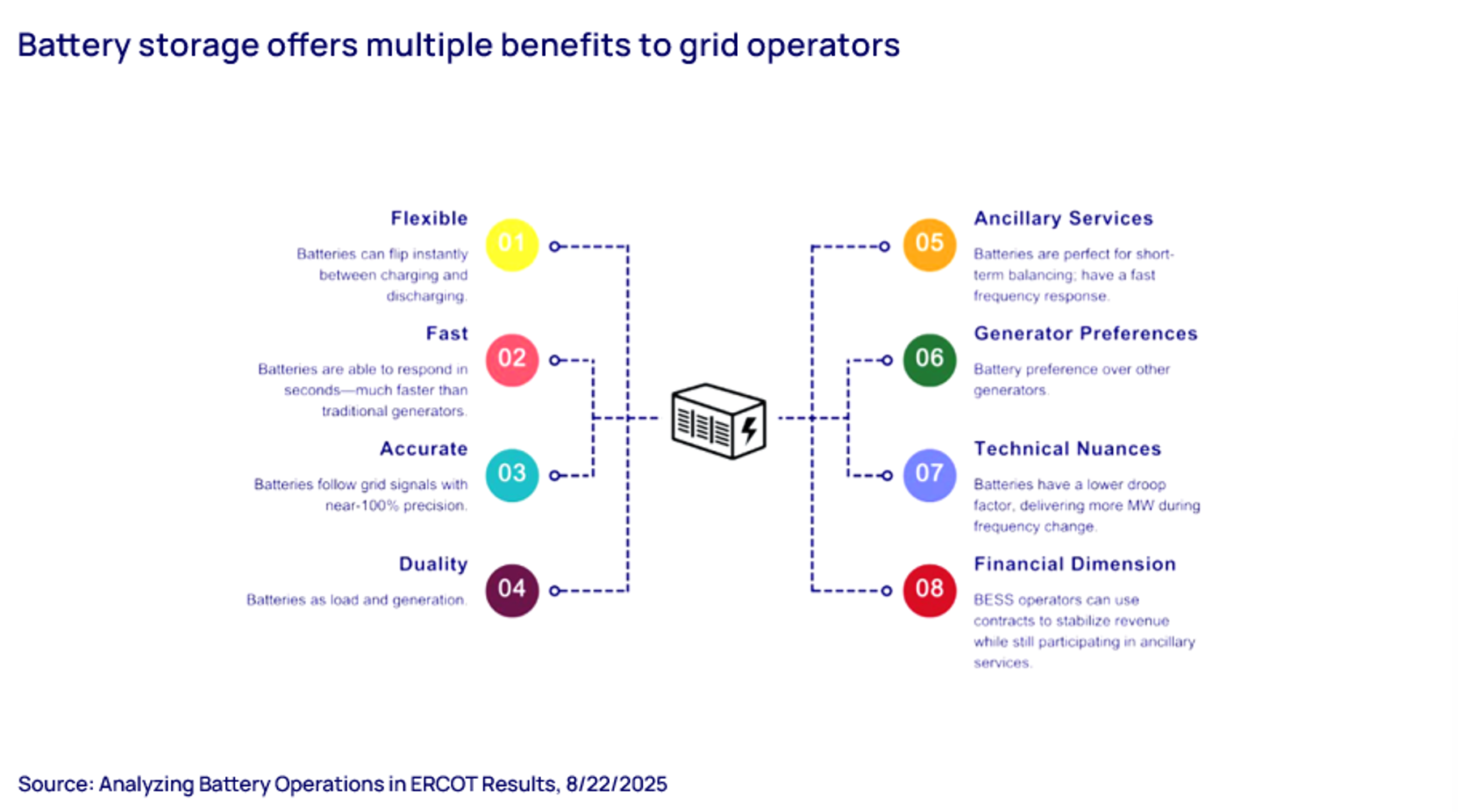
Battery storage is usually attached to renewables, allowing excess capacity to be stored during off-peak or low-demand periods and discharged during peak hours when load is greatest. It therefore acts as both a source of demand when charging and as generation when discharging.
Other ISOs are already making use of this dual behaviour of batteries to help manage price spikes and reserve shortages. A prime example is the Electric Reliability Council of Texas (ERCOT), which has around 9.1 GW of operational capacity with a further 3.7 GW undergoing testing.
The potential benefits of battery storage for grids include:
- Fast response for instant grid balancing and improved system resilience
- Reduced reliance on thermal generation for frequency stability
- Real-time arbitrage through shifting energy from low-price to high-price hours
- Support for reliability during scarcity conditions
- Maintaining grid stability and absorption of renewable variability

Lack of storage makes it challenging to manage outlier days and events, including winter and summer load surges and sudden voltage drops. PJM therefore needs more distributed energy sources — especially batteries — to keep power affordable and its grid reliable. Batteries offer a fast, effective solution that bypasses the ISO’s multiyear connection queue and can come online in step with rising demand.
Data centres should do their part by investing in the generation they rely on — with enough battery storage to cover around eight hours of load, data centres can support the grid and access stable and reliable power three-to-five years sooner than if a new gas-fired power plant is built.
To learn more about how battery storage can help, fill out the form to download the full PJM presentation deck and webinar replay, which also includes a comprehensive fall recap and winter outlook.
Cold comfort: How seasonal rules and winter constraints will reshape NYISO prices
For the New York Independent System Operator (NYISO), winter peaks are now a capacity and energy problem. Rising winter demand is narrowing the gap with summer, driving resource adequacy risk due to the combination of high load with potential fuel availability and north-south transmission issues.
When winter peaks push towards record levels, locational marginal prices (LMPs) and congestion spreads in NYISO’s Zones J and K in particular become more volatile. This is especially true if gas supply is constrained or when north-south transmission bottlenecks are already an issue.
In response, NYISO proposes a shift away from a single annual installed capacity (ICAP) pricing curve to separate summer and winter curves that are better aligned with where modelled adequacy risk now sits. Under the new rules:
- Seasonal New York Control Area (NYCA) ICAP requirements will be set based on summer and winter peaks plus reserve margins
- Seasonal Locational Minimum Installed Capacity Requirements (LCRs) will be computed for each zone to reflect winter transmission limits and load patterns
- Seasonal demand curves will be aligned accordingly with winter having its own steeper curve, increasing price sensitivity so small shortfalls in deliverable unforced capacity can produce larger ICAP price moves

Learn more
These reforms aim to reduce total capacity costs by 15-45%, while shifting value into genuinely risky winter hours — particularly in Zones J and K. However, fuel security will remain the swing factor, with gas pipeline limits, LNG send-out, dual-fuel readiness and short-duration BESS deployment shaping both winter ICAP clears and energy prices.
To go deeper into this issue and get the lowdown on key watchpoints and potential scenarios for Winter 2025-26, download the full NYISO presentation deck and recording. Like the other webinars, this also includes a comprehensive autumn recap and winter outlook for this ISO.
You may also want to learn more about Wood Mackenzie’s Power Trading Analytics products.