


Sign up today to get the best of our expert insight in your inbox
Built to last: why insurers are helping design resilience into renewable energy and storage facilities
As solar and energy storage expand into higher-risk regions, resilience is becoming critical

Ed Crooks
Vice Chair Americas and host of Energy Gang podcast
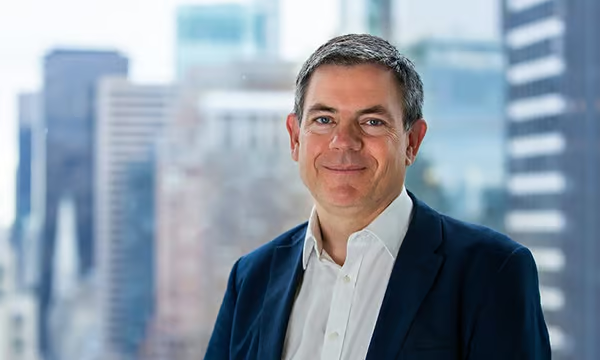
Ed Crooks
Vice Chair Americas and host of Energy Gang podcast
Ed examines the forces shaping the energy industry globally.
Latest articles by Ed
-
Podcast
Predictive care for energy workers
-
Opinion
Elon Musk’s gas strategy shows how the US market is changing
-
Podcast
AI beyond the hype
-
Opinion
US oil production starts to respond to higher prices
-
Podcast
Can energy security and climate action work together?
-
Opinion
US permitting reform plan could transform energy investment
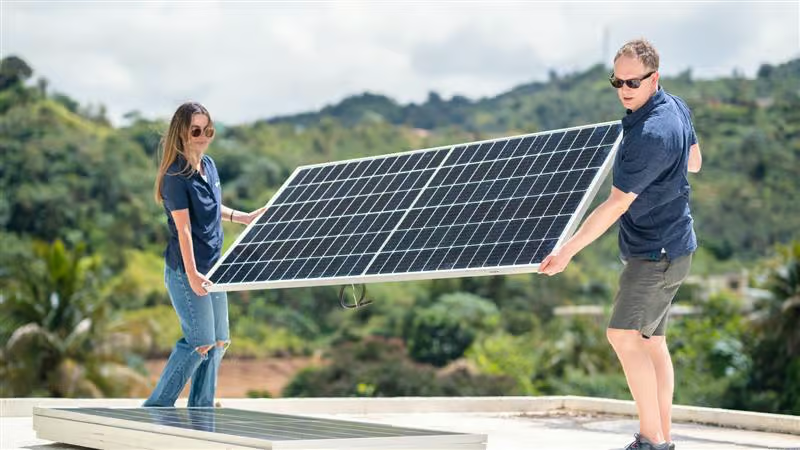
As renewable energy and storage industries grow, and enter more hostile geographies, asset resilience is becoming an increasingly pressing concern. Developers, owners and lenders want to know how solar, storage and other facilities can increase their resilience to the growing risks of physical threats such as hailstorms and wildfires. The rush to add capacity to meet surging demand from new data centres is adding to the pressure, making calculations about the value of asset reliability increasingly complex.
In this special episode, host Ed Crooks speaks with Mike Perron, Renewable Energy Market Lead at FM and Cassian Walker, Operations Vice President and Renewables Engineering Manager at FM, one of the world’s largest commercial property insurers. They explain how insurers are starting to build resilience into renewable project design far earlier in the development process, and why that has become a financing issue as much as a technical one.
For solar power, that means understanding the inherent physical risks such as hail, then deciding what combination of tracker systems, stowing technology and panels is right for the location. The same equipment that performs adequately in California or New Jersey can become a major liability in Texas or Arizona.
Cassian explains how modern trackers can tilt panels away from an incoming storm to turn a direct hit into a glancing blow. Mike contrasts a devastating nine-figure loss at one Texas site with a far smaller loss at another facility that successfully stowed. Those resilience strategies can work only if the system is designed for the local wind and hail conditions, and the performance of the equipment has been tested and verified.
From there, the conversation broadens to the economics. Insurance can account for a large share of a project’s operating costs, and lenders are asking harder questions about resilience before they finance new builds. FM’s case is that better engineering, better hazard modelling and earlier involvement from insurers and independent engineers can lower lifetime risk and improve financial performance, even if they raise up-front costs.
Today, renewable developers still often treat insurance as a late-stage procurement exercise, after key technology decisions have already been locked in. Mike and Cassian argue that that is changing, but the industry is still early in that learning curve. As renewables become more important to the power system, those questions will only get harder to avoid.
This episode of Energy Gang is sponsored by FM.
As one of the world's leading commercial property insurers, FM combines engineering expertise, scientific research, and data-driven insights to help organizations understand, mitigate, and prevent loss before it occurs. From utility-scale solar and battery storage projects to thermal power generation, manufacturing operations, and other critical infrastructure, FM helps organizations build stronger, more resilient businesses.
To learn more about FM's engineering-based approach to resilience, visit FM.com. For additional insights on risk, resilience, and business continuity, subscribe to FM's Sound Policy podcast.
FM. Protect Your Purpose

Full video episodes of the Energy Gang are live on YouTube. Watch the latest episode now and browse the archive.

Energy Gang is a bi-weekly podcast. Join Ed Crooks and the gang for their take on the biggest energy stories shaping the world, with sharp analysis from top experts in climate, policy and the energy industry.