



Sign up today to get the best of our expert insight in your inbox.
A wild week for gas markets
Volatile prices are a sign of what’s to come
1 minute read

Simon Flowers
Chairman, Chief Analyst

Simon Flowers
Chairman, Chief Analyst
Simon is our Chief Analyst; he provides thought leadership on the trends and innovations shaping the energy industry.
Latest articles by Simon
-
The Edge
How war in the Middle East is hitting Asia hard
-
The Edge
The energy crisis is coming to the boil
-
The Edge
Boiling a frog – could oil prices test US$200/bbl?
-
The Edge
War is once again reshaping gas and LNG
-
Opinion
Middle East conflict set to drive oil and LNG prices significantly higher
-
The Edge
Can natural hydrogen deliver its potential?

Gavin Thompson
Vice Chairman, Energy – Europe, Middle East & Africa

Gavin Thompson
Vice Chairman, Energy – Europe, Middle East & Africa
Gavin oversees our Europe, Middle East and Africa research.
Latest articles by Gavin
-
The Edge
How war in the Middle East is hitting Asia hard
-
The Edge
The energy crisis is coming to the boil
-
The Edge
War is once again reshaping gas and LNG
-
Opinion
Middle East conflict set to drive oil and LNG prices significantly higher
-
The Edge
The big themes on Big Oil’s mind
-
Opinion
European gas: 6 Q&As on prices, supply, and regulatory impact

Massimo Di Odoardo
Vice President, Gas and LNG Research

Massimo Di Odoardo
Vice President, Gas and LNG Research
Massimo brings extensive knowledge of the entire gas industry value chain to his role leading gas and LNG consulting.
Latest articles by Massimo
-
The Edge
The energy crisis is coming to the boil
-
The Edge
War is once again reshaping gas and LNG
-
Opinion
Middle East conflict set to drive oil and LNG prices significantly higher
-
Opinion
European gas: 6 Q&As on prices, supply, and regulatory impact
-
The Edge
A wild week for gas markets
-
Featured
Gas & LNG: region-by-region predictions for 2026
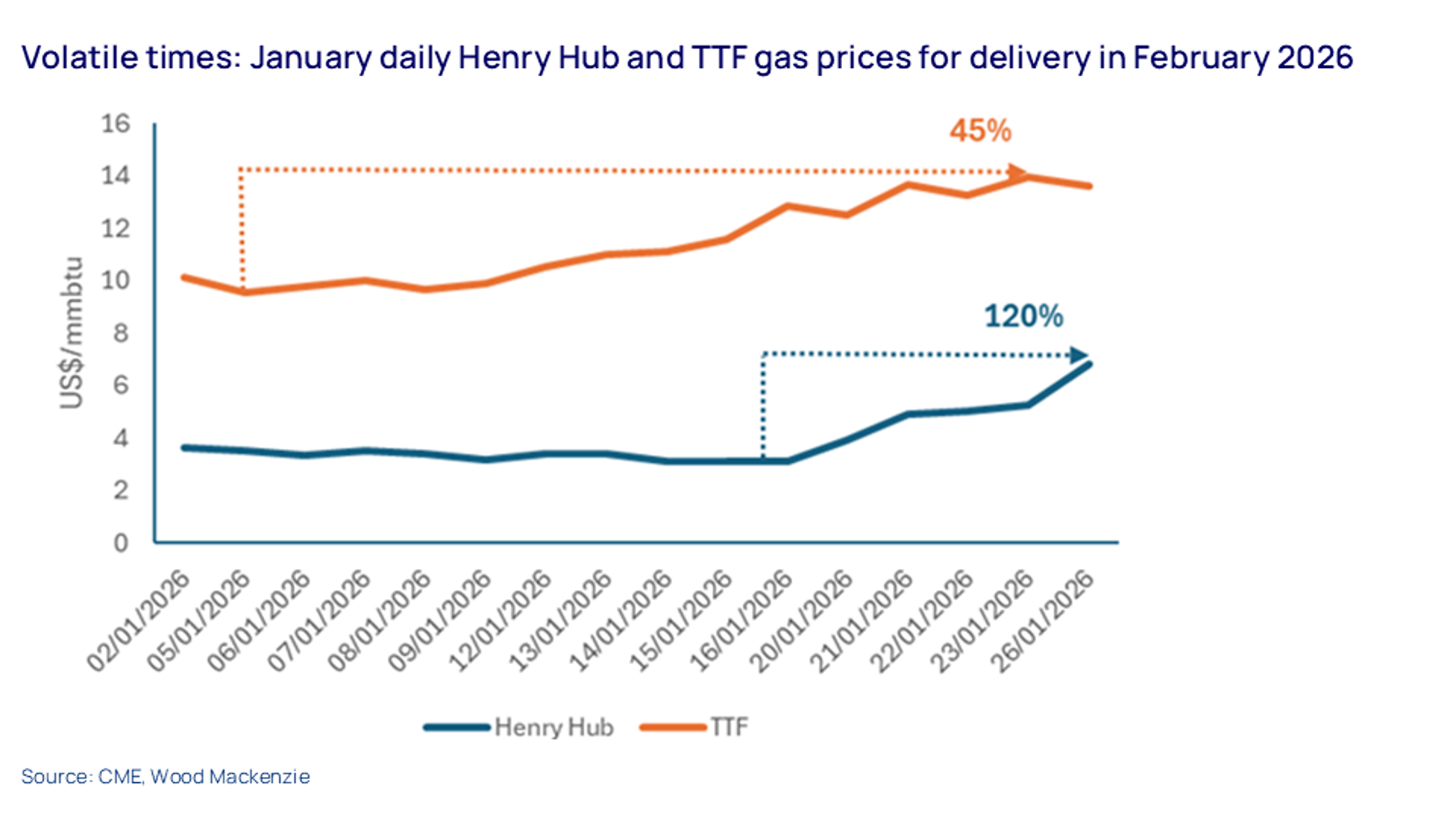
Freezing winter temperatures across the northern hemisphere have helped push global gas prices significantly higher. Europe’s TTF forward for February delivery has shot up by over 40% since the start of the month. In the US, Henry Hub prices have more than doubled since 19 January as an ‘Arctic siege’ swept across more than 20 US states. This led to a record freeze-off in gas production just as demand soared.
There’s more to these price spikes than just cold weather, however. I asked Massimo Di-Odoardo, Head of Gas and LNG Research, for his thoughts on how the increasing interconnection between the US and global gas markets is impacting traded prices.
What just happened?
Europe got the ball rolling, with natural gas prices rising through January as cold weather quickly shifted the bearish narrative and boosted withdrawals from already low storage levels. Europe entered winter with storage just above 80%, the lowest in four years. Sites are now less than half full. TTF prices touched US$14/mmbtu at the start of this week, their highest in over six months.
In the US, severe weather drove Henry Hub gas prices for February delivery up by almost US$3.70/mmbtu in just six trading days – a 120% jump and the largest percentage increase in the prompt future’s contract history. Our US gas team notes that at its peak, around 16% of total US gas production was impacted by freeze-offs, exceeding levels seen during Winter Storm Uri in February 2021.
Was there more at play than low temperatures?
Cold weather was the trigger for higher prices in both the US and Europe. But beyond the snow and ice, the impact of infrastructure, economics and the growing interconnectivity between the US and global gas markets was increasingly evident.
US storage started the winter at comfortable levels, but a record weekly withdrawal highlighted years of underinvestment in new capacity, boosting price upside as almost half the US population hunkered down. Fears over reduced US LNG exports amplified prices in Europe and, to a lesser extent, across Northeast Asia. Gas into Gulf Coast LNG plants has fallen by more than 40% in recent days, helped by some LNG suppliers capitalising on higher domestic netbacks as day-ahead Henry Hub prices soared to US$30/mmbtu. This provided flexibility to the US market and prevented Henry Hub prices going even higher. But, in turn, gas supply to the global market risks being restricted, pushing up LNG prices.
Barring another cold spell, prices are now coming down. But given US LNG exports are set to double over the next five years, concerns about whether US domestic production can meet increasing demand from both domestic consumers and LNG facilities – and still limit price upside – have been heightened.
Weren’t we meant to be heading into an oversupplied market?
Yes, although the cold spell has shifted the narrative for 2026, as European summer injection into storage means the market will be tighter this year than previously anticipated. But the sheer amount of LNG capacity currently under construction will progressively bring prices down over the next five years.
If European prices drop to levels that squeeze US LNG export margins, offtakers will consider cancelling cargoes. Reduced US exports would then make more gas available to the domestic market and lead to corresponding periods of lower prices. This, in turn, would quickly restore US LNG competitiveness and incentivise more LNG demand, lifting prices again. The upshot? Increased volatility becomes a standard feature as interconnected markets seek a new equilibrium.
What are the implications?
Increased volatility has consequences for the US’s role in the global gas market. Henry Hub has been among the steadiest commodity benchmarks worldwide, with global LNG buyers spending big to leverage its low and stable prices. Looking ahead, the US faces twin challenges: ensuring supply keeps pace with demand growth and increasing gas storage capacity. In this new world, strategies will need to adapt.
What’s the takeaway for gas market players?
In our recent book ‘Connected’, we noted that more commodities are being traded globally by more participants across regional borders. As energy markets become more complex and interconnected, commodities are highly exposed to market change or disruption. This has been laid bare by recent cold weather. LNG suppliers and traders may be cashing in on high prices right now, but with more variables and complexity impacting the market, the real story is greater volatility.

Make sure you get The Edge
Every week in The Edge, Simon Flowers curates unique insight into the hottest topics in the energy and natural resources world.
Sign up today using the form at the top of the page.