




Sign up today to get the best of our expert insight in your inbox.
The big themes on Big Oil’s mind
What the Q4 results reveal
1 minute read

Simon Flowers
Chairman, Chief Analyst

Simon Flowers
Chairman, Chief Analyst
Simon is our Chief Analyst; he provides thought leadership on the trends and innovations shaping the energy industry.
Latest articles by Simon
-
The Edge
How war in the Middle East is hitting Asia hard
-
The Edge
The energy crisis is coming to the boil
-
The Edge
Boiling a frog – could oil prices test US$200/bbl?
-
The Edge
War is once again reshaping gas and LNG
-
Opinion
Middle East conflict set to drive oil and LNG prices significantly higher
-
The Edge
Can natural hydrogen deliver its potential?

Gavin Thompson
Vice Chairman, Energy – Europe, Middle East & Africa

Gavin Thompson
Vice Chairman, Energy – Europe, Middle East & Africa
Gavin oversees our Europe, Middle East and Africa research.
Latest articles by Gavin
-
The Edge
How war in the Middle East is hitting Asia hard
-
The Edge
The energy crisis is coming to the boil
-
The Edge
War is once again reshaping gas and LNG
-
Opinion
Middle East conflict set to drive oil and LNG prices significantly higher
-
The Edge
The big themes on Big Oil’s mind
-
Opinion
European gas: 6 Q&As on prices, supply, and regulatory impact
Big Oil’s big strategic goal is to strengthen upstream portfolios for the next decade (look out for our forthcoming February Horizons for deep analysis). The Q4 results released over the last fortnight added some colour to companies’ plans but also highlighted the need for corrective financial measures, given uncertain commodity markets. I chatted through the main themes from the results with our Corporate Analysis team.
How does the industry see the outlook for commodities?
The messaging is downbeat for the immediate future across almost the entire hydrocarbon complex – Brent, downstream (where refining is doing better than petrochemicals) and global LNG, with the growing consensus of an imminent glut is consistent with the WoodMac view. The strong production growth of TotalEnergies, Equinor, Chevron and ExxonMobil partly offsets the hit to their respective bottom lines from weaker prices. However, it’s no surprise that companies are emphasising renewed efforts to cut operating costs and trim investment.
Why are some companies more positive about the US gas market?
The argument is that the January surge in Henry Hub prices is a portent of a progressive tightening of fundamentals. Certainly, US gas demand will surge in the next few years, driven by data centre capacity build-out and new LNG export projects coming onstream. Our view is that higher-cost gas will need to be tapped to meet higher demand, pushing the price up to US$4.60/mmbtu (real) by 2030.
How has the weak macro outlook affected shareholder distributions and balance sheets?
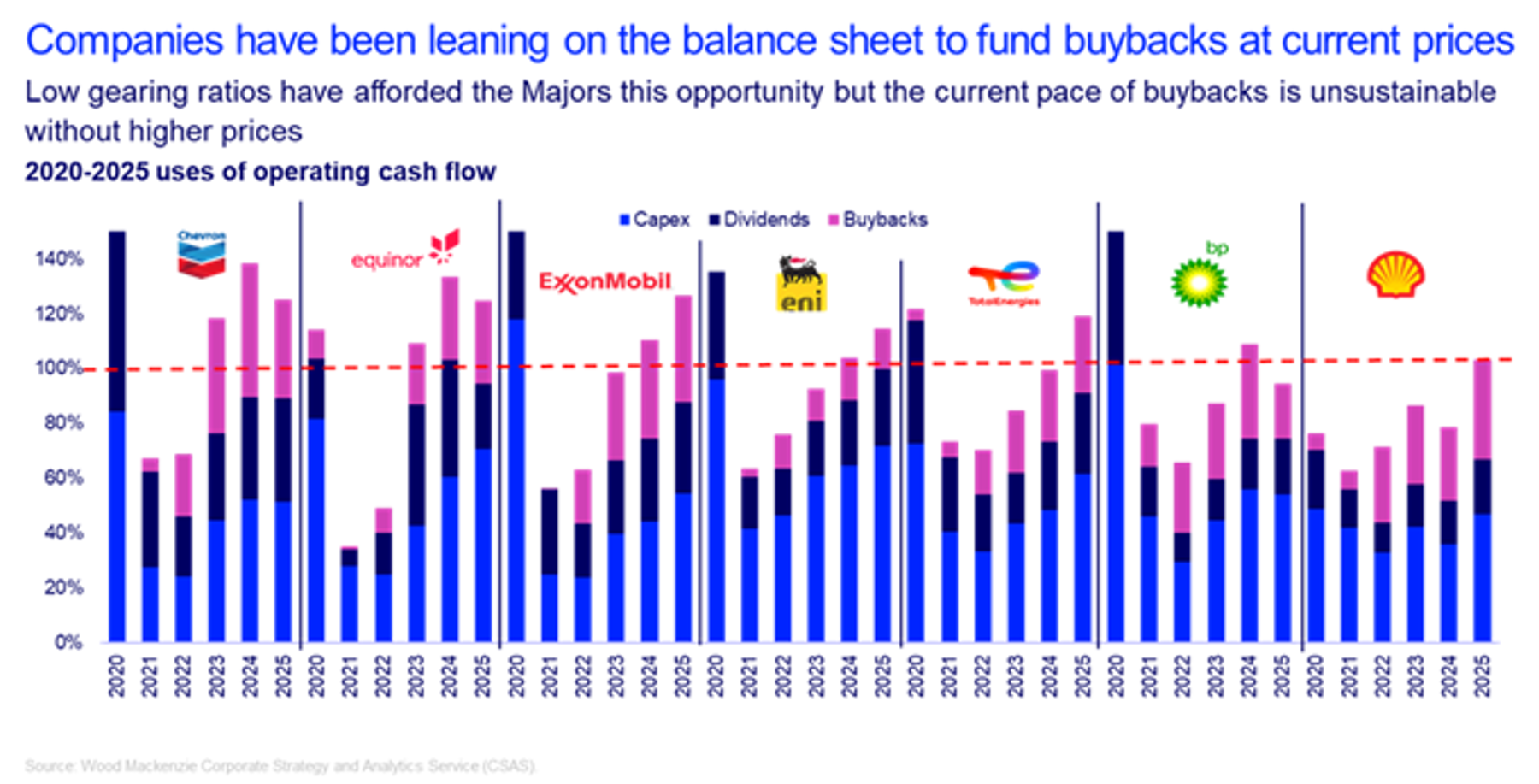
Buybacks are being wound back in a big way, with low oil prices limiting free cash flow after dividends. Collectively, the Majors have spent US$285 billion – 18% of the combined market cap – in the four years from 2022 to 2025. That bountiful period is now at an end.
Equinor announced a cut to its buyback, as did TotalEnergies, which is aiming to maintain gearing around its current 15%. BP ceased buybacks entirely to accelerate deleveraging and dropped its shareholder payout guidance. Expected full-year 2026 disposal proceeds totalling US$9 billion to US$10 billion will also support its net debt reduction. With a new Chair in 2025 and an incoming CEO (Meg O’Neill starts April 1st 2026) the company is shifting the investor story to a “unique, world-class” upstream opportunity set, built organically. A speedy strengthening of the balance sheet will provide the financial capacity to deliver.
What’s the latest on upstream portfolio renewal?
It’s the big theme strategically. Big Oil needs to avert declining production in the next decade, although the urgency to do so varies greatly by company. Shell, for one, was taken to task on its investor call about its weak post-2030 hopper.
The challenge is substantial. To fill the gap, the Majors will need to use a combination of discovered resource opportunities (DROs), M&A and exploration. Access to DROs is gaining momentum. In Libya, TotalEnergies and ConocoPhillips have both signed 25-year contract extensions, Chevron is a new entrant. Iraq is on the radar as is Venezuela though TotalEnergies, however, has downplayed the latter because of high costs (our view is that new project breakevens are US$80/bbl (real) on current fiscal terms).
M&A will inevitably play a part in portfolio building even if TotalEnergies observed that high-quality assets are expensive. Shell was candid about its willingness to make acquisitions but equally clear that it’s in no rush.
An emerging alternative to M&A is a pivot to execution focus, espoused by a Chevron bolstered by the Hess acquisition, Occidental, and ExxonMobil. ConocoPhillips made clear it’s not interested in M&A and plans to double free cash flow in the next four years via cost efficiencies and major project start-ups.
Exploration will play a prominent role in the resource renewal toolkit, evidenced by acreage reloading across the board. BP’s latest estimate for its 100%-equity Bumerangue discovery in Brazil in 2025 is 8 billion barrels of liquids in place. TotalEnergies envisages its huge Namibia discoveries, which have complex reservoirs, can grow into a multi-FPSO hub next decade.
Is low-carbon investment by the Majors dead?
Shrinking, but not quite dead. BP took an additional US$5.1 billion of write-downs in Q4 on its low-carbon assets. Equinor’s residual interest in low carbon is solely to deliver existing renewables projects – additional investments are off the table. In stark contrast, TotalEnergies delivered US$2.6 billion of operating cash flow and a 10% ROACE in Integrated Power, both in line with guidance.
What are the Majors’ aspirations for data centres and AI?
Meeting data-centre energy demand is an emerging growth theme. TotalEnergies is scaling up its data centre business with Big Tech to capture a pricing premium. The US Majors are well placed. ExxonMobil, for example, hopes to sanction its first decarbonised data centre project, deploying carbon capture and storage, by the end of 2026. Most companies talked about the opportunity in AI, though it’s still early days. Equinor reckons it has already benefitted by NOK1 billion (US$100 million) in cost improvements from AI, with more to come. TotalEnergies plans to invest US$1 billion in its AI strategy between 2026 and 2028. Its view is that using AI to increase plant uptime (refineries, power generation, liquefaction) may have the biggest positive impact near-term.
What does the latest US E&P consolidation deal tell us?
The Devon-Coterra deal has created another “elite” E&P, confirmation that scale matters to the market. Almost all of the companies in that lower large-cap oil-focused group have either been acquired (Noble, Concho, WPX, Cimarex, Hess, Marathon Oil) or found a way to grow into US$60 billion-plus “elite” Enterprise Value scale (Diamondback, EOG, Devon-Coterra).
Could this current phase of sector consolidation usher in a new one, the Majors looking at acquisitions in that elite group of E&Ps to help address their longevity challenge?
Thanks to: Tom Ellacott, David Clark, Luke Parker, Greig Aitken, Alex Beeker, Vishabh Soni

Make sure you get The Edge
Every week in The Edge, Simon Flowers curates unique insight into the hottest topics in the energy and natural resources world.
Sign up today using the form at the top of the page.