



Horizons Live: Breaking the speed limit | Webinar replay
On demand webinar: can US data centre development outpace grid development?
2 minute read

Chris Seiple
Vice Chairman, Energy Transition and Power & Renewables
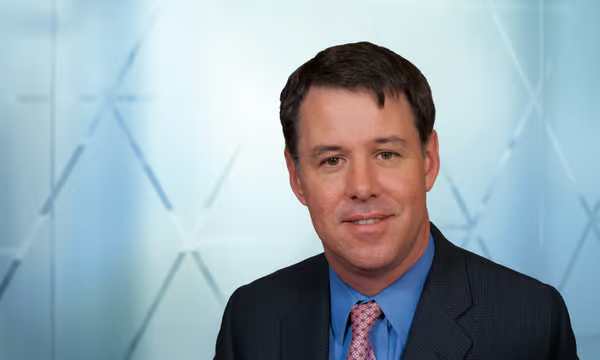
Chris Seiple
Vice Chairman, Energy Transition and Power & Renewables
Chris brings more than 30 years of global power industry experience to his role.
View Chris Seiple's full profile
Ben Hertz-Shargel
Global Head of Grid Transformation & Large Loads
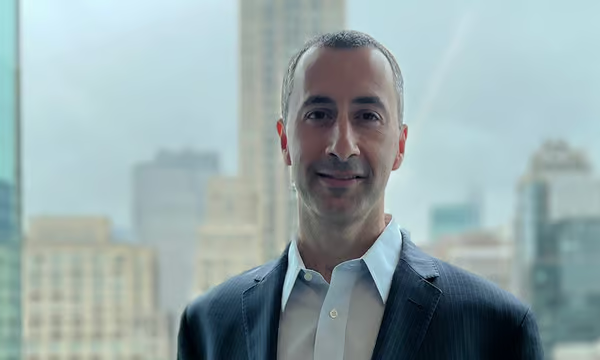
Ben Hertz-Shargel
Global Head of Grid Transformation & Large Loads
Ben leads research across electrification, data centres, grid modernisation, distributed energy resources and VPPs.
Latest articles by Ben
-
Opinion
Horizons Live: Breaking the speed limit | Webinar replay
-
Opinion
Reality bytes: the US data centre pipeline additions halved in Q4 2025 compared to the previous quarter
-
Opinion
‘Access to power’ has become ‘access to energy’
-
The Edge
How data centre growth is driving up US power prices
-
Opinion
Virtual power plant growth is getting very real
-
Opinion
US utility large-load pipelines: a reality check
This month’s Horizons report explores one of the defining infrastructure challenges of the AI era: whether US power systems can scale quickly enough to support explosive data centre growth. Our Horizons Live brought together an expert panel that debated the key points from the report and answered your questions live.
Key themes included:
- The race for grid power: how transmission build-outs and generation shortages are shaping data centre development timelines across US power markets
- The limits of deregulated markets: why PJM, ERCOT and other regions face growing tension between affordability, reliability and investment incentives
- Conditional interconnection and collocation strategies: how developers are using onsite generation and flexible load arrangements to accelerate deployment
- Technical and operational risks: the engineering challenges associated with collocating volatile AI workloads with gas generation and battery systems
- Regulatory uncertainty and market intervention: how evolving grid rules could reshape project economics, asset valuations and long-term infrastructure planning
- Implications for developers and investors: which business models are best positioned to scale as the AI-driven power demand boom accelerates
The panel:
- Chris Seiple, Vice Chairman, Energy Transition and Power & Renewables
- Ben Hertz-Shargel, Global Head of Grid Transformation & Large Load
- Nina Sadighi, Founder of Eradeh Power Consulting