



Energy transition outlook: Africa
Africa will shape the next phase of global energy demand growth
4 minute read

Roshna N
Research Analyst, Energy Transition

Roshna N
Research Analyst, Energy Transition
Roshna N specialises in integrated energy and emission models for Asia-Pacific and African markets.
Latest articles by Roshna
-
Opinion
How is energy transition investment evolving in 2026?
-
Opinion
Energy transition outlook: Asia Pacific
-
Opinion
Energy transition outlook: Africa
-
Opinion
What are the energy transition technologies to watch in 2025?
-
The Edge
How the world gets onto a 1.5 °C pathway
-
Opinion
What would it take for India to reach net zero emissions?

Prakash Sharma
Vice President, Head of Scenarios and Technologies

Prakash Sharma
Vice President, Head of Scenarios and Technologies
Prakash leads a team of analysts designing research for the energy transition.
Latest articles by Prakash
-
Opinion
Rising demand for nuclear fuels: security, supply and the AI power boom
-
The Edge
Will falling populations reshape energy demand?
-
Opinion
How is energy transition investment evolving in 2026?
-
The Edge
How the Iran war could change energy markets
-
Opinion
Energy transition outlook: Asia Pacific
-
Opinion
Energy transition outlook: Africa
Over the coming decades, Africa will play an increasingly central role in shaping fuel markets, investment flows and emissions trajectories.
Yet Africa enters this moment from a position of deep structural scarcity. It has the world’s lowest per-capita energy consumption, limited industrialisation and the fastest population growth globally. The defining risk is not carbon lock-in but growth lock-out, with economic development constrained by insufficient energy supply, infrastructure and capital.
Our latest Energy Transition Outlook (ETO) draws on Wood Mackenzie Lens Energy Transition Scenarios to map four distinct routes through the global transition with increasing levels of ambition. Our regional updates examine how these pathways unfold at country level, reflecting differing resource endowments, policy environments and development priorities.
You can access a complimentary extract from the Africa 2026 update by filling in the form at the top of this page. Below, we introduce some of the key themes shaping Africa’s outlook.
Africa as the centre of incremental demand
As demand growth plateaus in mature economies, Africa becomes the dominant source of global energy demand growth. Rapid population expansion, urbanisation and rising incomes drive this shift, even though the continent starts from a very low consumption base. Per-capita energy use remains a fraction of that in the US, EU and China, underscoring both the scale of unmet demand and the magnitude of future expansion.


Both renewables projects and fossil fuel production slowed in 2024 in many parts of Africa
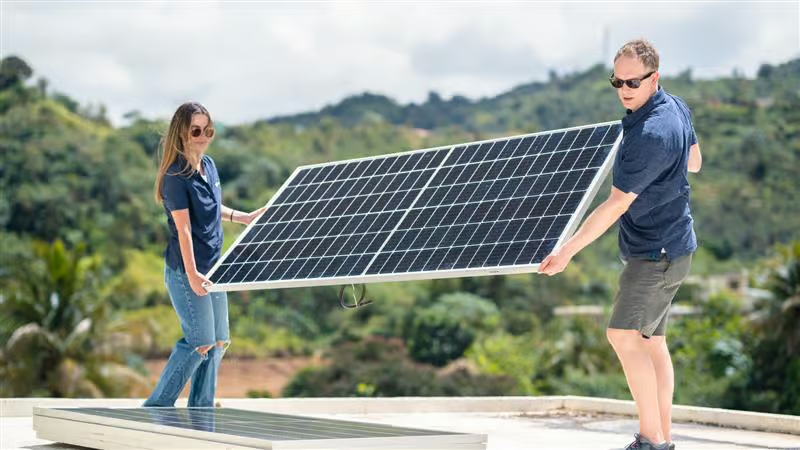
Africa saw a drop in renewable energy installations in 2024. Solar capacity additions were around 3.5 GW in 2024 compared to 4 GW in 2023. Moreover, most of the installations were concentrated in South Africa.
Meanwhile, oil and gas production in the Sub-Saharan African region grew by 5% in 2024. This increased output was due to production growth in Nigeria, Senegal, Congo, Mozambique and Côte d'Ivoire. However, production of gas in Egypt, Algeria and Libya dropped compared to 2023.
Meanwhile, the demand gap remains deeply concerning. Around 42% of the continent’s population lacks access to electricity and nearly 70% lack access to clean cooking fuels.
Africa's emissions will continue to rise if its energy mix and consumption patterns remain unchanged
Improving energy access is a clear priority. However, greater emphasis must also be placed on low-carbon energy and efficiency to curb emissions and air pollution growth effectively.
Transitioning from bioenergy to electricity offers significant efficiency advantages, reducing the primary energy required to meet demand. Additionally, this shift provides critical benefits by lowering indoor air pollution and mitigating associated health risks.
Bioenergy demand currently constitutes 81% of residential, commercial and agriculture (RCA) energy demand. In our base case, this only declines to 70% by 2050, primarily as clean fuels growth fails to match the rising energy demand driven by population growth. Under a net zero scenario, bioenergy's share drops to 50% by 2050.
Funding will be key to realising Africa’s climate and development objectives. Africa desperately needs substantial external sources of low-cost financing – a major challenge when capital costs for African projects are often up to three times those of other countries. To date, it has received only a small portion of the promised annual US$100 billion in climate finance from OECD countries.
Get a closer look at Africa’s energy transition scenarios
The full report – updated for 2025 – explores these themes and more in detail, tackling key questions including:
- What is the outlook for commodity demand and the power supply mix under our base case, country pledges, net zero by 2050 and delayed energy transition scenarios?
- How much renewables, hydrogen and carbon capture do we expect to see deployed in the region to offset the potential decline in fossil fuel consumption?
- What is the scale of the financing challenge in Africa – and how might it be solved?