




Discuss your challenges with our solutions experts
Gulf Coast Express expansion begins commissioning
Early Permian takeaway signals begin to shift pricing
2 minute read

Daniel Myers
Senior Research Analyst, North America Gas

Daniel Myers
Senior Research Analyst, North America Gas
Daniel delivers short-term fundamental modelling and regional market analysis.
Latest articles by Daniel
-
Opinion
The Blackcomb question: can the pipeline reach its full 2.5 bcfd capacity at startup?
-
Opinion
Gulf Coast Express expansion begins commissioning
-
Opinion
US gas prices slide as storage expectations tighten: what it means for summer 2026
-
Opinion
Natural gas futures shrug off winter storm impact despite storage drawdown
-
Opinion
Winter Storm Fern shuts in 18.3 bcfd of US gas production at its peak
-
Opinion
US L48 gas: injection season ends

Vania Lara
Research Analyst

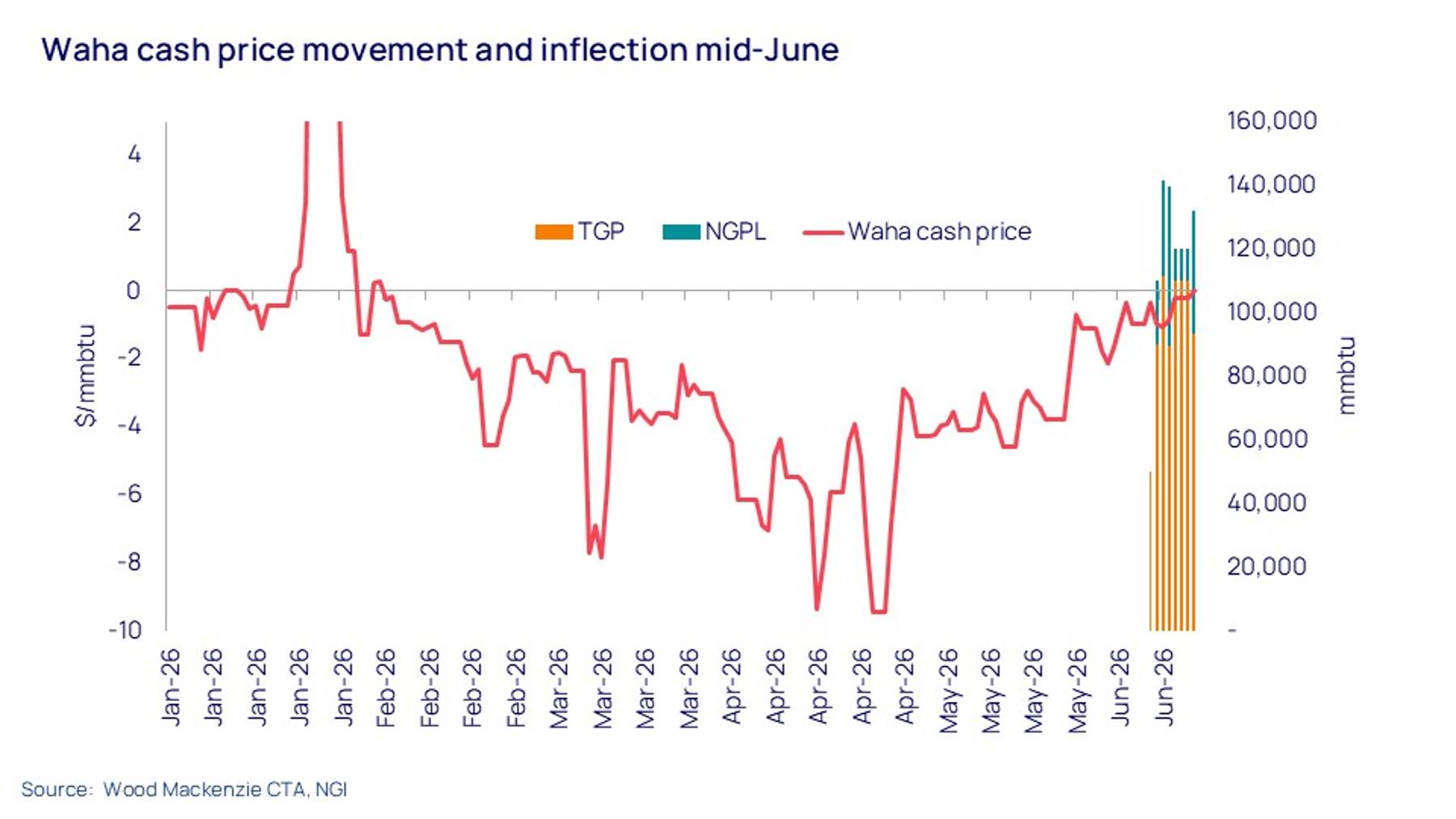
On 9 June 2026, two new nomination points linked to the Gulf Coast Express (GCX) expansion appeared in South Texas near Agua Dulce. Initial nominations were 50,000 MMBtu/d into TGP, followed by 20,000 MMBtu/d into NGPL on 10 June.
The expansion adds 570 mmcfd of incremental capacity, increasing total GCX system capacity to approximately 2.57 bcfd from Waha to Agua Dulce.
At the same time, Waha cash prices responded—rising above zero to $0.315/MMBtu for flow-date 16 June. This follows a prolonged period of weakness, with more than 130 consecutive days of negative pricing in 2026 and a record low of -$9.52/MMBtu on 16 April.
Our take
Early flows are already proving commercially meaningful. Waha prices moved from -$1.03/MMBtu on 8 June to -$0.34/MMBtu on 9 June, reaching positive territory by 16 June for the first time since February.
Nominations into NGPL and TGP confirm that commissioning is underway and point to early signs of wider Permian debottlenecking.

Relief, but not resolution
Despite the initial price reaction, the underlying imbalance remains. Permian production is currently around 24 Bcf/d and is expected to exceed 29 bcfd by 2030.
While capacity additions are forecast to outpace production growth by 2027, the GCX expansion represents an early step toward closing the takeaway gap rather than a full solution.
What comes next
Further infrastructure will be required to sustain price normalization. The next wave of projects—including Blackcomb Pipeline and Hugh Brinson Phase 1—is expected to add around 4 bcfd of additional takeaway capacity before year-end.
Until then, pricing dynamics are likely to remain sensitive to incremental capacity additions and commissioning progress rather than reflecting a fully rebalanced market.
Looking beyond the expansion
The Gulf Coast Express expansion has delivered immediate relief to the Permian market, but the broader takeaway challenge remains unresolved. While new capacity is beginning to ease constraints, future pricing will continue to depend on commissioning progress, infrastructure delivery and the pace of production growth across the basin.
With projects such as Blackcomb Pipeline and Hugh Brinson Phase 1 still to come, market participants will be watching closely to see whether additional takeaway capacity can keep pace with rising supply.
Understanding how these developments translate into market outcomes requires visibility across infrastructure, flows and fundamentals.
Learn more about Commodity Trading Analytics