




Discuss your challenges with our solutions experts
US utility sector supplier diversity: sustained momentum amid political transition
Diverse supplier spend holds steady even as federal DEI policy shifts create uncertainty across the private sector
3 minute read

Angela Cosme
Data Associate, Supply Chain Market Intelligence

Angela Cosme
Data Associate, Supply Chain Market Intelligence
Devin leads our supply chain group and leads on creating new or improved supply chain products and research.
Latest articles by Angela
View Angela Cosme's full profile
Cliff Moore
Manager, Supply Chain Data and Analytics
Cliff Moore
Manager, Supply Chain Data and Analytics
Cliff is the lead analyst for Wood Mackenzie’s Supply Chain Carbon (Scope 3) and Risk insights.
Latest articles by Cliff
-
Opinion
US utility sector supplier diversity: sustained momentum amid political transition
-
Opinion
Cross purchases: how trends in supplier acquisitions are affecting utility spending
-
Opinion
Critical risk: cracking down on the use of forced and child labour in supply chains
Major US utilities maintained supplier diversity spending levels in 2025 despite significant changes in the broader DEI policy environment. On average, diverse suppliers represented 12.5% of sourceable supply chain spend across major US utilities in 2025. California utilities averaged 26.1%, while non-California utilities averaged 8.8% - both consistent with 2024 levels. This stability, in the context of federal policy changes and continued procurement growth, underscores the resilience of utility supplier diversity programs.
State regulation continues to shape procurement
The Trump administration's January 2025 Executive Orders on DEI introduced uncertainty for diversity and procurement programs across much of the private sector. While many organizations reassessed DEI-related policies and investments, the impact on utility procurement practices appears to have been comparatively limited.
Utilities are primarily regulated at the state level. Frameworks such as California's CPUC General Order 156, which requires utilities to track and disclose spending with diverse suppliers, continued to shape procurement behavior throughout 2025. States including New York and Illinois maintain similar requirements, providing a regulatory foundation that operates independently of federal policy. In addition, many utilities entered the year with supplier diversity objectives and procurement budgets already in place, helping sustain diverse supplier spending levels through the year.
Diverse spend remained stable in 2025
In 2025, California utilities maintained diverse spend between 25% and 28%, while non-California utilities remained between 8% and 10%. Both regions saw modest Q4 dips, suggesting a potential year-end effect in which fourth-quarter procurement activity shifts towards larger, non-diverse contracts. The gap between California and non-California remained largely unchanged over the year, consistent with structural differences in state-regulatory frameworks.

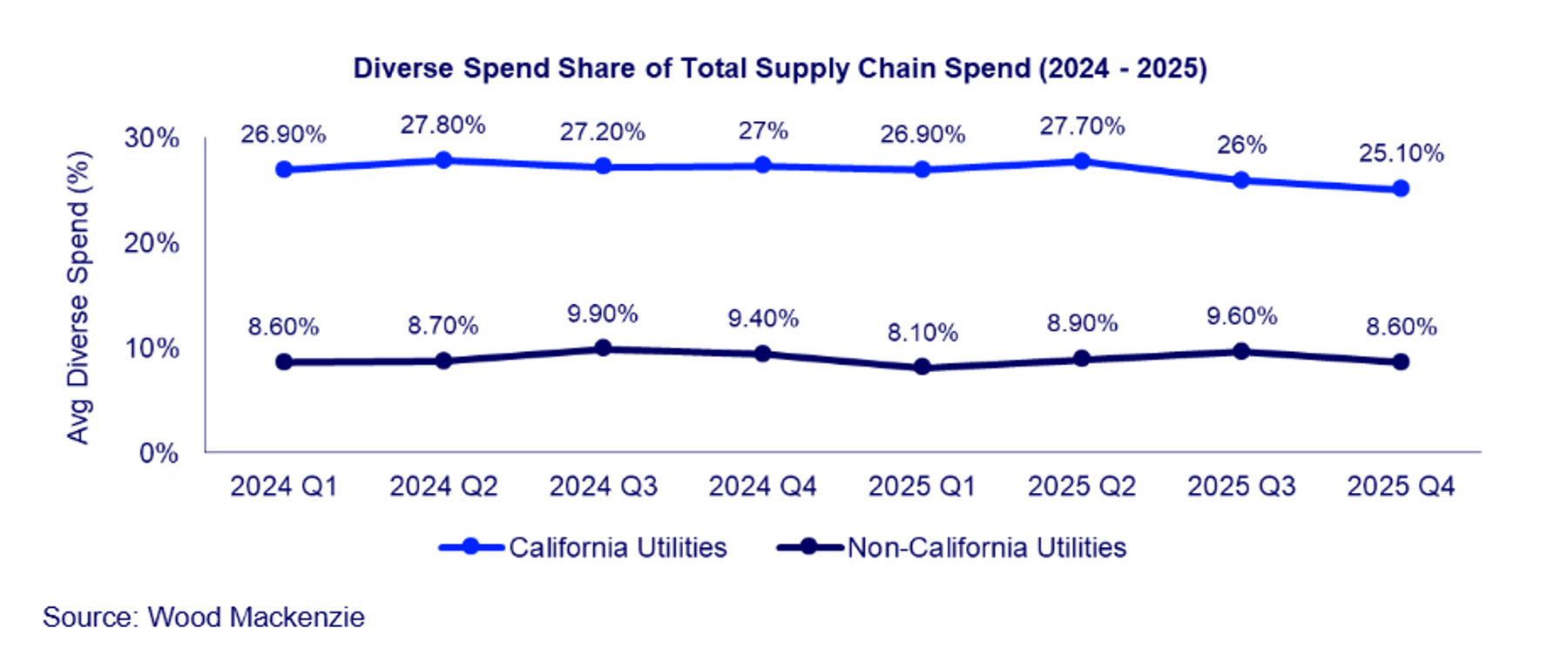
The stability observed across both regions appears largely structural. As total supply chain spend expands, diverse spend must grow at an equal or faster rate simply to maintain its share. At the same time, the share of diverse suppliers decreased by 2.2%, suggesting utilities are concentrating spend among established suppliers with proven delivery capabilities rather than broadly expanding their diverse supplier base.
Construction, engineering and technical services, industrial services, and maintenance consistently account for a high share of both total and diverse supplier spend across utility supply chains. This combination, along with a substantial and growing pool of qualified diverse suppliers, makes these categories the most practical starting point for expanding diverse supplier participation.
Drivers for future performance
Wood Mackenzie expects diverse spend to remain stable through 2026. California utilities are well-positioned to deepen existing supplier partnerships, while non-California utilities have a strong foundation for growth as state regulatory frameworks continue to evolve. At the same time, ongoing grid modernization and Infrastructure Investment and Jobs Act (IIJA)-driven investment in battery storage, EV charging, and digital grid infrastructure are expanding procurement into new categories, creating additional opportunities for diverse suppliers.
Demand for ESG disclosure from institutional investors is also increasing, with diversity data widely integrated into reporting expectations. Utilities with strong spend tracking capabilities are better positioned to meet these requirements. Overall, supplier diversity programs across US utilities remain structurally supported and stable, shaped by state-level regulatory frameworks and procurement capabilities.