




What growing demand and large-load dynamics mean for US gas and power
Concentrated demand from data centres is amplifying price and basis risk, while demand growth from both large loads and LNG will lead to structurally higher prices
1 minute read

Rebekah Llamas
Head of Market Intelligence, Power Markets Research

Rebekah Llamas
Head of Market Intelligence, Power Markets Research
Rebekah oversees our Short-term Market Intelligence Team for North America.
Latest articles by Rebekah
-
Opinion
US power market outlooks Winter 2025/26: hot topics for MISO, NYISO and PJM
-
Opinion
What growing demand and large-load dynamics mean for US gas and power
-
Opinion
Powerhouses: monitoring grid developments from Texas to California and beyond
-
Opinion
Infographic | Nodal Price Forecast for ERCOT
-
Opinion
H2 2025: a power trader’s guide
-
Featured
Oil, power, gas trading 2025 outlook

Randall Collum
Senior Vice President, Commodity Trading Data and Analytics

Randall Collum
Senior Vice President, Commodity Trading Data and Analytics
Randall is an experienced analyst with more than 20 years of experience in natural gas and oil production analytics.
Latest articles by Randall
-
Opinion
What growing demand and large-load dynamics mean for US gas and power
-
Opinion
North America natural gas summer market outlook – 2025
-
Featured
Oil, power, gas trading 2025 outlook
-
Opinion
4 critical moments for North American oil and gas trading
-
Opinion
5 factors affecting North American natural gas markets this winter
-
Opinion
What does summer 2024 hold for North American gas and LNG?

Amir Rejvani
Senior Research Analyst, LNG and Intrastate Storage

Amir Rejvani
Senior Research Analyst, LNG and Intrastate Storage
Latest articles by Amir
-
Opinion
What growing demand and large-load dynamics mean for US gas and power
-
Opinion
What does summer 2024 hold for North American gas and LNG?
-
Opinion
Cold weather impacts on US natural gas
-
Opinion
US LNG maintenance forecast | On-demand webinar
The structural growth in electricity demand driven by the rapid pace of data centre and other large-load buildout is getting a lot of attention among power market stakeholders. So, what are the consequences for real-time dynamics of adding these huge sources of demand to existing networks? And can domestic production meet significant demand growth from both LNG production and power generation?
Gas production and pricing and the impact of large-load real-time behaviour on power markets were key themes at our recent Power and Gas Trading Conference in Houston. Fill out the form at the top of the page to download slide decks from the event covering these and other topics, or read on for a brief overview.
Theme 1: The impact of large loads on power markets
Large loads are the new volatility source for power trading
Power market traders are used to tracking a range of issues that can impact real-time pricing in energy markets, from generating facility downtime, network outages and renewables intermittency to more serious weather-related disruption. However, our real-time analysis of US power markets shows that large-load behaviour is driving a critical shift, with large loads increasingly a major source of volatility.
Our case studies of the Lake Mariner Data Center in upstate New York and Meta’s 2.5 million square feet Henrico Data Center campus in Virginia show these single facilities are the source of massive, un-forecasted load swings. Lake Mariner executed 13 demand response events in July 2025 alone, more than twice the number of Emergency Actions taken by NYISO, the regional independent system operator. With the Lake Mariner campus representing around 9% of Zone A demand in NYISO, demand fluctuations at the facility are having clear price impacts.
Concentrated demand amplifies congestion risk
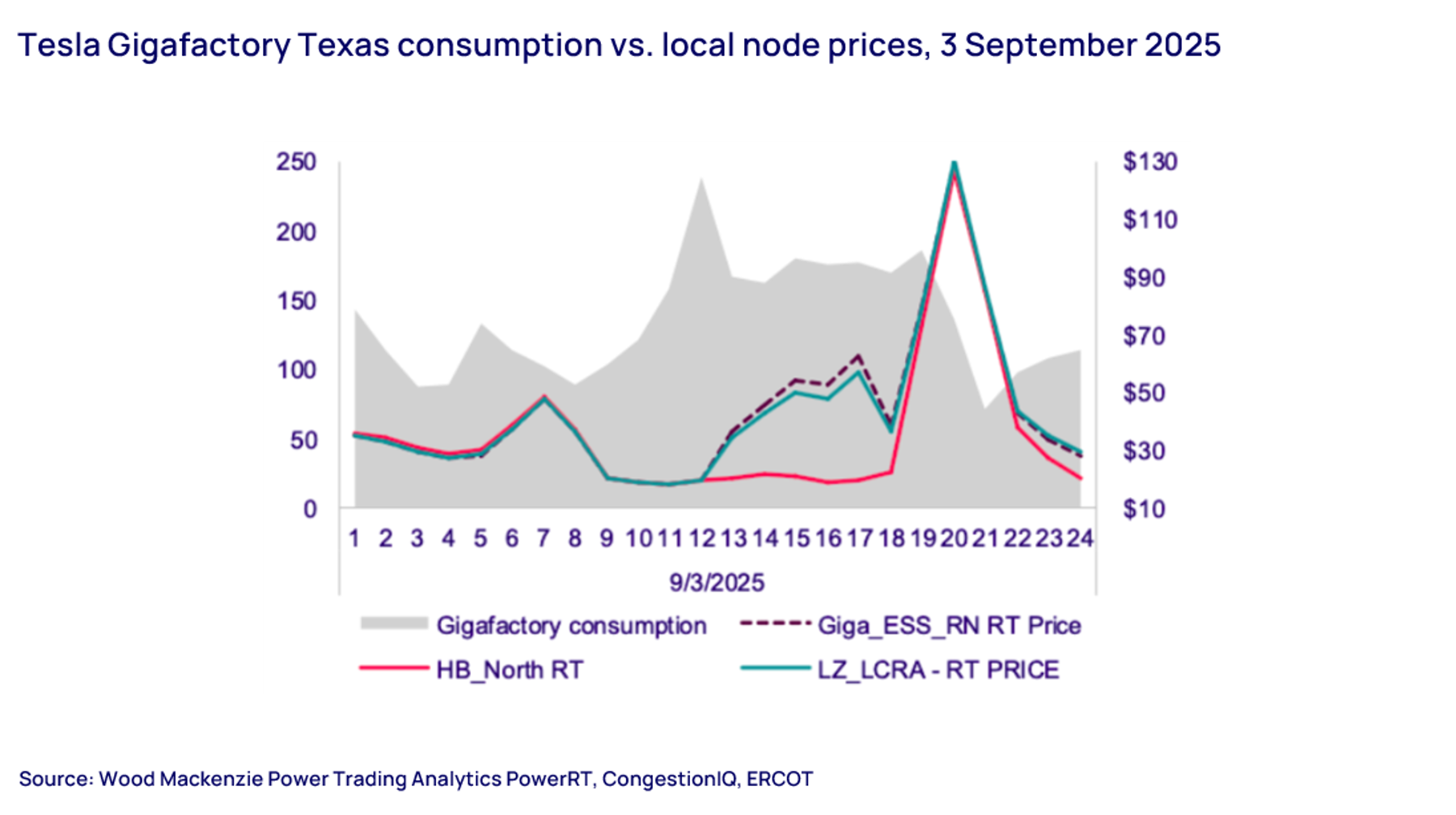
Real-time power market dynamics driven by Tesla’s Gigafactory in Austin Texas highlight a further issue caused by concentrated demand from large loads: the amplification of congestion risk. This huge manufacturing facility employs around 20,000 people and is the world’s second largest building by volume. The site has an assumed consumption capacity of around 250 MW, with onsite solar generation and battery storage helping to reduce the amount of power drawn from the grid during peak summer pricing.
Fluctuating demand and generation at the facility bring congestion risk. For example, during the first week of September 2025, a constraint in Bell County coupled with a long-standing line outage in the area resulted in elevated real-time prices for the plant throughout peak consumption hours (see dotted lines on the chart below). This demonstrates how concentrated demand coupled with onsite generation can be susceptible to basis risk, that must then be managed around.

Real-time visibility into un-forecasted load ramps gives traders the edge
The ability to monitor and detect un-forecasted load ramp-ups and ramp-downs caused by large-load facilities like Lake Mariner and Gigafactory Texas is a vital advantage in fast-moving power markets. Wood Mackenzie’s PowerRT solution provides the real-time visibility traders need to act quickly and exploit trading opportunities as these events unfold. At the same time, our new Nodal Price Forecast for ERCOT leverages our congestion expertise, allowing large load facilities to manage basis risk while enabling traders to capture spreads ahead of the market.
Theme 2: Meeting growing gas demand from LNG and data centres
US LNG production continues to grow
Several major projects have contributed to US LNG export capacity growing by over 30% year on year. Work has progressed ahead of schedule on the third phase of Cheniere’s Corpus Christi Liquefaction facility in Texas, with four of seven trains already online. At Venture Global’s Plaquemines LNG plant, all trains are online, with power island commissioning ongoing. And at ExxonMobil and QatarEnergy’s Golden Pass joint venture in Texas, Train 1 (of three) is expected to begin liquefaction around the end of the year.
Can gas prices incentivise enough production to meet LNG growth?
Based on projects under construction or nearing a final investment decision, we forecast durable growth in US LNG production, with an additional 18 billion cubic feet per day (bcfd) of capacity becoming operational over the next ten years.
Gas production and LNG exports have become increasingly interconnected over the past few years, with the US Lower 48 and Western Canada effectively turned into synthetic storage, adapting daily production to ongoing demand. At the moment, gas prices are incentivising enough production to meet current growth expectations for increased LNG production, with supply from Haynesville, Marcellus/Utica and Permian plays expected to increase steadily. However, if incremental gas supply is needed to meet additional demand growth from large loads, higher prices will be required.
Can gas production grow as needed to meet large-load demand growth?
In theory, domestic gas production should be able to grow to meet the significant added power demand from the growth in data centres and other large industrial loads. Pipeline capacity could present an obstacle to supply growth; for example, there are limits on export capacity in the Marcellus/Utica. However, local demand growth should debottleneck the region and allow for more production growth. Increasingly, the availability of gas as an electricity generating resource will be a key factor in the siting of data centres and other large-load facilities.
Wood Mackenzie’s gas market data gives you an edge
Our weekly production and demand forecast updates are driven by prices and economics. If you want to stay on top of how real-time price changes impact the outlook for gas markets and gain a competitive edge, find out more about our North America Gas Service.
Learn more
Don’t forget to fill out the form at the top of the page to gain access to the full slide decks. These include a range of charts and data exploring gas and LNG production and large-load dynamics in more detail. Other topics covered include a Summer 2025 US power market recap - and a look ahead to how forecasted weather may impact electricity demand this winter.