


Sign up today to get the best of our expert insight in your inbox.
Is there still life in decarbonising hard-to-abate sectors?
Europe and China carry the torch as global investment slows
1 minute read

Simon Flowers
Chairman, Chief Analyst

Simon Flowers
Chairman, Chief Analyst
Simon is our Chief Analyst; he provides thought leadership on the trends and innovations shaping the energy industry.
View Simon Flowers's full profile
Kian Akhavan
Consultant, EMEA

Kian Akhavan
Consultant, EMEA
Kian is a specialist in public policy, with a focus on public-private partnerships.
Latest articles by Kian
-
The Edge
Is there still life in decarbonising hard-to-abate sectors?
-
Opinion
Reassessing Canadian Export Infrastructure
-
Opinion
Evaluating infrastructure and optionality in Canadian hydrocarbon exports
-
Opinion
How public-private partnerships can accelerate the energy transition

Prakash Sharma
Vice President, Head of Scenarios and Technologies

Prakash Sharma
Vice President, Head of Scenarios and Technologies
Prakash leads a team of analysts designing research for the energy transition.
Latest articles by Prakash
-
The Edge
How the Iran war could change energy markets
-
Opinion
Energy transition outlook: Asia Pacific
-
Opinion
Energy transition outlook: Africa
-
Opinion
Energy transition outlook: Middle East
-
Opinion
Energy transition outlook: UK
-
The Edge
Is there still life in decarbonising hard-to-abate sectors?
Confidence has waned that the goals of the Paris Agreement – to limit the global temperature increases to 2 °C or lower by 2050 – can be achieved. Wood Mackenzie’s base case shows that the world is currently on a 2.6 °C pathway, edging higher than our previous analysis.
Displacement of fossil fuels is just not happening. Scalable, market-competitive low-carbon technologies, including renewables, are merely complementing oil, gas and coal in helping to meet growth in global energy demand. It’s an energy addition, rather than transition.
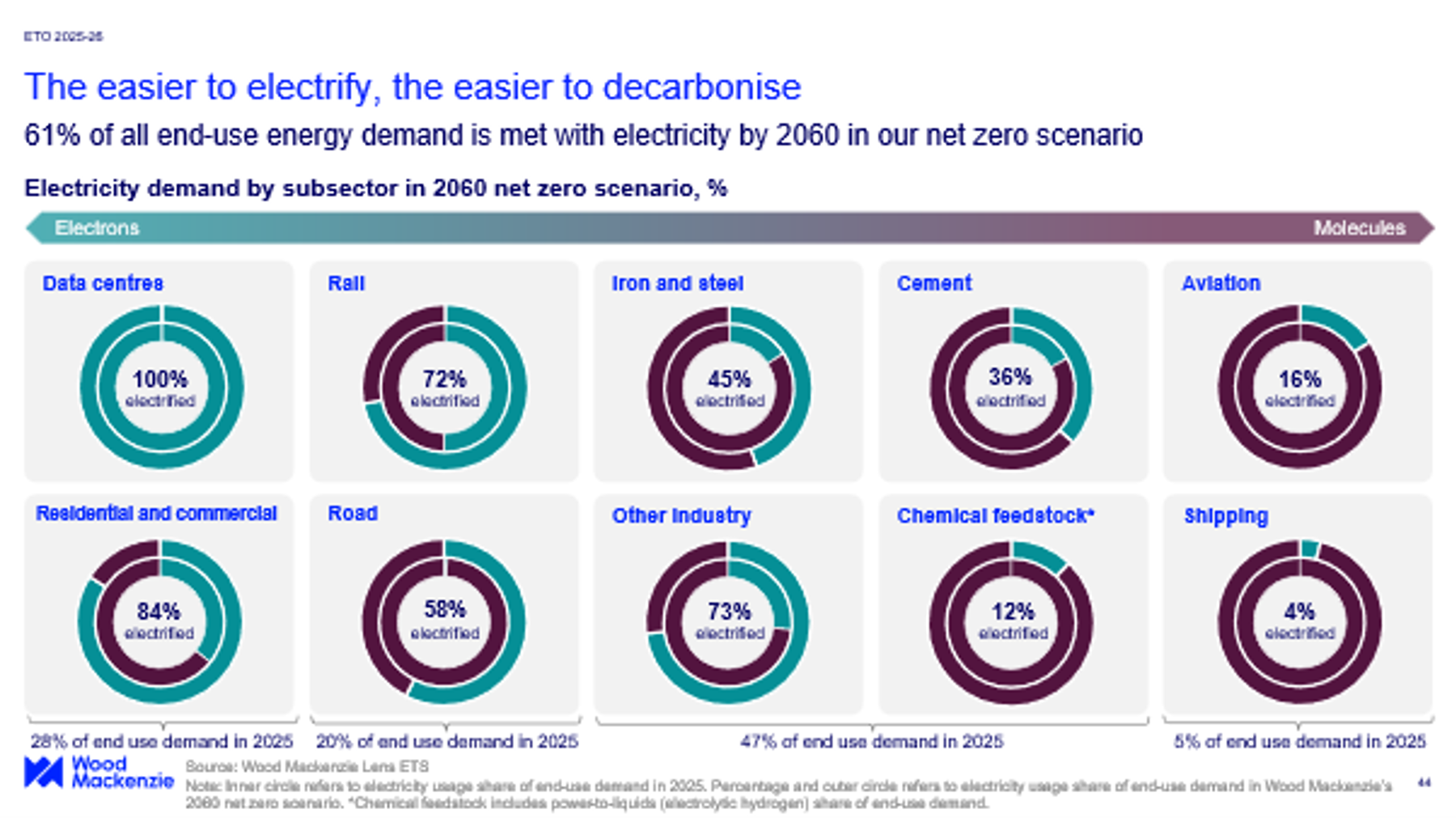
What hope, then, for the most hard-to-abate sectors, including steel, cement, aviation, shipping and chemicals? These economically vital industries are carbon intensive and lack a clear, commercially viable path to decarbonisation, creating a thorny problem for years to come. While we project absolute emissions from hard-to-abate sectors to fall through 2050 they do so more slowly than other sectors, and their combined share of global carbon emissions rises from 21% today to 27% by 2050.
Solutions do exist. Low-carbon fuels – including biofuels (aviation), hydrogen or electrification (steel) or calcined clays (cement) – are one option. Carbon capture, utilisation and storage (CCUS) bolted onto legacy fossil fuel-based operations (steel, cement) is another. High costs, however, remain the major hurdle to commercialisation and industrial scalability. Policy shifts, not least in the US after 2025’s One Big Beautiful Bill Act, have also dampened the industry’s appetite for investment.
But all is not lost. Kian Akhavan, Downstream Consulting, and Prakash Sharma, Energy Transition Service, identify Europe and China as showing the most promise in tackling the decarbonisation of hard-to-abate sectors.
Europe is the crucible for this decarbonisation effort, based on its bold policy initiatives
The EU’s Emissions Trading Scheme (ETS), the Carbon Border Adjustment Mechanism (CBAM) and ReFuelEU have laid a foundation globally to push for decarbonising aviation and shipping fuels, steel and cement.
ReFuelEU’s provisions feature ambitious sustainable aviation fuel (SAF) adoption targets, including a 70% share of SAF in all EU airports by 2050. This has created a premium export market for regions that produce large volumes of SAF. With both the UK and EU excluding SAF from their anti-dumping legislation, China could redirect biodiesel feedstock to produce and export SAF to European markets as it continues to rapidly accelerate its SAF production capacity. For producers within Europe, the EU continues to strengthen policy support for SAF, including a 20% capex subsidy for new projects.
Despite producing a relatively modest percentage of the world’s steel, Europe is also well ahead in decarbonising its steel sector. Much of Europe’s blast furnace fleet is approaching end of life, creating an opportunity to replace ageing fossil fuel-fired furnaces with lower-carbon technologies. The EU ETS and public funding have also encouraged producers to take an early lead in green steel projects.
Even so, progress in Europe has struggled to build momentum. Only 10 to 12 Mt (Tata Steel UK, Hy4Smelt, Stegra and SSAB) of the 45 Mt of mooted green steel projects have moved to construction, the rest paused or cancelled. Persistent high gas and power costs have been a factor.
EU ETS and CBAM regulations have helped to put European cement producers ahead of international rivals on decarbonisation. Many European companies are transitioning to lower-carbon feedstocks, with an estimated 55% of total feedstocks already replaced by waste-derived alternatives. Some projects have achieved up to 90% substitution rates. These same producers are also expected to operate 36 Mtpa of CCUS capacity, 75% of total global capacity through 2032.
Highlights among cement decarbonisation projects include Heidelberg Materials Brevik project in Norway (commissioned) and Padeswood in the UK (under construction). Holcim’s Greek Olympus project (under construction) is expected to be the first net zero cement plant.
China could be the global game changer
The world’s largest emitter is also the largest producer of cement, iron, steel and chemicals and home to the world’s largest shipping industry and the second-largest aviation industry.
At COP30, China signalled its intent by announcing a target to reduce its absolute carbon emissions by up to 10% over the next 10 years – equivalent to emissions reduction of roughly 1.2 billion tonnes of CO2e per year by 2035. China has already built out the supply chains to decarbonise road transport and power generation, including electric vehicles, battery storage and renewables.
The next step will be tackling China’s hard-to-abate sectors. While not leading in these sectors today, it is accelerating its rollout of the new decarbonisation technologies such as hydrogen-based fuels and carbon capture that have emerged elsewhere. The country’s track record and formidable industrial capacity suggests that it will likely introduce key tech quickly and become a sandbox for new approaches to decarbonising hard-to-abate sectors. It’s also yet another opportunity to assume global leadership in low carbon tech.
There are green shoots elsewhere, not least in the Middle East, though they remain modest. Green steel is a case in point: of 40 Mt of projects proposed across the region, Jindal’s hydrogen-ready 5-Mt project in Oman is the only one under construction.
Finally, momentum globally has undoubtedly slowed, but the decarbonisation of hard-to-abate sectors is far from dead. Policy initiatives, mandates and incentives are key to ensure investment picks up, with Europe and China likely front and centre in the next phase.
Thanks to contributors: Isha Chaudhary (steel), Ismael Justo-Reinoso (cement), John Ferrier (carbon management).

Make sure you get The Edge
Every week in The Edge, Simon Flowers curates unique insight into the hottest topics in the energy and natural resources world.
Sign up today using the form at the top of the page.