


The 3 challenges to exploiting Greenland’s rare earths
The region’s resources are a key focus of increasing geopolitical attention, but what real potential is there for extracting them?
1 minute read

Suzanne Shaw
Head of Energy Transition & Battery Raw Materials

Suzanne Shaw
Head of Energy Transition & Battery Raw Materials
Suzanne specialises in commodities including cathode and precursor, lithium, cobalt, graphite, rare earths and lead.
Latest articles by Suzanne
-
Opinion
The 3 challenges to exploiting Greenland’s rare earths
-
Opinion
How will the new US Republican government reshape the global electric vehicle supply chain?
-
Opinion
Four key takeaways from LME 2024
-
Opinion
Three challenges to overseas expansion for the Chinese cathode sector
-
Opinion
What’s next for the EV and battery value chains?
-
Opinion
Battery raw materials: tracking key market dynamics

Yue Wang
Senior Consultant, Rare Earths

Yue Wang
Senior Consultant, Rare Earths
Yue specialises in the rare earth market research and supporting cathode and precursor asset research.
Latest articles by Yue
View Yue Wang's full profile
David Riley
Senior Research Analyst, Rare Earths, Metals & Mining

David Riley
Senior Research Analyst, Rare Earths, Metals & Mining
David brings extensive experience in mined commodities research as a senior research analyst for the rare earths market.
Latest articles by David
View David Riley's full profileThe fast-moving world of global geopolitics has increasingly focused on Greenland in recent weeks. Aside from its geographical location between the US and Russia - and close to potential global shipping routes - a key motive for this interest is the region’s resources of oil and raw materials, particularly Greenland's rare earths. But how significant are these resources, and how easily could they be commercially exploited?
Greenland’s rare earth potential
The main area considered for rare earth development so far is the alkaline igneous Gardar region at the countries southern tip. Companies have been undertaking mineral exploration in Greenland for over a decade; yet there are currently no active mines, and most projects remain in early-stage development only. Among the most advanced are Energy Transition Metals’ (ETM’s) Kvanefjeld and Critical Minerals’ Tanbreez projects (see map below).

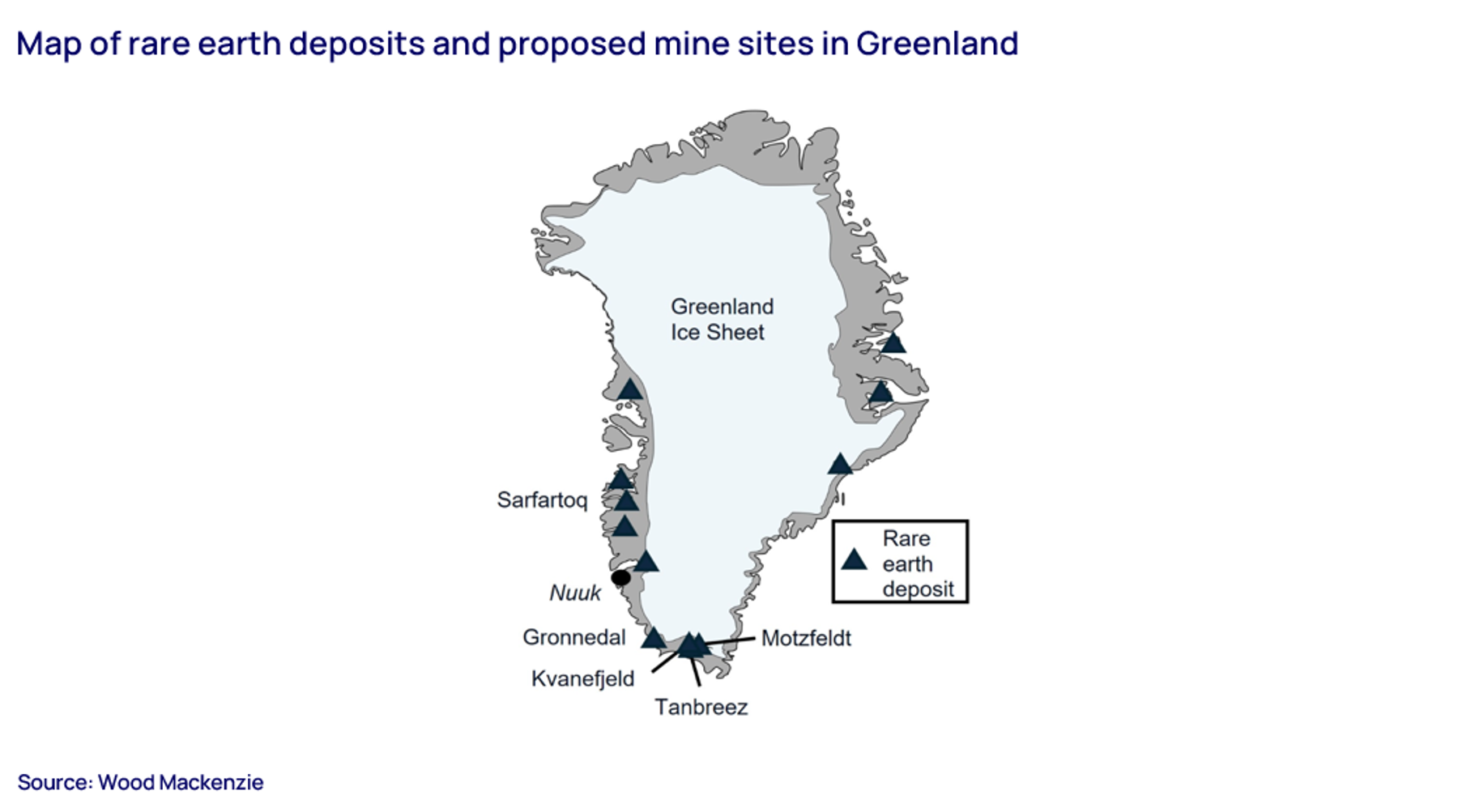
With the territory estimated to rank eighth in the world for rare earth resources and the world keen to diversify away from China, Greenland has the potential to become an important supplier of rare earths, whoever holds the reins. However, commercial-scale development of deposits is rarely easy, and fully exploiting Greenland’s minerals in particular will involve addressing significant challenges.
Challenge one: geography
Greenland’s harsh natural environment and permanent ice cap is a significant barrier to commercial development of deposits. While the ice sheet is expected to recede over the coming century, it will continue to cover most inland areas, limiting exploration to the coastal fringes.
Even on the coast, freezing temperatures, high snowfall and limited winter daylight will make industrial operations difficult. Only ports in the southwest of the territory can operate year-round; of these only Nuuk (see map) has modern port infrastructure, while ports near deposits in the south aren’t designed for commercial-scale export. Overall, existing infrastructure is limited and the local population is small; companies would therefore need to create their own transport and energy infrastructure and import a skilled labour force. All these issues can be overcome, but it will take time and money.
Challenge two: ESG
Mining development is a contentious issue in Greenland. In 2021, the Inuit Ataqatigiit party performed strongly on an anti-mining ticket, and while the more pro-development Democrats won most votes in 2025, the territory’s current minister of Industry, Raw Materials, Mining and Energy is affiliated to Ataqatigiit.
Having said that, Greenland’s Mineral Resource Strategy 2025-2029 recognises a need to attract international investment and encourage multilateral development of the mineral sector. The territory signed a memorandum of understanding with the US Government to cooperate on development back in 2019 - although efforts to renew the arrangement have stalled in the current geopolitical context.
It also has a strategic partnership with the European Union to develop sustainable raw materials value chains. However, with sustainability a key focus, any development will need to meet high standards for environmental and social impact.
Challenge three: geopolitics
Given Greenland’s geographical position between Europe and North America, rare earth mines could supply both regions. Sharing financing and risk could benefit both sides, supporting the EU to meet Critical Raw Materials Act (CRMA) targets while helping the US improve security of supply. However, this would require cooperation at a time when the relationship between the US and the EU is under strain.
China also has limited involvement in Greenland’s nascent mining sector; namely, a 6.5% ownership share of ETM that stems from an agreement to consider downstream processing of material from the Kvanefjeld project in China. While the Greenland government has made clear it favours Western partnerships, it has warned that hesitation could force the territory to seek development support from China.
How would a change in administration affect the situation?
President Trump’s designs on Greenland have been widely criticised by Greenland itself and Denmark (of which Greenland is an autonomous territory), as well as by the UK and EU. But what would be the impact of any takeover on mining development?
Based on the US Government’s strategy for Alaska, under American control, environmental compliance requirements would be relaxed. This would boost the Kvanefjeld project specifically, as its uranium-rich ores are currently affected by a law preventing uranium development. Direct US government intervention could also channel US capital, equipment, skilled labour and expertise in Arctic environments to the territory.
Given that Greenland is already open to US investment, any uplift from a change in administration may be limited, however. Ultimately, we expect the severe climate and high capital requirements, together with a lack of infrastructure and skilled labour, to be major limiting factors whoever runs the territory.
Learn more
To download your complimentary copy of the report, Polar prize?: The realities of developing Greenland's rare earth potential, fill out the form on this page.
Plus, learn more about Wood Mackenzie Lens Metals & Mining; the end-to-end data analytics solution to help you unlock high-quality insights across rare earths and other key mined commodities.