



Sign up today to get the best of our expert insight in your inbox
Ceasefire in the Middle East
How quickly could Gulf oil and gas supply recover?
1 minute read

Simon Flowers
Chairman, Chief Analyst

Simon Flowers
Chairman, Chief Analyst
Simon is our Chief Analyst; he provides thought leadership on the trends and innovations shaping the energy industry.
Latest articles by Simon
-
The Edge
How the Iran war could change energy markets
-
The Edge
How war in the Middle East is hitting Asia hard
-
The Edge
The energy crisis is coming to the boil
-
The Edge
Boiling a frog – could oil prices test US$200/bbl?
-
The Edge
War is once again reshaping gas and LNG
-
Opinion
Middle East conflict set to drive oil and LNG prices significantly higher

Gavin Thompson
Vice Chairman, Energy – Europe, Middle East & Africa

Gavin Thompson
Vice Chairman, Energy – Europe, Middle East & Africa
Gavin oversees our Europe, Middle East and Africa research.
Latest articles by Gavin
-
The Edge
How war in the Middle East is hitting Asia hard
-
The Edge
The energy crisis is coming to the boil
-
The Edge
War is once again reshaping gas and LNG
-
Opinion
Middle East conflict set to drive oil and LNG prices significantly higher
-
The Edge
The big themes on Big Oil’s mind
-
Opinion
European gas: 6 Q&As on prices, supply, and regulatory impact

Alan Gelder
SVP Refining, Chemicals & Oil Markets

Alan Gelder
SVP Refining, Chemicals & Oil Markets
Alan is responsible for formulating our research outlook and cross-sector perspectives on the global downstream sector.
Latest articles by Alan
-
The Edge
The energy crisis is coming to the boil
-
The Edge
Boiling a frog – could oil prices test US$200/bbl?
-
Opinion
Middle East conflict set to drive oil and LNG prices significantly higher
-
The Edge
How Venezuela complicates the oil market’s delicate rebalancing
-
Opinion
Venezuela regime change: what it means for oil production, crude and product markets
-
The Edge
Oil’s resilience in the energy system

Massimo Di Odoardo
Vice President, Gas and LNG Research

Massimo Di Odoardo
Vice President, Gas and LNG Research
Massimo brings extensive knowledge of the entire gas industry value chain to his role leading gas and LNG consulting.
Latest articles by Massimo
-
The Edge
The energy crisis is coming to the boil
-
The Edge
War is once again reshaping gas and LNG
-
Opinion
Middle East conflict set to drive oil and LNG prices significantly higher
-
Opinion
European gas: 6 Q&As on prices, supply, and regulatory impact
-
The Edge
A wild week for gas markets
-
Featured
Gas & LNG: region-by-region predictions for 2026

Fraser McKay
Head of Upstream Analysis

Fraser McKay
Head of Upstream Analysis
As head of upstream research, Fraser maximises the quality and impact of our analysis of key global upstream themes.
Latest articles by Fraser
-
Opinion
The biggest topics in global upstream
-
Opinion
Middle East conflict set to drive oil and LNG prices significantly higher
-
Opinion
Global upstream update: the biggest issues revisited
-
Featured
Upstream-oil-gas-2026-outlook
-
Opinion
Venezuela regime change: what it means for oil production, crude and product markets
-
Opinion
The latest developments in global upstream
A resolution of the Iran war has taken a tentative step forward. The announcement of a 14-day ceasefire between Iran and the US and Israel provides a glimmer of hope that a more permanent peace agreement might emerge. Direct talks are due to begin this weekend in Pakistan.
Relief may be coursing through energy and financial markets, but massive uncertainties remain. Not least among these are the questions of when and how the Strait of Hormuz can be reopened to shipping. Our base case, initially published on 2 March, anticipated a short conflict ending in mid-April with oil and gas supply returning to pre-war dynamics by July. Here, we assess how our base case – what may prove to be a best-case scenario – could play out.
How quickly could Gulf oil supply be restored?
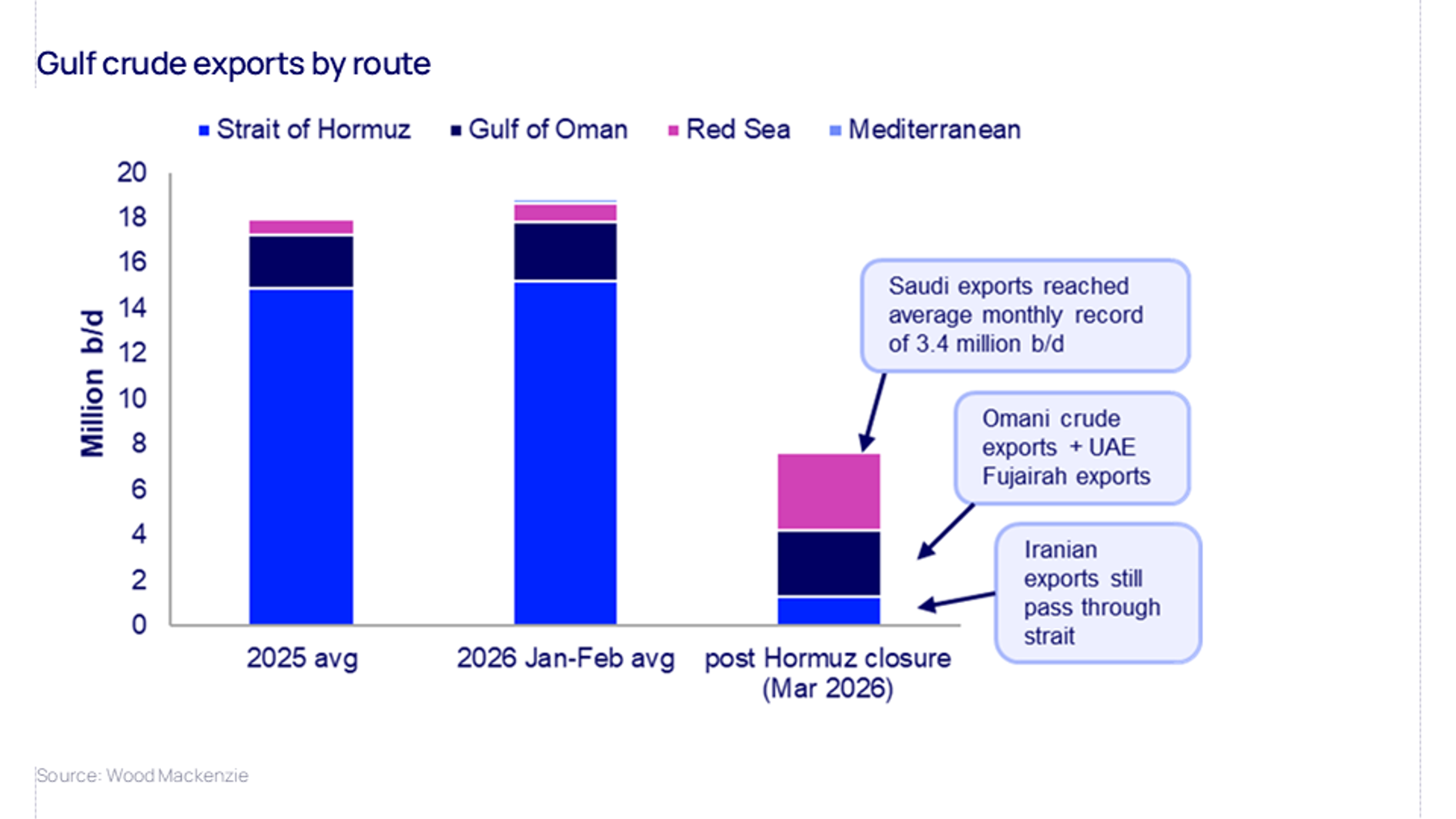
Months for all of it, but the bulk of supply could be back in the market within weeks. Around 11 million b/d of production is curtailed right now, after accounting for the increased flows through Saudi Arabia’s East-West pipeline and other outlets in the region.
Any forecast for restoring these volumes inevitably assumes that the Strait of Hormuz is transitable. Much is still required to move beyond a fragile ceasefire towards a lasting peace agreement, verified safe passage and any potential transit fee arrangements.
Should the green light come, over 120 million barrels of crude stored in vessels on the water could quickly pour back into the market, reaching Europe within two to three weeks and North Asia within four weeks.
What about restarting oil and gas production?
In a best-case scenario, around half of the 11 million b/d of upstream production that is currently shut in could resume within days, and up to three quarters within two weeks. But the last mile is always the hardest. The final barrels will take months to restart, requiring well interventions and optimisation of production systems from wellhead through pipelines, gas plants, water facilities and export logistics.
With 77 Mtpa offline – equal to 20% of global LNG supply – Qatari LNG production will be returned in sequence. We assume up to three days to bring wells back onstream and a seven-day ramp-up for each train. Should production begin restarting from early May, the 41-Mtpa North site could be in full service by July. Damage to two trains (totalling 12.8 Mtpa) at the South site will require repair, leading to additional delays and preventing Qatar from returning to its full LNG capacity for several years.
Could Gulf refineries crank up swiftly? We believe so. There has been some damage to several refineries across the region, but nothing on the scale of the LNG facility at Ras Laffan in Qatar. Refineries in Saudi Arabia, the UAE, Kuwait, Iraq and Iran have been ticking over through the conflict to meet local demand, which totals around 7 million b/d at present. Barring no further infrastructure attacks, refinery utilisation can be ramped back up within a few weeks.
What is the outlook for oil prices?
Our latest view, published this week, envisages Brent averaging US$89/bbl in Q2 before slipping back below US$75/bbl in Q3 and under US$70/bbl into Q1 2027. We forecast Brent stabilises at an average of US$65/bbl for 2027, with ample supply in the market. However, this new equilibrium price is US$4 to US$5/bbl above our pre-war forecast, reflecting a higher risk premium and the need to refill depleted inventories.
What about LNG prices and the impact on demand?
The war has sent traded LNG prices soaring, particularly for Asian buyers most dependent on contracted Qatari volumes. Demand destruction among price-sensitive buyers resulted in Asian LNG imports falling by 5% year-on-year in March, despite Qatari cargoes still arriving until mid-month. Even with Qatar and UAE LNG supply resuming, the impact of the war is expected to reduce Asian demand by 10 Mtpa in 2026 compared to last year.
Meanwhile, LNG supply growth in the rest of the world is continuing. However, delays to projects in the Gulf impact the market into 2027. We have delayed the first cargo at Qatar North Field East from November 2026 to August 2027, which results in continued market tightness through next year. Consequently, it is not until 2028 that global capacity additions deliver much lower prices, likely shifting the market into the long-anticipated oversupply.
What next if the ceasefire fails?
Huge risks remain. The ceasefire agreement has been severely tested within its first 24 hours, curbing some optimism. If a resolution to the war proves unachievable, we expect Brent to trade upwards again, with higher prices and demand destruction ultimately balancing the market. This would have significant ramifications for the global economy.
Our analysis suggests Brent averaging above US$90/bbl for 2026 would lead to global GDP growth dropping from our pre-war forecast of 2.5% to below 2%, pushing major economies like the US and EU into recession. At US$100/bbl, global GDP growth could slow to 1.7%. At US$200/bbl, the global economy could contract by 0.5%.

Make sure you get The Edge
Every week in The Edge, Simon Flowers curates unique insight into the hottest topics in the energy and natural resources world.
Sign up today using the form at the top of the page.