





Carbon capture continues to grow, despite challenges
CCUS cannot be a complete solution for decarbonisation. But it can play a vital role in some sectors
9 minute read

Ed Crooks
Vice Chair Americas and host of Energy Gang podcast

Ed Crooks
Vice Chair Americas and host of Energy Gang podcast
Ed examines the forces shaping the energy industry globally.
Latest articles by Ed
-
Opinion
US permitting reform plan could transform energy investment
-
Podcast
Energy in a more dangerous world
-
Opinion
US considers diesel export restrictions
-
Podcast
Power under pressure | Climate Week NYC special
-
Opinion
The US Federal Reserve responds to the rise in oil prices
-
Podcast
Climate finance without Washington
Carbon capture has become a hot political issue in Louisiana. Because it is a way to reconcile continued fossil fuel use with falling greenhouse gas emissions, carbon capture, utilisation and storage (CCUS) has benefited from bipartisan support in the US. Tax credits for CCUS were expanded and increased in 2022 by a Democratic-controlled Congress, and retained and increased again by the Republicans in the One Big Beautiful Bill last year. But the industry is still capable of stirring up political controversy.
In the Republican primary contest to choose a candidate for a US Senate seat for Louisiana, one contender made opposition to carbon capture and storage a key plank in his campaign. John Fleming argued that projects to develop CCUS infrastructure would “deprive the property rights of Louisiana citizens for the benefit of wealthy corporations seeking to store dangerous carbon dioxide underground”.
Fleming’s campaign was unsuccessful: he was defeated in a runoff election over the weekend. But he picked up substantial support in the rural areas of western Louisiana. The assessment from The Center Square news service was that his opposition to carbon capture had helped him, but not enough to offset his opponent’s support from President Donald Trump and other leading Republicans.
The public and political resistance to CCUS, even in a heartland of the US oil and gas industry such as Louisiana, is a symptom of the challenges the industry is facing. The technology is generally well-established but can be complex and costly to deploy. It usually needs government support to be economically viable, and in many places there is still scepticism about its benefits and risks.
There has been a series of delays and cancellations of carbon capture projects, caused by difficulties in building out infrastructure, inadequate financial incentives and opposition from local communities. The total volume of CCUS capacity under development worldwide rose strongly between 2019 and 2024 but has grown only slowly since then.
Projects are still making progress. Between the fourth quarter of last year and the first quarter of 2026, the total volume of CCUS capacity under construction worldwide rose by 9%, while the capacity in advanced development rose by 23%. The capacity in early-stage development fell by 7%, however, suggesting the industry is in a phase of consolidation rather than rapid growth.
The big tech companies, which need always-available dispatchable power for their data centres and also have demanding goals for cutting emissions, are an obvious fit for carbon capture. But the tech industry has so far been cautious about investing in CCUS. The flagship project is a new gas-fired power plant with carbon capture being built by Broadwing Energy in Illinois, with backing from Google.
Tech companies’ support for carbon capture, including carbon dioxide removal, has generally come from buying credits. Two weeks ago, Stripe, Google, Salesforce and Anthropic announced a commitment to buy US$915 million of carbon credits through the Frontier group, following a US$1 billion commitment announced in 2022. Microsoft has been the dominant player in the carbon credit market, accounting for more than 90% of purchases worldwide last year.
The question is whether this investment, which is relatively modest when set against the many hundreds of billions of dollars of capital spending by the tech industry each year, can be scaled up enough to have a material impact on global emissions.
The record-breaking heatwaves in Europe last week, linked to global warming, have been a reminder of the consequences of allowing unchecked increases in greenhouse gas emissions. Political and public views on climate change have been on a pendulum since the 1990s, and at some point, may swing back in favour of more ambitious action.
The question for the CCUS industry is whether it will be able to show enough progress to demonstrate it can be a significant part of the solution, if and when that revival in support for climate action comes.
The Wood Mackenzie view
Last week, Wood Mackenzie held a private roundtable for CCUS industry leaders to discuss the challenges and opportunities the sector faces today. There was a wide range of perspectives reflected at that meeting. Some participants were making good progress with their projects, others had faced setbacks and delays. Some were hanging on and waiting for policy support to improve.
Despite the difficulties it faces, CCUS can still play an important role in moving the world towards a lower-carbon energy system. For hard-to-abate industrial sectors, including cement, steel and fertilisers, there are few if any alternatives to CCUS for reducing emissions.
Carbon capture can also play a role in power generation. Gas or coal-fired plants fitted with CCUS could be competitive against other dispatchable sources of low-carbon power. Wood Mackenzie’s levelised cost of electricity (LCOE) estimates suggest that power from gas-fired plants with CCUS would cost more than enhanced geothermal generation, but less than new nuclear plants, including small modular reactors.
CCUS, like geothermal energy and new nuclear, is not going to be a first choice for the tech companies that are driving much of the investment in new generation in the US. Speed to power is critical, and the extra time needed to build a CCUS system at a power plant can be a deal-breaker.
Over time, however, fossil fuel power plants with CCUS could become part of the mix for supplying low-carbon electricity.
As things stand, carbon prices around the world are generally not high enough to justify investment in CCUS without additional support. The prices that would be needed to ensure the carbon capture industry takes off are unlikely to be politically acceptable today.
Even so, Wood Mackenzie still expects strong growth in the CCUS sector over the coming decades, as an essential part of any global strategy to address climate change. In our base case forecast, we project that global carbon capture capacity will rise from about 91 million tons per year today to about 3 billion tons per year in 2060.
We estimate that means that less than 6% of global emissions will be captured 35 years from now. CCUS cannot be a complete solution to the challenge of global warming. But in some sectors, especially where few alternatives exist, it can play a vital role.
US-Iran ceasefire formally remains in place, despite clashes
In the past few days, there have been strikes by both Iran and the US on targets around the Gulf region. Iran attacked a cargo ship moving through the Strait of Hormuz, prompting a round of US air strikes on Saturday. Iran then responded in turn by launching drones and missiles at Bahrain and Kuwait.
Shipping traffic through the strait, which had picked up strongly after the US and Iran agreed their Memorandum of Understanding 10 days ago, slowed again after the latest clashes. Even so, the strait has been significantly more active than during the period after the war began. Wood Mackenzie’s Vesseltracker service counted about 50 vessels a day passing through the strait over the past few days, compared to 10 to 20 a day for most of March, April and May.
Abbas Araghchi, Iran’s foreign minister, on Sunday reiterated his country’s demand to control traffic through the strait. “Any attempt to establish new or separate arrangements from those currently being carried out by the Islamic Republic of Iran will only lead to further complications, delay the reopening of the Strait of Hormuz and increase the level of tension,” he said. The US sent a delegation to Qatar for renewed peace talks on Tuesday, but Iran said it was not yet ready to resume high-level negotiations.
Oil markets remained calm despite the latest tensions. Brent crude was trading at about US$73 a barrel on Tuesday morning.
In brief
Oracle is suing regulators in Wisconsin over rules intended to protect ratepayers when investments in electricity infrastructure are made for new data centres. The suit is focused on provisions in Wisconsin Electric’s new adopted large load tariffs, which require financial guarantees from customers. Oracle argues that the requirements “will impose substantial and unreasonable costs” on customers seeking to use the large load tariffs. It says those costs are “wholly disproportionate” to any risks being borne by Wisconsin Electric.
Oracle is developing a nearly 1-gigawatt data centre campus on a 672-acre site in Wisconsin, along with Vantage Data Centers and OpenAI. The US$15 billion project is one of the largest private sector investments in the state’s history.
Other views
Has the oil price bubble burst? – Simon Flowers and others
Power and renewables 2026 outlook: half-time report – Akif Chaudhry and Norman Valentine
Global solar 2026 outlook: half-time report – Michelle Davis
Orbital data centres cost three times more than terrestrial alternatives
Gulf Coast Express expansion begins commissioning – Daniel Myers
Progress and Peril – Bank for International Settlements
(Important analysis on the financial risks associated with the AI boom)
Quote of the week
"Gasoline Retailers must get their Prices down, IMMEDIATELY! They’re too high considering that Oil is now at $68 a Barrel, and heading south. The Retailers must quickly react to this statement, and do what they know is right — DROP YOUR PRICE FOR OUR GREAT AMERICAN PEOPLE!... If Retailers don’t do this, big problems lie ahead!”
President Trump posted on his Truth Social platform urging retailers to cut gasoline prices. Crude prices have fallen sharply since the Memorandum of Understanding to end the conflict on the Middle East was agreed between the US and Iran.
The President also told retailers that price gouging was illegal, and urged them to aim for a price of about US$2.50 a gallon. The current average price of gasoline in the US is about US$3.85 a gallon, according to the Automobile Association of America.
Chart of the week
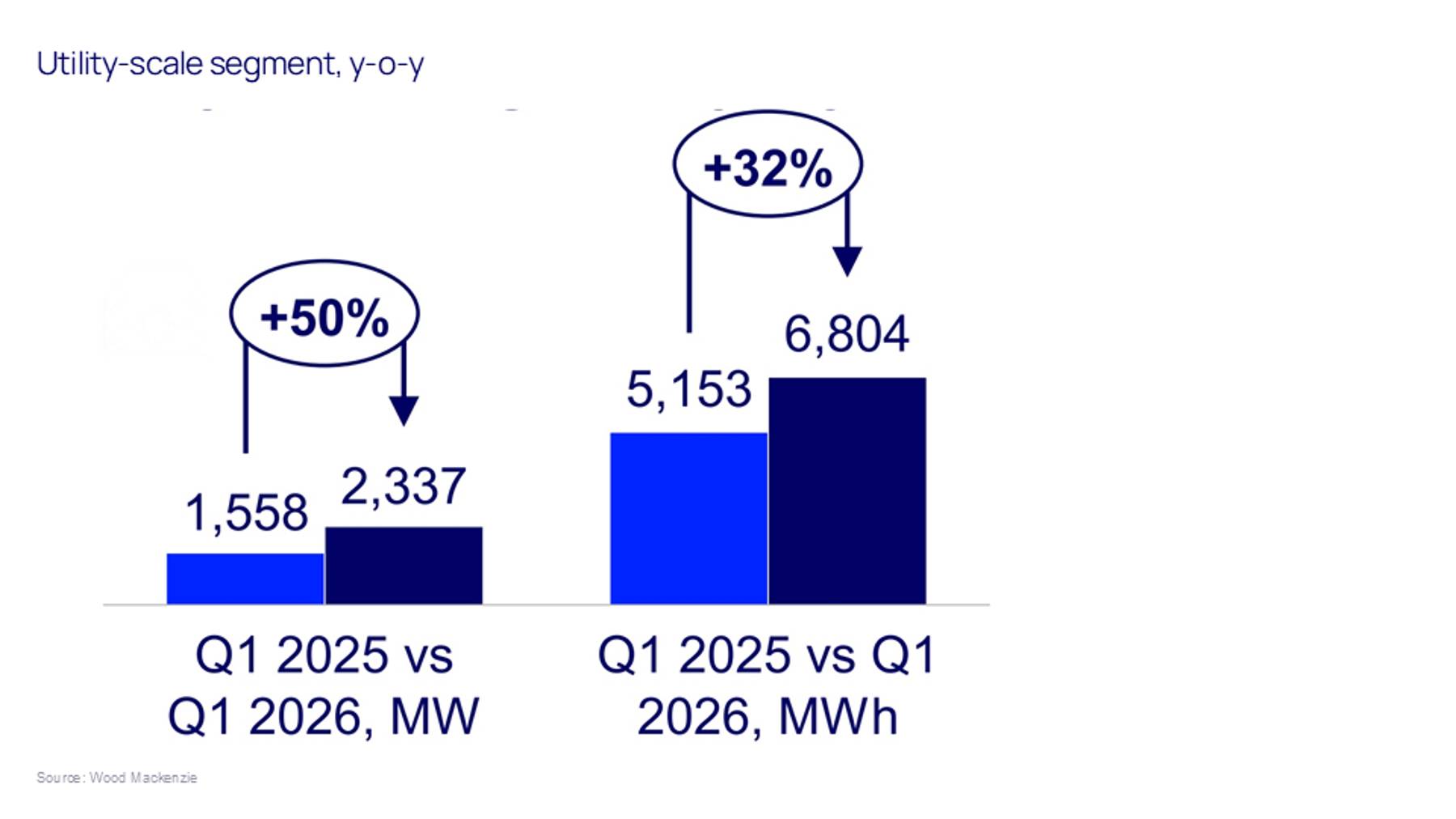
This comes from the latest US Energy Storage Monitor, published by Wood Mackenzie Power & Renewables and the American Clean Power Association. It shows the rise in utility-scale storage installations in the US, which is part of a broader picture of growth across the industry. Our forecasts indicate there is more to come.
For details, including projections for growth out into the 2030s, download the summary for free, or to dig deeper purchase the full report.

Get The Inside Track
Ed Crooks’ Energy Pulse is featured in our weekly newsletter, the Inside Track, alongside more news and views from our global energy and natural resources experts. Sign up today via the form at the top of the page to ensure you don’t miss a thing.