



Sign up today to get the best of our expert insight in your inbox
How war in the Middle East is hitting Asia hard
The economic pain of high oil prices for importers
1 minute read

Simon Flowers
Chairman, Chief Analyst and author of The Edge

Simon Flowers
Chairman, Chief Analyst and author of The Edge
Simon is our Chief Analyst; he provides thought leadership on the trends and innovations shaping the energy industry.
Latest articles by Simon
-
The Edge
The energy crisis is coming to the boil
-
The Edge
Boiling a frog – could oil prices test US$200/bbl?
-
The Edge
War is once again reshaping gas and LNG
-
Opinion
Middle East conflict set to drive oil and LNG prices significantly higher
-
The Edge
Can natural hydrogen deliver its potential?
-
The Edge
The big themes on Big Oil’s mind

Yanting Zhou
Principal Economist, Asia Pacific

Yanting Zhou
Principal Economist, Asia Pacific
Yanting leads our in-house macroeconomic research for Asian economies.
Latest articles by Yanting
-
The Edge
The energy crisis is coming to the boil
-
Opinion
Metals and mining: trade woes, growth slows
-
Opinion
Metals and mining: trade woes, growth slows
-
The Edge
Getting China back on track
-
Opinion
How do Western sanctions on Russia impact the global metals, mining and coal markets?
-
The Edge
Can China’s recovery turn the oil market around?

Sushant Gupta
Research Director, Asia Pacific Refining and Oils

Sushant Gupta
Research Director, Asia Pacific Refining and Oils
Sushant has over 15 years of experience with a strong focus on the refining, crude oil and chemicals industry.
Latest articles by Sushant
-
Opinion
5 top takeaways from our APPEC 2025 briefings
-
The Edge
Getting China back on track
-
The Edge
Refining’s perfect storm passes
-
Opinion
From grey and brown to green and blue: low-carbon hydrogen in refining
-
Opinion
Refinery emissions: implications of carbon tax and mitigation options

Joshua Ngu
Vice Chairman – Asia Pacific

Joshua Ngu
Vice Chairman – Asia Pacific
Joshua advises clients across upstream, gas, LNG, downstream, petrochemicals and energy transition.
Latest articles by Joshua
-
The Edge
The energy crisis is coming to the boil
-
The Edge
India’s energy challenge
-
Opinion
India’s energy roadmap: 5 key themes for IEW 2026
-
Opinion
Is Indonesia’s domestic gas supply in crisis?
-
The Edge
Walking Japan’s energy tightrope
-
The Edge
Five themes shaping the energy world in 2025

Gavin Thompson
Vice Chairman, Energy – Europe, Middle East & Africa

Gavin Thompson
Vice Chairman, Energy – Europe, Middle East & Africa
Gavin oversees our Europe, Middle East and Africa research.
Latest articles by Gavin
-
The Edge
The energy crisis is coming to the boil
-
The Edge
War is once again reshaping gas and LNG
-
Opinion
Middle East conflict set to drive oil and LNG prices significantly higher
-
The Edge
The big themes on Big Oil’s mind
-
Opinion
European gas: 6 Q&As on prices, supply, and regulatory impact
-
The Edge
A wild week for gas markets
A glimmer of hope emerged in week four of the war, with reports of talks between the US and Iran initially pushing Brent below US$100/bbl. Time will tell if this marks a turning point for the crisis or if the constraints on Gulf exports are prolonged and push prices higher.
The importance of oil and the sensitivity of the global economy to price can’t be overstated. Wood Mackenzie analysis suggests that a scenario of Brent averaging US$125/bbl through 2026 will lead to a global recession, a view broadly echoed this week by Blackrock CEO Larry Fink. No economy is immune to the fallout of sustained, high crude prices, but some are impacted more than others. The major oil-importing countries of Asia are among those feeling the pain most acutely.
The region's governments have rapidly deployed an unprecedented array of cushions to protect the hardest-hit sectors and consumers. But such interventions come at a staggering cost and, if oil prices remain high, some Asian governments will soon hit fiscal breaking point. Our Asia experts, Yanting Zhou, Sushant Gupta and Joshua Ngu, guided me through the economic and political challenges.
Why are Asian economies so strategically vulnerable to this conflict?
Asia’s dependence on Middle Eastern oil is a long-established structural reality. Before the war, around 80% of the crude that passed through the Strait of Hormuz was delivered to Asian refineries. Japan and South Korea sourced more than 90% and 70%, respectively, of their oil imports from the Gulf before the outbreak of the war. China and India, the world’s two largest oil importers, have actively diversified their supplies to include Russia and the US but still depend on the Middle East for around half their crude supplies.
Developing economies across Southeast and South Asia, where economic growth typically depends on manufacturing and exporting goods, are particularly vulnerable. Most have limited foreign currency reserves to pay for soaring oil import bills. In 2026, the “war premium” is no longer a theoretical risk but will hit national balance sheets hard.
How are Asian governments responding?
They’re trying to prevent a repeat of the 2022 cost-of-living crisis. Beyond demand-side management, Asian governments have shifted from market pricing for oil products to aggressive intervention. A plethora of policy responses are being rolled out across the region. Most, though, amount to pretty much the same thing – subsidies for consumers.
Price caps at the pump are the go-to lever, with governments compensating losses through a variety of mechanisms. In Indonesia, losses by national oil company (NOC) Pertamina will be recovered by government compensation later; Japan and Malysia have a similar scheme for their refiners and fuel suppliers. In Thailand and Vietnam, oil company losses are currently made good from dedicated funds – though the longevity of these funds is already being tested. China, meanwhile, has a US$130/bbl crude price ‘cap’ on refined product prices that refiners can pass through to customers. Perhaps in anticipation of higher prices, China introduced subsidies on diesel and gasoline this week despite the cap not being breached.
India has a twist on the theme. The government moved fast to freeze retail prices but the state-owned oil marketing companies initially have to absorb the losses. Once these become unsustainable, the central government intervenes by cutting taxes, essentially sacrificing tax revenue to keep the pump price stable.
How sustainable are fuel subsidies across Asia?
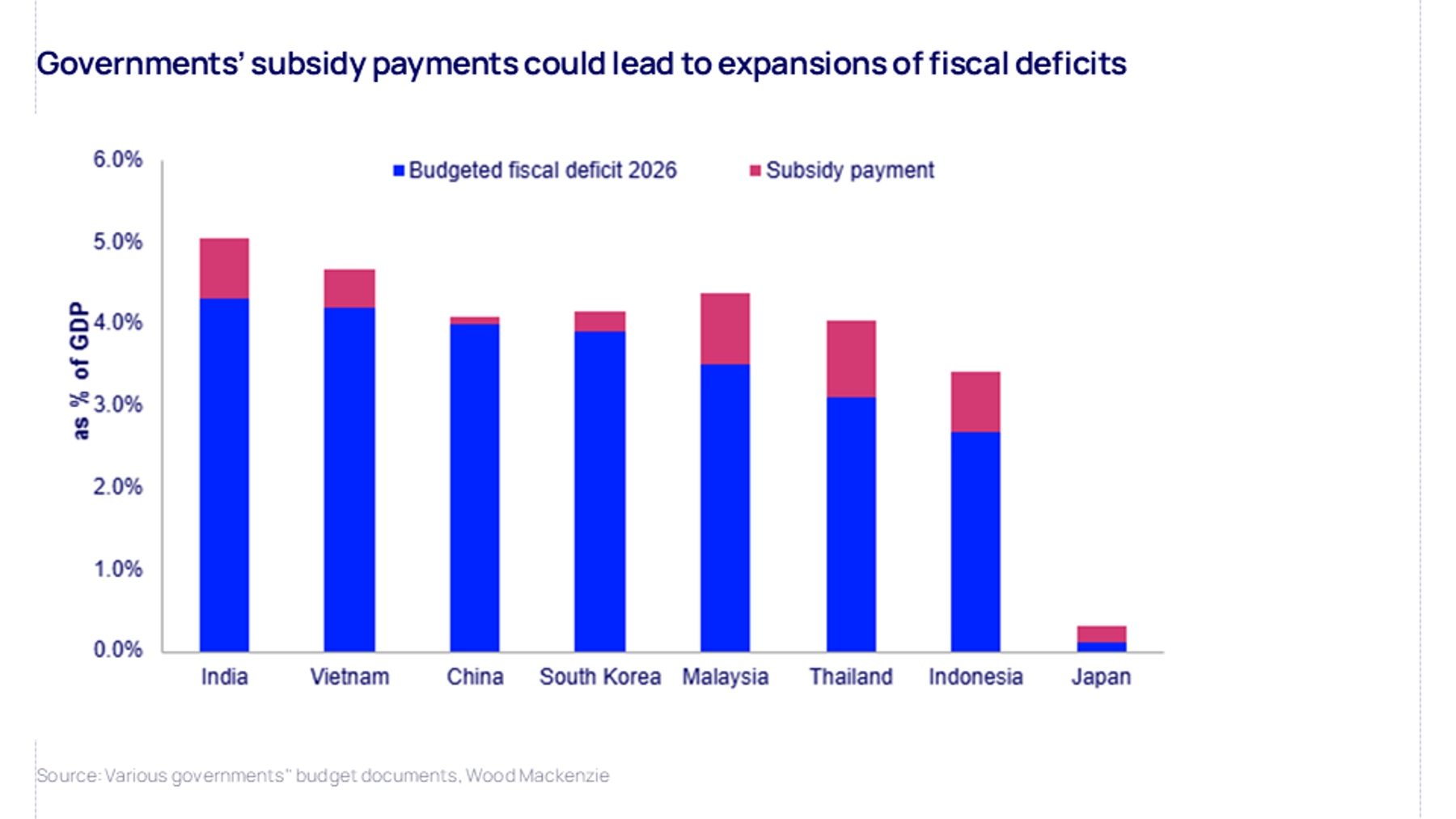
Collectively, fuel subsidies will be a huge cost to governments. If oil remains at US$100/bbl for four months, we estimate Asia’s total subsidy bill will exceed US$80 billion. In a higher-for-longer scenario, as well as demand destruction, the economic pain multiplies, impacting fiscal deficits, balance of payments and perhaps credit ratings.
The affordability of current subsidy schemes varies greatly by country. Thailand and Vietnam have tapped into budget rainy-day funds to make subsidy payments. But Thailand’s fund is already in deficit, while Vietnam’s will be fully drawn by early April under the current subsidy scale.
Expanded fiscal deficits look near-certain through 2026 across much of Asia. If Brent averages US$100/bbl for four months, India is hit hardest among Asia’s major economies: we estimate a cost equivalent to 0.7% of GDP and 7.2% of government revenue in fiscal year 2025-26. Indonesia is in danger of breaching its legal limit of 3% on its fiscal deficit if subsidy payments persist.
Even those governments not facing near-term funding challenges for subsidies, the burden of a higher fiscal deficit may haunt budgets for several years to come. Currency depreciation for these energy importers may exacerbate the debt issue.
Where next for Asia’s challenge in dealing with high prices?
Conflict escalation is clearly a nightmare scenario for Asian economies. Brent averaging US$125 in 2026 would see the global economy crash into recession and do massive damage not only to Asian markets but also their key export markets worldwide.
For Asia and the rest of the world, the modest drop in oil prices these last few days is hugely welcome. But a lasting ceasefire and the return of laden oil tankers transiting the Strait of Hormuz is what really matters.

Make sure you get The Edge
Every week in The Edge, Simon Flowers curates unique insight into the hottest topics in the energy and natural resources world.
Sign up today using the form at the top of the page.