



Sign up today to get the best of our expert insight in your inbox.
War is once again reshaping gas and LNG
Rebuilding confidence beyond the Middle East conflict
1 minute read

Simon Flowers
Chairman, Chief Analyst and author of The Edge

Simon Flowers
Chairman, Chief Analyst and author of The Edge
Simon is our Chief Analyst; he provides thought leadership on the trends and innovations shaping the energy industry.
Latest articles by Simon
-
The Edge
The energy crisis is coming to the boil
-
The Edge
Boiling a frog – could oil prices test US$200/bbl?
-
The Edge
War is once again reshaping gas and LNG
-
Opinion
Middle East conflict set to drive oil and LNG prices significantly higher
-
The Edge
Can natural hydrogen deliver its potential?
-
The Edge
The big themes on Big Oil’s mind

Gavin Thompson
Vice Chairman, Energy – Europe, Middle East & Africa

Gavin Thompson
Vice Chairman, Energy – Europe, Middle East & Africa
Gavin oversees our Europe, Middle East and Africa research.
Latest articles by Gavin
-
The Edge
The energy crisis is coming to the boil
-
The Edge
War is once again reshaping gas and LNG
-
Opinion
Middle East conflict set to drive oil and LNG prices significantly higher
-
The Edge
The big themes on Big Oil’s mind
-
Opinion
European gas: 6 Q&As on prices, supply, and regulatory impact
-
The Edge
A wild week for gas markets

Massimo Di Odoardo
Vice President, Gas and LNG Research

Massimo Di Odoardo
Vice President, Gas and LNG Research
Massimo brings extensive knowledge of the entire gas industry value chain to his role leading gas and LNG consulting.
Latest articles by Massimo
-
The Edge
The energy crisis is coming to the boil
-
The Edge
War is once again reshaping gas and LNG
-
Opinion
Middle East conflict set to drive oil and LNG prices significantly higher
-
Opinion
European gas: 6 Q&As on prices, supply, and regulatory impact
-
The Edge
A wild week for gas markets
-
Featured
Gas & LNG: region-by-region predictions for 2026

Frank Harris
Head of Global LNG Consulting

Frank Harris
Head of Global LNG Consulting
Frank is a recognised expert on the global LNG industry and leads our global consultancy practice in this area.
Latest articles by Frank
-
The Edge
War is once again reshaping gas and LNG
-
Opinion
Five key takeaways from our Gastech 2025 Leadership Roundtables
-
The Edge
Gastech 2025: when will the music stop for US LNG?
-
The Edge
Could US LNG become a victim of its own success?
-
The Edge
Taking the pulse of the global LNG industry
-
Opinion
Debating the future direction of the LNG market

Kristy Kramer
Head of LNG Strategy and Market Development

Kristy Kramer
Head of LNG Strategy and Market Development
Kristy brings over fifteen years of gas and energy industry experience to her role leading our Gas and LNG Consulting.
Latest articles by Kristy
-
The Edge
The energy crisis is coming to the boil
-
The Edge
War is once again reshaping gas and LNG
-
Opinion
Five key takeaways from our Gastech 2025 Leadership Roundtables
-
Opinion
US LNG expansion: Balancing growth ambitions with oversupply risks
-
Opinion
Managing the nitrogen challenge in Permian gas
-
Opinion
How LNG and power are shaping US gas pipeline development
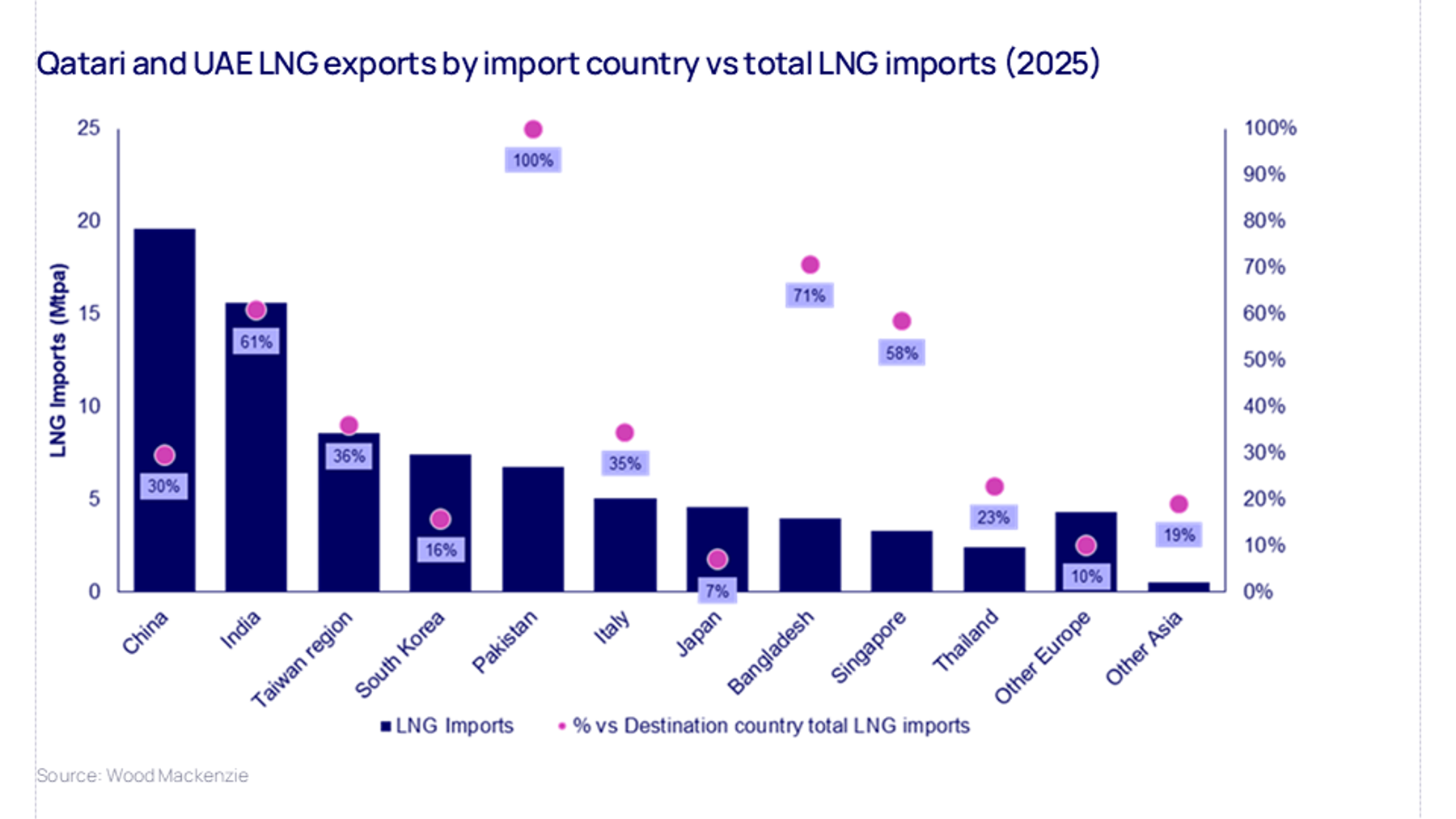
The Middle East conflict is wreaking havoc with global gas and LNG markets, even more so than oil. The effective closure of the Strait of Hormuz and QatarEnergy’s declaration of force majeure on LNG shipments from Ras Laffan have instantly removed about 20% of global LNG supply. With seemingly no imminent prospect of the war ending, Asian markets – China and South Asia in particular, depend on LNG imports from the Gulf – are the most exposed. But Europe is also in panic mode. The April month-ahead spot TTF price has almost doubled since Monday’s opening.
The consequences of the war for gas and LNG are uncertain but could rival those that followed Russia’s invasion of Ukraine in 2022. Much will depend on whether the disruption is a short-lived blip or is more enduring, and whether regional gas and LNG infrastructure suffers major damage. Here we consider how the war could reshape the market.
Will war boost diversification in LNG supply?
Yes. Assuming no significant damage to existing projects in Qatar and the UAE (79 Mtpa and 5.6 Mtpa of capacity, respectively), the amplified risks associated with these volumes will, in time, dissipate. But the crisis will drive home the importance of supply diversification. The raft of US pre-FID projects – almost 100 Mtpa currently – come without a single geographic point-of-failure risk.
The US, however, can’t be the only solution. Now the world’s biggest LNG producer, the US has its own limitations for buyers, not least domestic energy politics. Elsewhere, pre-FID projects in Canada, Mozambique and Argentina will look to capitalise on the uncertainty but also have challenges. Others that have slipped to the right, such as Abadi in Indonesia and Browse in Australia, could gain fresh impetus.
Portfolio suppliers will sense opportunity as buyers fret over supply diversification. National oil companies that also produce LNG, including QatarEnergy, may look for more diversification of supply for their own portfolios.
Has war again shaken the perception of gas and LNG as a reliable and affordable fuel?
Following Russia's invasion of Ukraine, the reputation of gas and LNG as a reliable and affordable fuel was put to the test, most notably in Europe. Swift action to increase LNG availability helped rebuild confidence among buyers. But in the eyes of gas and LNG sceptics, war has once again highlighted how supply disruptions and volatile prices can imperil energy security and affordability.
A swift restoration of supply and lower prices will allay some concerns among importers in the short term. But beyond the immediate crisis, more work will be required to rebuild confidence.
Will the war lead countries to reassess energy policy?
Responses will vary, but few countries importing gas and LNG will be unscathed. Asia is the cornerstone of the bullish outlook for gas and LNG – the surge of new supply over the next several years from projects already committed depend on the region’s anticipated demand growth. We forecast Asian LNG demand alone to increase by around 200 Mtpa over the coming decade. However, that growth depends on competitive pricing and supply reliability.
Asian markets could respond to the current loss of supply in several ways. First, coal will take market share from gas and LNG in the power sector in Japan, South Korea, China, India and Southeast Asia. Second, Asian governments could accelerate growth plans for renewables though the near-term upside will be limited. Third, additional incentives for the development of domestic gas resources could be fast-tracked but will similarly offer little immediate upside.
None of this is positive for Asian LNG demand growth. Fundamentally, however, Asia needs more energy, while the region’s rising emissions will need to be addressed. With limited alternative options, we maintain our long-held view that LNG remains central to meeting future Asian energy demand.
Will Europe push harder to cut its dependence on gas and LNG?
It is no secret that Europe remains determined to move away from its dependence on the fuel. Gas and LNG opponents have already flagged supply disruption and price spikes as major vulnerabilities.
The reality, however, is that Europe is already moving as fast as it realistically can on decarbonisation, with governments facing budget constraints on accelerating the rollout of low-carbon alternatives. Looking beyond the war – and assuming no major damage to supply infrastructure – gas and LNG prices will fall and memories of the crisis will fade. With lower gas, LNG and electricity prices still expected from 2027, European governments will struggle to deny their consumers access to cheaper energy.
Russia remains Europe’s ultimate energy dilemma. European countries now face towering gas prices for the second time this decade. With the war in Ukraine still raging, however, the chances of the EU lifting the ban on Russian gas and LNG imports is highly unlikely.
Gas and LNG have work to do to rebuild confidence
Gas and LNG markets are reeling from the loss of supply. The industry has been here before – and in very recent memory – and has proven it can recover. Gas’s primary role in decarbonisation ‒ displacing coal and supporting the expansion of renewables ‒ is clear, but the industry may need to go further this time. Building in spare capacity and higher levels of storage, for example, could help soothe a market anxious about reliability and volatility, just as has been done with oil. But this will be neither quick nor easy, requiring investment, time and coordinated effort.
For now, an end to the conflict is the priority. Longer term, reinforcing gas and LNG supply reliability and minimising price volatility will be required to ensure the fuels’ demand trajectory remains intact.

Make sure you get The Edge
Every week in The Edge, Simon Flowers curates unique insight into the hottest topics in the energy and natural resources world.
Sign up today using the form at the top of the page.