




Discuss your challenges with our solutions experts
Wind supply chain financials decoded: colliding margins and rising prices
The path to affordable wind energy runs through sustainable supply chain margins, not around them
1 minute read

Yufan Wang
Senior Analyst, Global Offshore Wind Research

Yufan Wang
Senior Analyst, Global Offshore Wind Research
Yufan covers global offshore wind markets with a focus on China.
Latest articles by Yufan
-
Opinion
Wind supply chain financials decoded: colliding margins and rising prices
-
Opinion
Expansion opportunities beckon for China’s wind companies

Søren Lassen
Head of Wind

Søren Lassen
Head of Wind
Søren tracks, analyses and forecasts value chain dynamics, technological advancements and the market outlook.
Latest articles by Søren
-
Opinion
On-demand webinar | UK offshore wind: has Allocation Round 7 delivered a win for the wider energy sector?
-
Featured
Wind 2026 outlook
-
Opinion
Wind supply chain financials decoded: colliding margins and rising prices
-
Opinion
The Danish government charts course through offshore wind headwinds
-
Featured
Wind: predictions for 2025
-
Opinion
Industry divergence on costs and turbine sizing manifests itself in the first commercial floating wind tender

Finlay Clark
Principal Research Analyst, Global Offshore Wind

Finlay Clark
Principal Research Analyst, Global Offshore Wind
Finlay plays a pivotal role in our comprehensive coverage of the offshore wind supply chain.
Latest articles by Finlay
-
Opinion
On-demand webinar | UK offshore wind: has Allocation Round 7 delivered a win for the wider energy sector?
-
Opinion
Wind supply chain financials decoded: colliding margins and rising prices
-
Opinion
Offshore wind: policy frameworks decide who wins – but not when
-
Opinion
Change is coming to the offshore wind towers sector

Endri Lico
Principal Analyst, Global Wind Supply Chain and Technology

Endri Lico
Principal Analyst, Global Wind Supply Chain and Technology
Latest articles by Endri
-
Opinion
Wind supply chain financials decoded: colliding margins and rising prices
-
Opinion
Onshore wind: diverging cost trends, converging turbine maker strategies
-
Opinion
Future wind installations: the great divide between Chinese scale and Western strongholds
-
Opinion
Liberation Day tariffs threaten to disrupt US wind and solar industries
-
Opinion
New frontiers: order intake by Chinese wind turbine OEMs advanced beyond domestic dominance in H1 2024
-
Opinion
Wind from the east gathering strength: the outlook for OEMs
As wind energy costs escalated post-COVID, scrutiny on supply chain margins has intensified. Against the backdrop of supply chain bottlenecks, commodity volatility, and risk premiums, global margins have shifted significantly over the past eight years.
Wood Mackenzie’s latest insight - 'Wind supply chain financials decoded' - analyses global wind supply chain financials, reviewing historical trajectories for wind suppliers and identifying the key factors influencing the direction of travel for supply chain margins in future.
Historical margins: Western margins rebounded while fierce competition drove a profitability squeeze in China
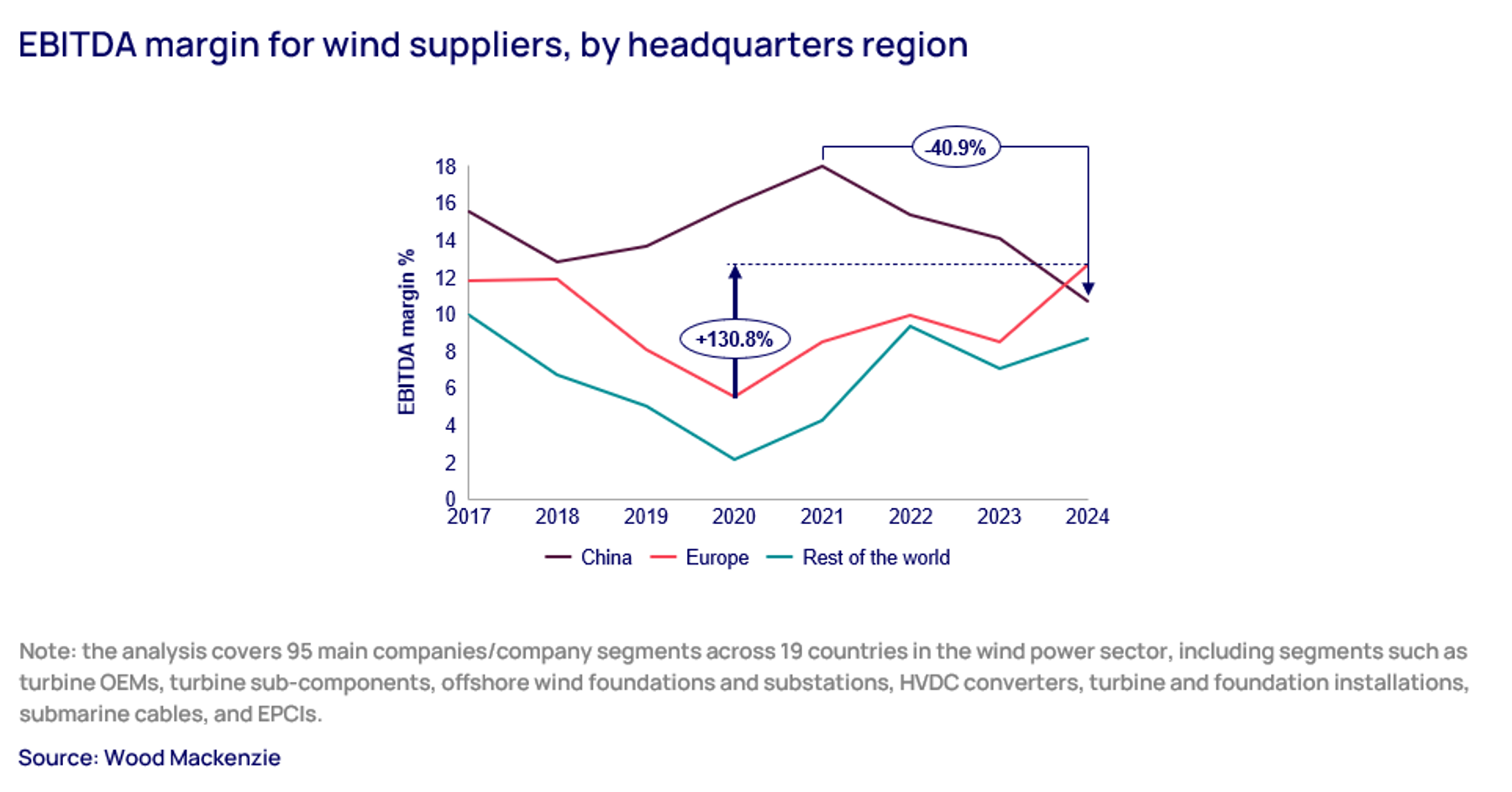
Wind supplier EBITDA margins reveal opposite trends shaped by different market structures and competitive environments. Chinese wind supplier margins have declined since 2021 as national feed-in tariff subsidies were phased out. Between 2021 and 2024, average margins of the Chinese supply chain declined by 41%. For wind suppliers with diversified business portfolios, their wind power equipment division experienced even steeper margin declines compared to overall company results. The combination of fierce domestic competition and high oversupply drove the contraction, despite robust growth in onshore wind demand.
Conversely, Western suppliers more than doubled their EBITDA margins between 2020 and 2024, driven by robust demand, improved pricing, and tight supply conditions. Greater component standardisation and simpler designs enabled leaner production, enhanced visibility, and reduced R&D costs.
In contrast, Western turbine OEMs saw their EBITDA margins plummet post-COVID, losing almost EUR 12 billion during the 2020 to 2024 period. Profitability was eroded by execution risks, including broader project scopes and warranty liabilities, alongside exposure to commodity price swings during long construction timelines. However, a recovery emerged in 2024, demonstrating that the strict measures and "value over volume" strategies adopted since 2021 have finally materialised into tangible results.

Future margins: Positive long-term fundamentals, volatile short-term execution
Growth fundamentals remain strong for supply chain margins, with Wood Mackenzie forecasting annual gross capacity additions for wind power to grow at CAGRs of 6.2% outside China and 5.5% in China between 2025 and 2034. However, translating this volume growth into stable margins will be a volatile process that varies across supply segments.
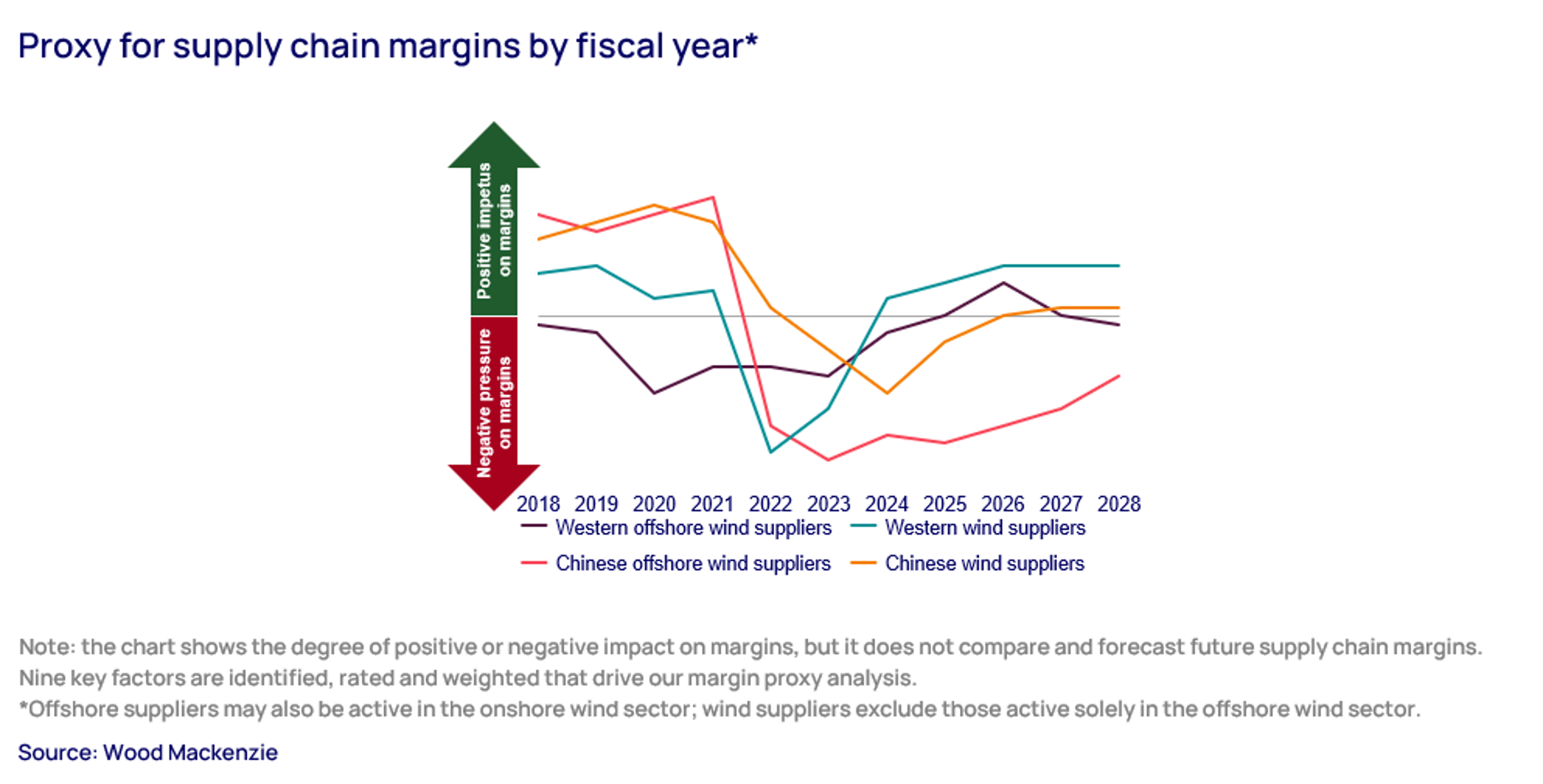
Key drivers of variability include component supply-demand imbalances, execution risks, and the evolving landscape of policy and Chinese exports, all of which influence pricing dynamics. These impacts will not be uniform, as conditions are expected to vary significantly across manufacturing segments, years, and regions.
The oversupply in China will likely ease as demand rises and new investment slows, with recent policies and industry agreements helping to curb overly fierce competition. Onshore turbine prices in China have rebounded after a two-year drop and are now stabilising, though downside risk remains from project revenue declines due to power market reform.
Outside China, the onshore wind supply chain is adjusting to regional demand outlooks and certainty. Offshore supply is increasing, but sector headwinds have led to a significant drop in short-term demand, which will ease current tightness through to 2030. This impact could be partially offset by supply attrition from potential market exits and industry consolidation.
Onshore turbine prices in Western markets have flattened after post-COVID increases, while the long construction lead times seen in the offshore segment mean high pricing impacts are only now flowing through to financial results.

Strategic implications: act now or repeat the cycle of boom, bust, and attrition?
The low-margin trap: Low supply chain margins do not guarantee lower costs for developers. Western offshore wind supplier margins, squeezed until 2020, are now improving, which is also part of the reason firms use stricter pricing and better terms to manage risk and recover losses. However, sustained low margins raise supply attrition risk, leading to project delays and capacity constraints that ultimately drive wind capex higher.
Supply responds to demand: Supply and demand are dynamic and self-correcting. When competition intensifies and demand weakens, suppliers respond by delaying new investments, cutting jobs, and pausing production capacity. Therefore, while oversupply is forecasted on paper, it does not persist in reality. Adequate demand visibility is critical for the wind supply chain to enable new investments, support healthy profitability, and create the conditions needed for sustainable growth.
Offshore wind risks supply chain constraints again: In 2026, approximately 30 GW of new offshore wind capacity outside China will be tendered for grid connections targeted between 2031 and 2033. However, recent delays in tendering and cancellations of offtake agreements are set to create an installation lull from 2027 to 2030. This creates a strategic risk; the lull will challenge supply chain margins and limit suppliers' ability to fund new investments just as demand prepares to spike. Therefore, stakeholders must manage pricing volatility during this interim lull to preserve supply chain health, preventing a return to the inflationary spikes and project delays of the past.

Breaking the 2 vs 1 trilemma
The wind supply chain is entering a new phase where margins are improving, but volatility and structural challenges persist. The “2 vs 1 trilemma” exposes a deadlock in the sector as every stakeholder has interests that conflict with those of the others.
The solution isn't about picking winners, but rather about coordinated de-risking. Moving forward requires clearer policy roadmaps, earlier market commitments, more transparent planning and cost frameworks, and robust risk-sharing mechanisms across policymakers, developers, and the supply chain.
Margins are a zero-sum game, while contingencies and execution risks are not. A sustainable supply chain is not only about maintaining healthy supply capacity but also requires sustainable financials.