



Sign up today to get the best of our expert insight in your inbox.
The energy crisis is coming to the boil
Key Gulf oil and gas infrastructure now in play
1 minute read

Simon Flowers
Chairman, Chief Analyst

Simon Flowers
Chairman, Chief Analyst
Simon is our Chief Analyst; he provides thought leadership on the trends and innovations shaping the energy industry.
Latest articles by Simon
-
The Edge
How the Iran war could change energy markets
-
The Edge
How war in the Middle East is hitting Asia hard
-
The Edge
The energy crisis is coming to the boil
-
The Edge
Boiling a frog – could oil prices test US$200/bbl?
-
The Edge
War is once again reshaping gas and LNG
-
Opinion
Middle East conflict set to drive oil and LNG prices significantly higher

Gavin Thompson
Vice Chairman, Energy – Europe, Middle East & Africa

Gavin Thompson
Vice Chairman, Energy – Europe, Middle East & Africa
Gavin oversees our Europe, Middle East and Africa research.
Latest articles by Gavin
-
The Edge
How war in the Middle East is hitting Asia hard
-
The Edge
The energy crisis is coming to the boil
-
The Edge
War is once again reshaping gas and LNG
-
Opinion
Middle East conflict set to drive oil and LNG prices significantly higher
-
The Edge
The big themes on Big Oil’s mind
-
Opinion
European gas: 6 Q&As on prices, supply, and regulatory impact

Yanting Zhou
Principal Economist, Asia Pacific

Yanting Zhou
Principal Economist, Asia Pacific
Yanting leads our in-house macroeconomic research for Asian economies.
Latest articles by Yanting
-
The Edge
How war in the Middle East is hitting Asia hard
-
The Edge
The energy crisis is coming to the boil
-
Opinion
Metals and mining: trade woes, growth slows
-
Opinion
Metals and mining: trade woes, growth slows
-
The Edge
Getting China back on track
-
Opinion
How do Western sanctions on Russia impact the global metals, mining and coal markets?

Joshua Ngu
Vice Chairman – Asia Pacific

Joshua Ngu
Vice Chairman – Asia Pacific
Joshua advises clients across upstream, gas, LNG, downstream, petrochemicals and energy transition.
Latest articles by Joshua
-
The Edge
How war in the Middle East is hitting Asia hard
-
The Edge
The energy crisis is coming to the boil
-
The Edge
India’s energy challenge
-
Opinion
India’s energy roadmap: 5 key themes for IEW 2026
-
Opinion
Is Indonesia’s domestic gas supply in crisis?
-
The Edge
Walking Japan’s energy tightrope

Daniel Toleman
Research Director, Global LNG

Daniel Toleman
Research Director, Global LNG
Daniel's expertise covers global LNG markets, asset analysis, project economics, contracting and corporate analysis.
Latest articles by Daniel
-
The Edge
The energy crisis is coming to the boil
-
Featured
Gas & LNG: region-by-region predictions for 2026
-
Opinion
Asia Pacific gas & LNG: 5 things to look for in 2026
-
Opinion
Video | Global LNG contracting trends: insights from Lens
-
Opinion
Video | Lens Gas & LNG: Valuing Petronas’ LNG assets
-
Opinion
Video | Lens gas & LNG: Three key LNG M&A opportunities

Kristy Kramer
Head of LNG Strategy and Market Development

Kristy Kramer
Head of LNG Strategy and Market Development
Kristy brings over fifteen years of gas and energy industry experience to her role leading our Gas and LNG Consulting.
Latest articles by Kristy
-
The Edge
The energy crisis is coming to the boil
-
The Edge
War is once again reshaping gas and LNG
-
Opinion
Five key takeaways from our Gastech 2025 Leadership Roundtables
-
Opinion
US LNG expansion: Balancing growth ambitions with oversupply risks
-
Opinion
Managing the nitrogen challenge in Permian gas
-
Opinion
How LNG and power are shaping US gas pipeline development

Massimo Di Odoardo
Vice President, Gas and LNG Research

Massimo Di Odoardo
Vice President, Gas and LNG Research
Massimo brings extensive knowledge of the entire gas industry value chain to his role leading gas and LNG consulting.
Latest articles by Massimo
-
The Edge
The energy crisis is coming to the boil
-
The Edge
War is once again reshaping gas and LNG
-
Opinion
Middle East conflict set to drive oil and LNG prices significantly higher
-
Opinion
European gas: 6 Q&As on prices, supply, and regulatory impact
-
The Edge
A wild week for gas markets
-
Featured
Gas & LNG: region-by-region predictions for 2026

Alan Gelder
SVP Refining, Chemicals & Oil Markets

Alan Gelder
SVP Refining, Chemicals & Oil Markets
Alan is responsible for formulating our research outlook and cross-sector perspectives on the global downstream sector.
Latest articles by Alan
-
The Edge
The energy crisis is coming to the boil
-
The Edge
Boiling a frog – could oil prices test US$200/bbl?
-
Opinion
Middle East conflict set to drive oil and LNG prices significantly higher
-
The Edge
How Venezuela complicates the oil market’s delicate rebalancing
-
Opinion
Venezuela regime change: what it means for oil production, crude and product markets
-
The Edge
Oil’s resilience in the energy system
No end to the war in sight. Nor any prospect of the Strait of Hormuz re-opening that would allow a restart of the oil, LNG, LPG and fertiliser exports that are essential to the global economy. The water temperature in the saucepan of our boiling frog analogy is close to bubbling. Crude and oil product prices keep going up, though Brent – even at US$115/bbl (as we go to print) after overnight bombing – may not be the best gauge of the unfolding energy and economic turmoil.
The hit to Iran’s South Pars gas field and the retaliatory strike on Qatar’s giant LNG facilities at Ras Laffan escalates the crisis to another level, and not just for LNG. Oil and gas infrastructure across the region is now in play. I asked our team for their latest thoughts.
Does the bombing of Ras Laffan change the outlook for LNG?
Yes – it’s a pivotal moment for gas and LNG markets. Prior to yesterday, the consensus was that disruption to Qatari LNG exports might be limited to two months and supply could return to full capacity by mid-year. That no longer looks realistic, and prices have reacted accordingly. European prices this morning are up 30% to €70/MWh ($24/Mmbtu), anticipating even fiercer competition between Asia and Europe for available LNG cargoes. Asia is far more dependent than Europe on volumes from Qatar and UAE that have now dried up – the last cargoes sent before the conflict started are now landing at their destinations. Consequently, Asian buyers will be paying a premium to pull cargoes away from Europe to fill the void.
The global LNG market was nearing a turning point after four years of tightness caused by the Russian invasion of Ukraine. New projects developed as a result of that war, mainly in the US, are expected to add 35 Mtpa (8%) to global supply this year. In comparison, the loss of export volumes from the Gulf is 6.5 Mt per month. The maths is simple – no Gulf exports beyond four or five months will mean annual LNG supply falls, upward pressure on prices through 2026 and demand destruction, particularly in Asia.
QatarEnergy has now confirmed that 12 Mtpa of its 77 Mtpa facility are damaged and possibly unavailable for the next three to five years. There is also a risk of delays to the 48 Mtpa of Qatari LNG under construction and due onstream over the next few years. As a result, the market may not only be tight in 2026 but elevated prices could persist in 2027, counter to the narrative of an upcoming oversupply. Beyond the immediate challenges, the crisis could augur profound changes for the LNG industry. Buyers exposed to LNG from the Gulf will look to diversify supply sources. The biggest risk, however, is that importing countries will reassess LNG’s role in energy policy.
How high could Brent go?
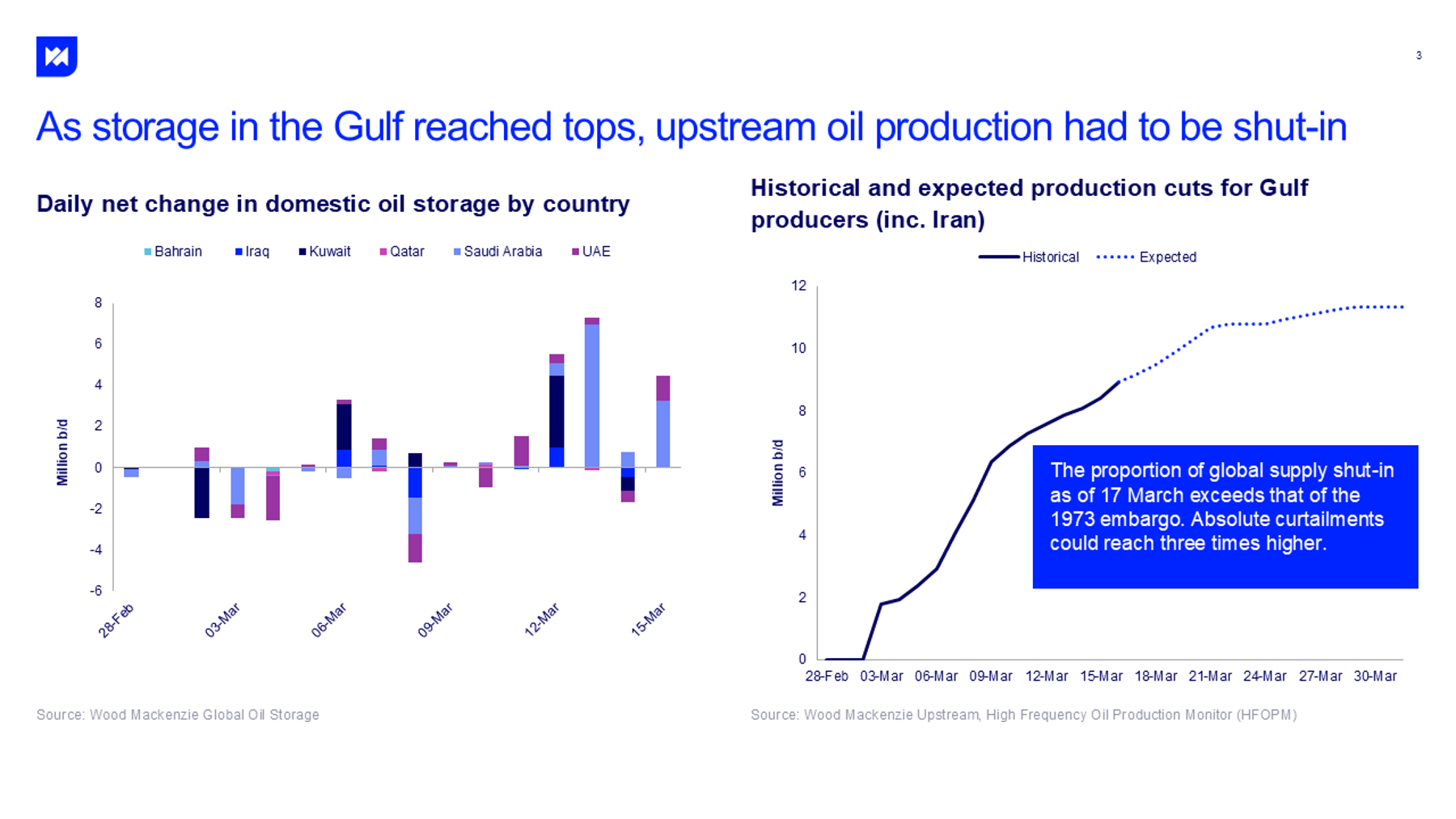
A lot higher. The oil market has been robbed of 15 million b/d of exports for almost three weeks, curtailments greater even than during the 1973/74 Arab oil embargo. Limited supply-side levers have only marginally eased the shortfall. The slow release of 400 million barrels from strategic petroleum reserves around the world and Saudi Arabia maximising spare capacity of the Yanbu East-West pipeline still leave the market short of at least 10 million b/d. Meanwhile, our data shows that storage capacity in the Gulf was filled by late last week, forcing producers to shut-in 9 million b/d of oil output across the region as of 17 March.
Prices across the oil and product complex reveal the pressures building. Early this week, refiners bid up to US$150/bbl on Omani crude, exported from outside the Strait of Hormuz and of similar grade to Gulf crudes. As refined product balances tighten, notably for middle distillates, Asia and Europe are in fierce competition for jet cargoes and willing to pay top dollar to secure them. Crack spreads for jet fuel in Asia and Europe have soared five-fold to US$100/bbl, equivalent to US$200/bbl Brent. Diesel is following a similar trajectory. In contrast, the smaller spike in gasoline cracks is due to cuts in refinery runs in Asia where refiners are starved of Gulf crude feedstock.
With a geopolitical stalemate, a war drifting on and inventory outside the Gulf dwindling, prices across the entire crude and product complex will push up. We continue to believe that US$150/bbl Brent, and perhaps even higher, is increasingly probable in the coming months.
What are the implications for the global economy?
The global economy is still sensitive to higher oil prices despite much improved fuel efficiency through this century. A scenario of Brent averaging US$90/bbl in 2026 would be inflationary and could push global GDP growth below 2% this year from our pre-war forecast of 2.5%. Major economies, including the US and Europe, might even slip into recession. A more aggressive scenario of Brent averaging US$125/bbl will lead to a global recession.
Asian countries, heavily dependent on imported oil and LNG, have high economic exposure to the crisis – China is 72% dependent on oil imports (with 47% coming from the Middle East), India (88%, 45%), South Korea (98%, 70%) and Japan (99%, 80%).
While the odd cargo of Iranian LPG and crude is getting through to Asian buyers, alternative supply options are relatively modest in volume and duration. Tapping into strategic oil reserves and buying the limited volumes of Russian crude on the water for 30 days after the US lifted sanctions only provides temporary relief.
Governments across the region are scrambling to mitigate the economic impact. Much of the immediate response will be on the demand side. Governments – including India, South Korea, Indonesia, Thailand, Malaysia and Vietnam – have started to cushion consumers with price caps for diesel and gasoline. Rationing will increasingly be part of the response and may come in different forms. Sri Lanka’s decision to limit gasoline and diesel purchases at the pump and declare Wednesdays a holiday to conserve fuel is an example of things to come. In India, gas is being rationed where city gas distribution is prioritised, while allocation to industrial sectors is halved. In power markets, thermal coal’s share in generation will inevitably increase.

Make sure you get The Edge
Every week in The Edge, Simon Flowers curates unique insight into the hottest topics in the energy and natural resources world.
Sign up today using the form at the top of the page.