



Electric shock How electric vehicles could hit the accelerator

August 2026


August 2026





Author(s):

David Brown
Director, Global Integrated Energy Research
David is a key author of our Energy Transition Outlook and Accelerated Energy Transition Scenarios.
Latest articles by David
-
Opinion
Speed to power: the infrastructure solutions shaping the global data centre race
-
Opinion
Congress pushes back on restrictions to US wind
-
Opinion
What the Middle East conflict means for the global power sector
-
Opinion
High oil prices could accelerate EV adoption
-
Featured
Autonomous electric vehicles: four things to look for in 2026
-
Opinion
Five things to watch at COP30

Emil Koenig
Senior Research Analyst, Power & Renewables
Latest articles by Emil
-
Featured
Autonomous electric vehicles: four things to look for in 2026
-
Opinion
AI on wheels: autonomous EV fleets and their impact on the grid
-
Opinion
Coordinated buildout of charging infrastructure will enable US medium and heavy-duty trucking electrification momentum
-
Opinion
Coordinated buildout of charging infrastructure will enable US medium and heavy-duty trucking electrification momentum
-
Opinion
US EV charging infrastructure shows resilience amid policy headwinds

Andrew Brown
Director, Head of Demand and Scenarios
Andrew is responsible for aligning our consumption views across commodities.
Latest articles by Andrew
-
Featured
Autonomous electric vehicles: four things to look for in 2026
-
Opinion
Can imports solve the plastic recycling challenge?
-
Opinion
Bottle battle: the fight for recycled plastic supply is on
-
Opinion
Closing the loop on plastic packaging
-
Opinion
Can the plastics industry decarbonise?
-
Opinion
Will coronavirus change the course of plastic circularity?

Prateek Biswas
Senior Research Analyst, Transport and Materials
Prateek specialises in EV policy drivers, automaker electrification strategies and battery supply chain trends.
Latest articles by Prateek
-
Featured
Autonomous electric vehicles: four things to look for in 2026
-
The Edge
Will Chinese BEVs be a gamechanger in Europe and the US?
-
Opinion
Carjacked: electric vehicle policy under a Delayed Energy Transition scenario
-
Opinion
Have policy headwinds pushed electric vehicles into the slow lane?
-
Opinion
How will the new US Republican government reshape the global electric vehicle supply chain?
-
Opinion
Could new EU tariffs on Chinese imports slow EV adoption?

Jom Madan
Principal Analyst, Scenarios & Technologies
Jom works on scenario modelling for country and global-level energy mixes across all major energy commodities
Latest articles by Jom
-
Opinion
Energy transition outlook: Americas
-
Opinion
How is energy transition investment evolving in 2026?
-
The Edge
How the Iran war could change energy markets
-
Opinion
Energy transition outlook: Asia Pacific
-
Opinion
Energy transition outlook: Middle East
-
Opinion
Energy evolution: navigating the path to a sustainable future
Electric vehicles (EVs) command a growing share of the world vehicle market. Wood Mackenzie’s “electric shock” scenario explores how three forces – oil supply shocks, policy decisions and technological innovation – could converge to accelerate that growth and send EV adoption into overdrive, with implications for oil, power and metals.
Under our electric shock scenario, global oil demand could fall to 99 million barrels per day (b/d) in 2040, bringing forward the closure of about 40 oil refineries around the world.
Neither metals nor electricity supply would be an insurmountable obstacle to faster EV growth. Additional investment to the tune of US$45 billion in the supply of metals, particularly copper, would support 50% growth in the global EV stock by 2040 – as long as new capital flows into high-risk jurisdictions.
If electricity suppliers and regulators can shift EV charging to periods of ample power supply, grids can be kept stable and charging costs competitive even as power demand from EVs rises.
In this edition of Horizons, we explore the potential for such accelerated EV growth and set out signposts – indicators such as high oil prices, EV costs and geopolitical flashpoints like the Middle East conflict – that will signal whether our electric shock scenario is set to become a reality.
Just cruising: our base case for EVs through 2040
EV sales are growing at radically different speeds around the world. In the US, passenger EV sales in the first five months of 2026 were down 33% from the same period of 2025, after tax incentives were withdrawn. In Europe, EV sales were up 30% over the same period. In China, a steep downturn in gasoline car sales lifted the market share of EVs from 33% in Q2 2025 to 42% in Q2 2026, despite a small fall in volume.
Wood Mackenzie’s base case projects that this growth will continue. We forecast EVs to jump from 4% of the global passenger and commercial vehicle fleet in 2025 to 25% in 2040.
On a total-cost-of-ownership (TCO) basis, EVs have already reached purchase price parity with gasoline or diesel vehicles in China. Our base case projects that this milestone is reached by 2030 in Europe and by 2033 in the US.
In this report, EVs refer to battery-electric vehicles only, excluding plug-in hybrids.
Figure 1: China has the cheapest EVs by far
Average TCO comparison for Europe, the US and China in 2026
Source: Wood Mackenzie Integrated Demand Model
Why we could be at an EV inflection point
Our electric shock scenario identifies three issues that could fuel EV sales even more.
- Governments accelerate investment in EV supply chains to strengthen resilience to oil market shocks, such as that delivered by the Middle East conflict. Policymakers around the world may conclude that increased licensing of Chinese EV technology is essential to strengthen resilience to oil price volatility, while also ramping up domestic EV supply chains.
- High fuel prices prompt consumers to switch to EVs. Persistently high oil prices could be a turning point for consumers to switch to EVs to cut fuel costs.
- EV technologies can progress faster. China is making rapid progress on innovations in battery technology, including five-minute charging, advanced lithium iron phosphate (LFP) batteries and sodium-ion batteries. Western nations could use government support to spur domestic innovation.
China: the global motor of faster EV adoption
With the explicit support of the state through government-backed loans, China’s EV sector is oversupplied. Production exceeded domestic sales by around 50% in 2025. As a result, most EV manufacturers operate with thin financial margins and are hunting for growth.
In our electric shock scenario, we model a future in which China’s government acts decisively to boost EV sales. Measures include new restrictions on gasoline consumption, a full purchase tax exemption on EVs and larger up-front sales credits.
These policy steps would cut the total cost of EV ownership in China by about 30%, meaning China’s EV sales would rise from 8.9 million last year to 29.9 million in 2040 under our electric shock scenario.
The scenario also projects a surge in China’s EV exports. EV manufacturing capacity increases by 50% by 2035. With growing economies of scale, Chinese manufacturers will have cost bases that enable them to sell into markets across the Global South.
Figure 2: EVs will only get cheaper
Global EV total-cost-of-ownership comparison: base case vs electric shock scenario, 2040
Source: Wood Mackenzie Integrated Demand Model
Emerging markets: a tidal wave of Chinese EV expansion
Power infrastructure, EV affordability and fossil-fuel subsidies hinder emerging-market EV adoption in our base case. However, high oil prices create an incentive to accelerate the switch.
There is a swelling tide of Chinese EVs in emerging markets. In Mexico, sales of Chinese EVs ballooned from around 3,000 in 2023 to nearly 80,000 in 2025. Chinese EVs now make up 6% of all Mexican car sales, a substantial feat in just two years.
Under our electric shock scenario, Chinese EV imports cut emerging market EV costs by 28%. Cheaper Chinese vehicles translate into big market gains, capturing nearly 30% of emerging market sales by 2040, double the share in our base case.
Chinese investments in charging infrastructure and declining fossil-fuel subsidies boost the total EV stock in emerging markets by 85% under our electric shock scenario compared with our base case in 2040.
Europe: a grand bargain ‒ trading tariffs for factories
Decarbonisation has long been Europe’s answer to its high oil import dependence. In 2025, EVs had a 3% share of Europe’s vehicle fleet. That rises to 35% by 2040 in our base-case forecast, driven by purchase incentives and continent-wide emission reduction goals.
With national budgets stretched thin, Europe adopts a €0.12/litre fuel tax to fund €10,000 EV purchase credits, maintaining budget neutrality in our scenario.
So far in 2026, Europe’s auto giants have announced some 60,000 layoffs, with more potentially on the horizon. Our scenario assumes a “grand bargain” for Europe to protect jobs that trades tariff relief for Chinese investment in local manufacturing.
New Chinese-backed factories, tariff reductions and fuel tax-funded purchase credits could lower the TCO for EVs in Europe by 23% in 2040 under our electric shock scenario. As a result, it projects a in the total EV stock by 2040.
United States: global competition propels US EV investment skyward
Abundant oil supplies mean the US has less of an incentive to shift to EVs than many other countries. Our base-case forecast sees EVs rising from 3% of the vehicle fleet today to 20% in 2040.
Even if the Democrats brought back EV incentives with a White House win in 2028, tariffs on Chinese EV imports would likely remain in place. Direct Chinese investment in US EV manufacturing will probably remain off the table.
Without advanced battery technologies, the US auto sector is at risk of ceding its home market to non-Chinese EVs and falling behind competitors internationally.
Under our electric shock scenario, policy support encourages foreign direct investment and directs state capital to EV supply chains. Automakers launch new greenfield EV plants that employ modular technologies, reducing EV production costs by up to 50% from current standards.
Under this scenario, increased government support and technological innovation cut the TCO for US EVs by 25%. EVs reach TCO parity with gasoline vehicles in 2031, two years earlier than our base case. By 2040, the US EV fleet is 51% larger than our base case.
Figure 3: The global EV fleet is set to take off
Share of EVs in the passenger and commercial fleets under our base-case and electric shock
Source: Wood Mackenzie Integrated Demand Model
The world’s public EV charging network can absorb a surge in EVs near term
The world's 7 million public ports can absorb near-term EV growth. The five-year build-out of public charging has outpaced EV sales, leaving 15% utilisation across all major markets as of end 2025. Sales growth in our electric shock scenario would soon consume that slack, requiring a second wave of elevated infrastructure build-out to keep pace.
China would need a further 4 million ports by 2040, corresponding to about US$200 billion more in additional investment, a 25% increase from our base case. Europe would require an extra US$108 billion over the same period to create 2.7 million additional ports above our base case. The US build-out would be smallest, reflecting slower EV adoption; our electric shock scenario implies just 500,000 ports above our base case by 2040.
Load management keeps grids stable and charging prices competitive
To accommodate higher power demand from EVs, countries will need to expand managed charging‒ programmes that shift charging to times when the grid has ample supply and costs are lowest.
This includes utilities managing home charging to smooth peak demand and consumers aligning charge times with renewable generation or periods of available excess grid capacity. In our electric shock scenario, we expect EV owners to increasingly cede control over when their vehicles charge in return for cheaper home charging.
Figure 4: Incentives and cheaper charging to fuel EV purchases
Transport electricity demand in 2040 under our electric shock scenario vs our base case
Source: Wood Mackenzie Lens Power & Renewables
In western Europe in 2025, 50% of EV charging was managed in this way. Under our electric shock scenario, that proportion rises to 85% across Europe by 2040.
Our scenario projects a 44% increase in Europe's total annual power consumption by 2040, with EVs responsible for about a third of that growth. EV charging at times of peak load on the grid rises from 0.4% of total generation capacity in 2026 to just 2.6% by 2040. This implies a need for just 28 GW of additional generation capacity to be added over the next 14 years. Maintaining this load flexibility is critical to sustaining EV growth.
In the US, managed charging amounted to no more than 5% of charging sessions in 2025. Under our electric shock scenario, usage rises sharply. At 50% participation in managed charging – the current rate in Europe – peak daily EV demand on the largest US grids in 2040 would be unchanged from our base case. This holds true even though electricity consumption for EVs under our electric shock scenario rises by 46%.
Figure 5: Managed charging reins in the rise in EV power demand
US 2040 PJM passenger EV loads in our electric shock scenario vs our base case
Source: Wood Mackenzie Lens Power & Renewables
What a faster EV world means for energy
Our electric shock scenario has three key implications for the global energy sector.
Oil: around 40 refiners face early closure
By 2040, our base case projects global oil demand at 104 million b/d, roughly its current level. In our electric shock scenario, global oil demand is 5 million b/d lower, at 99 million b/d in 2040. The refining industry would be hit hard by a more rapid decline in oil demand. Refining is a capital-intensive sector in which profitability relies upon high asset utilisation.
Falling demand lowers utilisation, driving capacity rationalisation as sites become loss-making.
As the average-sized refinery has a capacity of 200,000 b/d, a 5 million b/d drop in transport fuel demand could accelerate the closure of around 40 refineries. Refineries in Organisation for Economic Co-operation and Development (OECD) countries are most at risk due to their high energy costs and carbon prices.
Critical minerals: brave capital is needed to unlock supply bottlenecks
There are more than enough minerals globally to meet demand for EVs in our electric shock scenario. The challenge is how quickly new supply can be delivered. The additional investment in key metals needed over the next decade is about US$45 billion for greenfield capacity additions.
Copper is the most critical bottleneck. Annual mine capacity additions would have to rise from about 850 ktpa, the long-term average, to about 960 ktpa over 2025 to 2040. That could be provided with about US$25 billion of additional investment, a relatively modest sum relative to the roughly US$250 billion of investment in copper forecast in our base case.
This growth would require greater investment in higher-risk jurisdictions, including Argentina, the Democratic Republic of Congo and Pakistan. If established mining regions such as Chile, Peru or the US fail to streamline permitting and maintain competitive fiscal terms, a larger share of future growth will shift towards state-backed, risk-tolerant Chinese entities.
Figure 6: Metals demand is hard-wired for growth if EV adoption accelerates
Incremental 2025-40 demand uplift (kt); % labels show total 2040 demand in our electric shock scenario relative to the base case in 2040
Source: Wood Mackenzie Lens Metals and Mining
Lithium and nickel present a more acute version of the same challenge. China has established dominant positions in processing, refining, battery manufacturing and vehicle production, while increasingly expanding in upstream mining assets. Replicating that ecosystem elsewhere will take decades.
Cobalt and manganese are less exposed to bottleneck risks. Incremental cobalt demand can largely be met as a by-product of copper operations in the Democratic Republic of Congo and nickel high-pressure acid leaching projects in Indonesia, while the scale of the manganese market means higher demand is unlikely to become a material constraint.
The onus is on the West for technology and supply-chain innovation
Across multiple industry interviews for this edition of Horizons, there was a consistent message: Western automakers desire independent technology and supply chains. In the near term, the west can license Chinese technology. Given Chinese leadership in advanced battery chemistries today, innovating new battery chemistries within the OECD will be a major challenge.
Lithium-manganese-rich (LMR) batteries hold the strongest potential for Western-led battery technology through 2040. Advanced LFP and sodium-ion are also possibilities, but China is ramping up investment in these chemistries aggressively.
Scaling up new technologies and supply chains in the West requires blending direct funding from Western automakers, governments and public sectors. Crucially, Europe and North America should work with Japanese and South Korean battery manufacturers. Companies from these nations, looking to deploy capital into frontier chemistries rather than chase returns on legacy technologies, anchor our electric shock scenario.
Signposts for an electric shock scenario
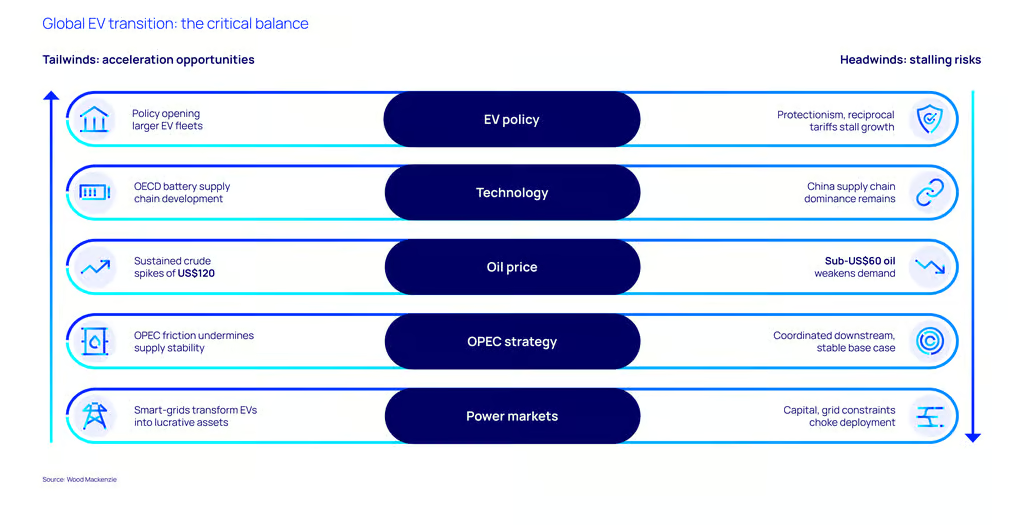
EV adoption will be influenced by key factors that accelerate or obstruct growth. The following are some of the key signposts that will indicate whether the electric shock scenario is becoming a reality.
Positive markers for EVs
- Oil price spikes are sustained over several years, driven by continued disruption in exports from the Gulf.
- Chinese EV exports surge, accelerating the decline in EV costs by 2030.
- Policy support and advances in battery technology unleash EV manufacturing in Western countries, combined with smart-charging networks, by 2035.
Negative markers for EVs
- OPEC targets sub-US$60/bbl oil prices, slowing EV sales outside of China, mirroring the strategy that hit US tight oil production in 2014-16.
- Protectionist measures, local-content mandates and trade tariffs slow the decline in EV costs through 2035. Battery supply chains remain dominated by China.
- Utilities struggle to scale up managed charging programmes and fail to keep charging costs down through 2040.


Want to dig deeper? Join the discussion
Join our Horizons Live webinar on 2 September, 4:00 to 5:00 pm BST / 11:00am - 12:00pm EST. This month's report authors will discuss the key findings and tackle your questions in a Q&A session
Explore our latest thinking in Horizons
Loading...
For details on how your data is used and stored, see our Privacy Notice.
Why sign-up?
By submitting your details you’ll gain access to the latest Horizons report, part of a thought-leadership series exploring the themes shaping the energy natural resources landscape. You’ll also receive the Inside Track, our weekly newsletter, so you won’t miss out on future editions.